
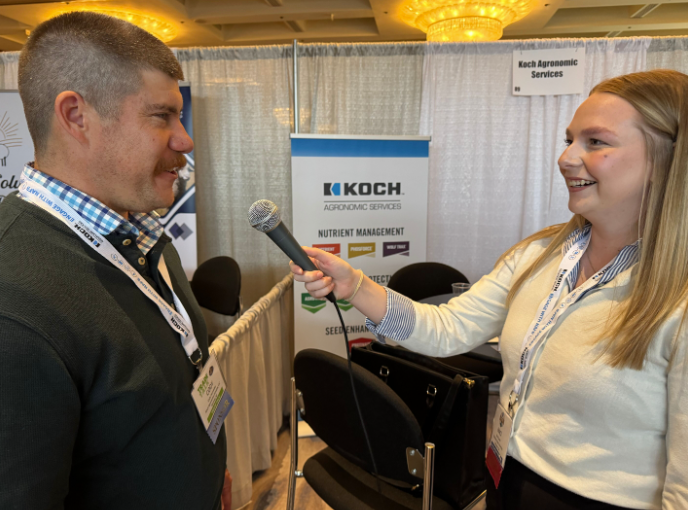
As the 2025 crop season wrapped up, Cody Hornaday of Koch Agronomic Services spoke with Maci Carter and said that weather-driven variability created major agronomic challenges, especially around nitrogen management. Looking back on the year, Hornaday emphasized that “Mother Nature was a key player as always,” noting that both above- and below-ground nitrogen losses were widespread. He explained that “there were some serious opportunities for loss in the 2025 season,” including volatilization, leaching, and denitrification, making nitrogen management a central lesson from the year.
Hornaday said those losses played out differently depending on regional conditions. In areas that received excessive rainfall, he pointed to below-ground issues, explaining that “lots of water…[made] that below ground loss being a real problem, whether…that’s leaching or denitrification.” Meanwhile, drier regions faced increased risk of volatilization, particularly with surface-applied urea. According to Hornaday, “all of the above were problems, depending on where you were,” reinforcing the need for region-specific fertility strategies.
In response, Hornaday noted strong adoption of nitrogen efficiency products in 2025, especially as growers began preparing for tighter margins in 2026. He said nitrogen stabilizers were key, but also urged producers not to overlook micronutrients when trimming costs. “What we don’t want to do is actually reduce our yield through leaving something off the table,” Hornaday said, adding that once macronutrients are balanced, “there’s a good possibility micronutrients is your next limiting factor.”
He highlighted micronutrient products like Wolf Trax for both agronomic and operational benefits. Hornaday explained that Wolf Trax “is a dry, dispersible powder that can adhere to the large or high-volume products that get spread every fall or mostly in the spring.” That approach, he said, allows growers to “save a trip” while also achieving “a nice, even spread across the entire acre,” improving consistency and efficiency in micronutrient delivery.
Looking ahead to 2026, Hornaday encouraged growers to review their fertility programs and focus on nutrient use efficiency. He stressed that nitrogen remains the most critical area for return on investment, noting that nitrogen can represent “upwards of 10% of all inputs being applied.” His key takeaway from 2025 was clear: “It would definitely be managing that nitrogen,” he said, adding that growers should focus on “utilizing all of those dollars effectively and efficiently” by mitigating loss with stabilizers like Anvil and Centuro.