
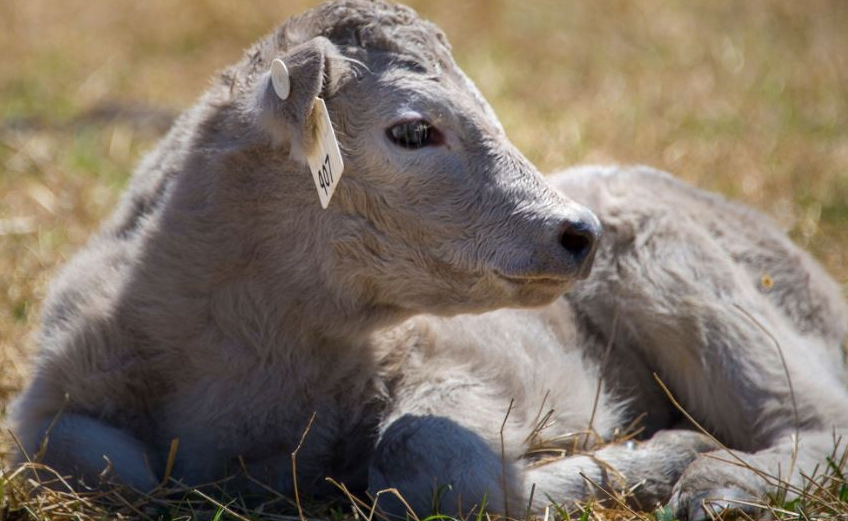
Over the years, premiums paid for preconditioned calves have generally increased alongside rising calf prices. Preconditioning reduces morbidity and mortality from bovine respiratory disease (BRD) and improves subsequent performance by getting calves better prepared for the stressors of the marketing and production systems. Historic calf prices and Oklahoma Quality Beef Network (OQBN) premiums over the last 12 years were summarized by Kellie Curry-Raper in a previous Cow-Calf Corner article (https://extension.okstate.edu/programs/beef-extension/cow-calf-corner-the-newsletter-archives/2025/september-1-2025.html). Last year, 500- to 600-pound preconditioned steer calves received a $23.36/cwt premium over non-preconditioned steers. This $128 per-head premium can only benefit stocker and feedlot operators if the increased revenue and decreased production costs outweigh the added purchase cost.
Data from multiple research sources were compiled to evaluate whether reduced health risk and improved performance provide sufficient economic return to justify paying premiums for preconditioned calves.
I began by comparing treatment rates from published research describing morbidity and death loss of preconditioned vs. auction-market calves (Richeson et al., 2012; Ward et al., 2017). I then applied performance impacts and economic consequences associated with treated vs. untreated calves from Beck et al. (2025) to estimate the effects of BRD during the stocker and finishing phases.
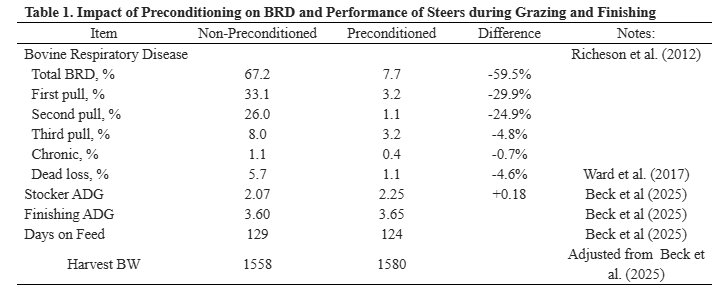
Based on comparisons of preconditioned and non-preconditioned calves during receiving, we estimated that preconditioning decreases total BRD treatments by 88%, with a 90% reduction in first pulls, 95% reduction in second pulls, a 60% reduction in third pulls, a 63% reduction in chronic cases, and 80% fewer death losses. Using estimates of the long-term impact of BRD on performance (Beck et al., 2025), these health advantages translated into higher gains, fewer days on feed, and increased harvest weights for preconditioned steers. These differences occurred even though treated steers were deemed recovered demonstrating that early health challenges have lasting consequences through slaughter.
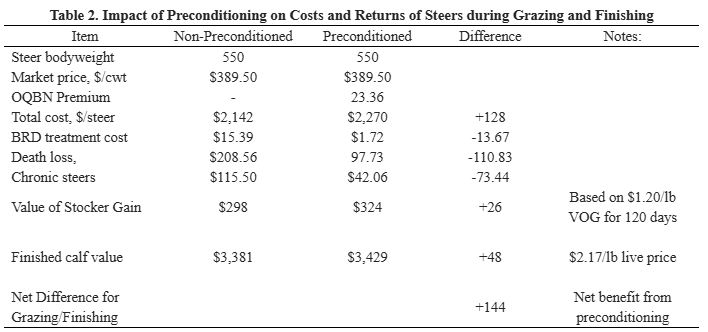
The $23.36/cwt average premium for preconditioned calves results in approximately $128 higher initial cost. However, this increased cost is offset by a $13.67/steer decrease in BRD treatment costs, a $111/steer reduction in total cost associated with death loss, and a $73/steer reduction in chronic-animal costs. These comparisons also do not fully account for the additional labor required to pull and treat non-preconditioned calves.
Improved gains during the stocker phase increased the value of gain by $26/steer, and decreased finishing days combined with increased harvest weights improved the final value of preconditioned steers by an additional $48/steer compared with non-preconditioned steers.
Overall, the improved performance and reduced health challenges of preconditioned calves provided a net benefit of $144 per head, representing a return on investment exceeding 110%. This calculation does not include additional advantages, such as reduced labor, improved animal welfare, and better carcass quality—factors that further favor preconditioned calves.
While results will vary between operations, the evidence overwhelmingly supports the value of preconditioned calves relative to their added cost.
References:
Beck, P. A., M. R. Beck, D. Rivera, E. B. Kegley, and G. W. Horn. 2025. Applied Animal Science 41:284-297. https://doi.org/10.15232/aas.2024-02576
Curry Raper, K. and D. Peel. 2025. Yet During 2024. https://extension.okstate.edu/programs/beef-extension/cow-calf-corner-the-newsletter-archives/2025/march-10-2025.html
Richeson et al. 2012. Professional Animal Scientist. 90:1972-1985. https://doi.org/10.2527/jas.2011-4077