To view the latest Oklahoma drought map, CLICK HERE.
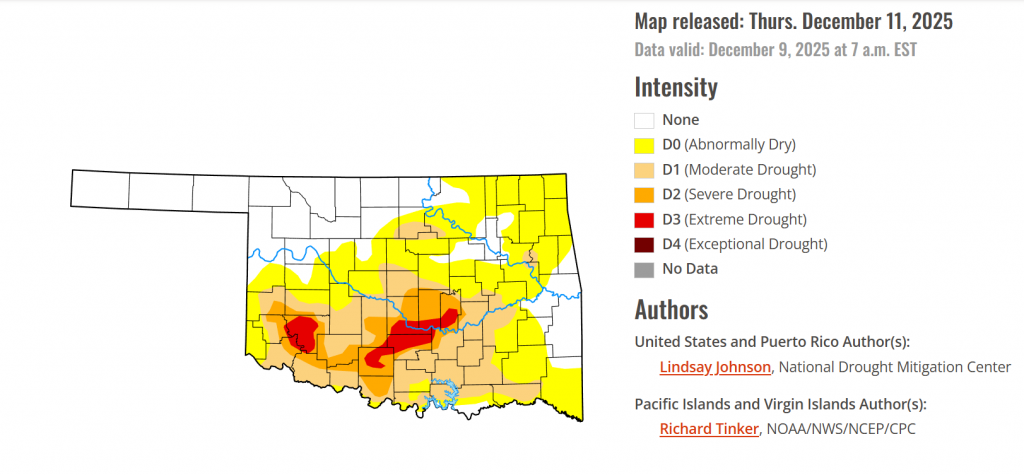
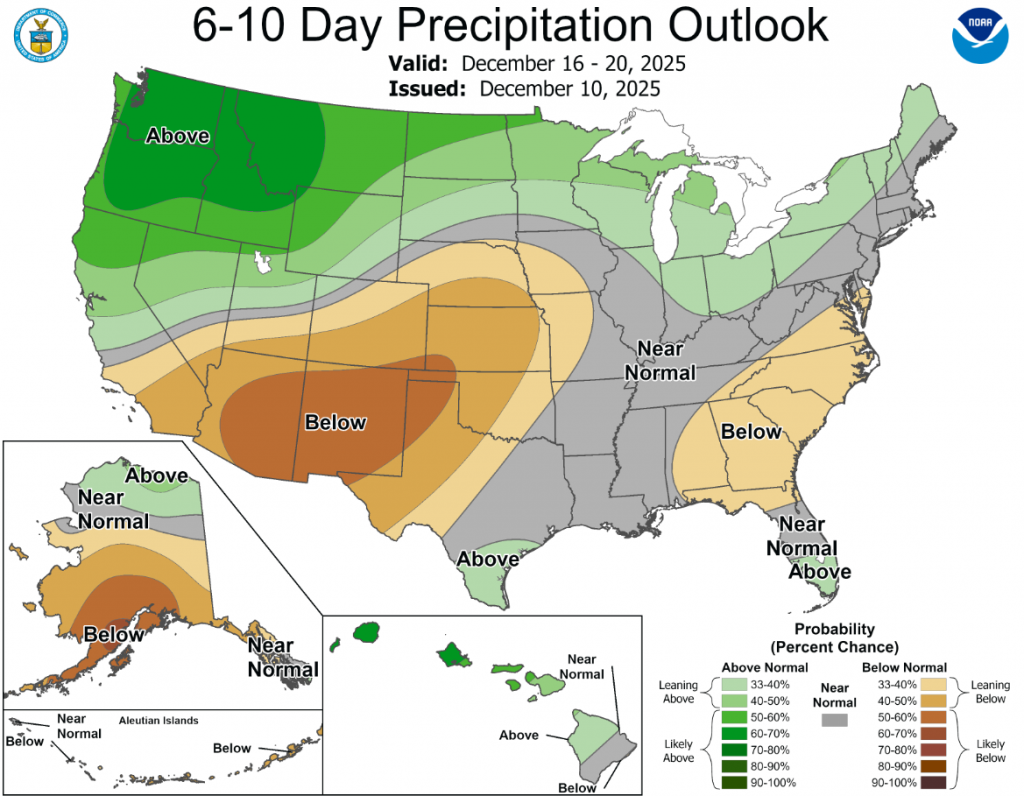
The latest Oklahoma Drought Monitor shows that while exceptional drought remains at zero percent, dry conditions continue to tighten their grip across the state, with overall drought coverage rising to 66% this week—up from 59% last week. Extreme drought holds steady in southern Oklahoma at just under 3.5%, but dryness has expanded in northeastern parts of the state as precipitation remains limited. Outlook maps offer little short-term relief, with most of Oklahoma leaning 33–60% below normal precipitation through December 20.
According to the latest Oklahoma Drought Monitor report, exceptional drought remains at 0 percent, unchanged from the start of the calendar year.
D0-D3 drought conditions in the current period indicate that 66.16 % of the state is affected by drought. Compared to last week at 59.20% drought has grown in the state
Extreme Drought (D3) has remained unchanged this week. No new extreme drought has emerged, but the conditions still remain in southern Oklahoma, covering 3.48% of the state, the same as the previous week.
According to the 6-to-10-day precipitation outlook map, eastern Oklahoma is expected to experience near normal conditions and lean below 33-40% chance of precipitation. Central Oklahoma and western Oklahoma are leaning below 40-50% chance of precipitation, and the panhandle is leaning below 50-60% through December 20th.
This U.S. Drought Monitor week saw both improvements and degradations across the country, shaped largely by uneven precipitation and widespread colder-than-normal temperatures. Much of the nation was colder than normal, with the sharpest departures in the Midwest and Northeast, where most of the week’s moisture fell as snow and offered limited short-term help for soils and streams. In the West, storm systems delivered substantial rain and mountain snow to the Pacific Northwest and northern Rockies, improving conditions in parts of Washington, northwest Oregon, western Montana and eastern Idaho. However, areas that missed the heaviest precipitation—especially central and southern Oregon, central Idaho and southwestern Montana—saw drought expand as snowpack remained well below normal. Parts of the Southwest, including southeastern California and western Arizona, continued to improve as moisture from earlier storms worked through the hydrologic system, while east-central Nevada saw worsening drought due to very low snowpack and long-term precipitation deficits. The central and southern Plains did not see any meaningful precipitation this week, leading to conditions remaining largely unchanged outside of localized areas. Short-term dryness worsened in southeastern Kansas and northeastern Oklahoma, where precipitation deficits continue to accumulate. In the east, several areas along the Gulf Coast and Southeast received 1 to 3 inches of rain, leading to widespread improvement short-term dryness and drought in southern Alabama, southern Georgia, the Florida Panhandle and portions of the Carolinas. Despite moderate precipitation in southern Florida and parts of the interior Southeast, longer-term precipitation deficits led to dryness continuing to intensify. In the Midwest and Northeast, cold temperatures and predominantly frozen precipitation led to limited improvements and degradations in areas that missed precipitation.
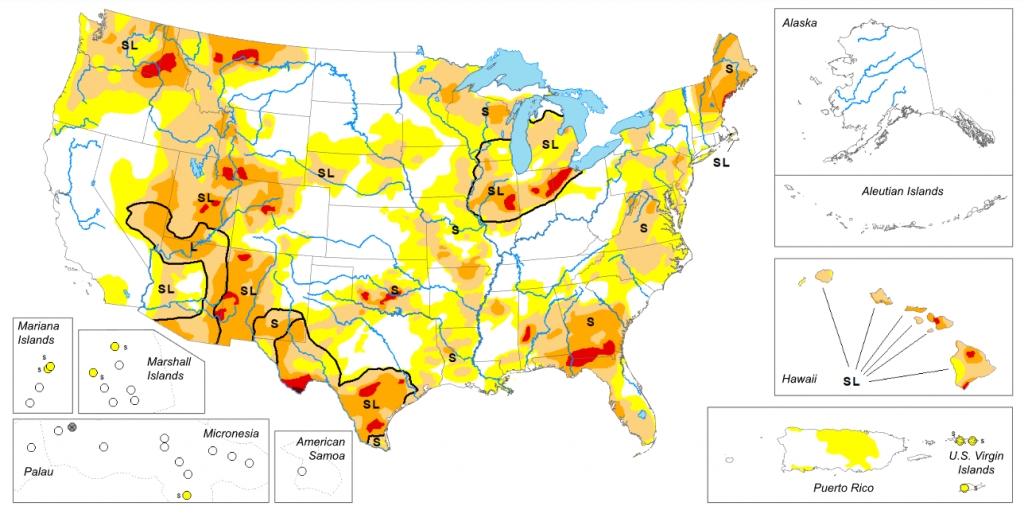
In the Southern Plains: The South saw mostly improvements this week following a mixture of below-normal temperatures and heavy rainfall. One-class improvements were seen from far eastern Texas to Mississippi where 1.5 to 3 inches of rain fell, with parts of southern Louisiana recording 5 to 6 inches of rain. Areas of central Texas and the Panhandle that improved last week, continued to see improvements in soil moisture and streamflows, leading to further improvements this week. Isolated degradation did occur in Texas’ southwestern Panhandle as well in northeastern Oklahoma as lack of precipitation continues to stress soils and lead to lower streamflows.
In the High Plains: Conditions across the High Plains changed very little this week as much of the region received only light precipitation and remained colder than normal. The Dakotas saw little meaningful moisture, and Nebraska saw none, leaving drought conditions unchanged. In Kansas, a lack of precipitation combined with continued short-term dryness led to an expansion of abnormal dryness (D0) that stretched into northeastern Oklahoma. In eastern Wyoming, dryness increased where precipitation was limited, resulting in some expansion of abnormal dryness. In eastern Colorado, light snowfall helped ease small pockets of abnormal dryness, though most areas saw little change.
In the West: Out West, there was a mixture of improvements and degradations. Improvements were seen in the Southwest despite no precipitation this week. Prior weeks’ moisture has made its way into the hydrologic cycle, as seen in improving streamflows and soil moisture. Despite snow falling across the Rocky Mountains, many stations continue to report that the snow water equivalent (SWE) is below the 30th percentile. Snowpack levels in the northern Rockies are doing better, with many stations showing snowpack at 100 percent for this time of year, which was further improved with 1 to 2 feet of snow falling across western Montana and eastern Idaho. This moisture led to areas of improvement in northwest Montana. Improvements were also seen along the Idaho-Wyoming border where up to 2.5 feet of snow fell. Southwestern Montana and central Idaho, which are experiencing below-normal snowpack, missed out on the snow and saw the expansion of moderate drought (D1) across the border. Over the Pacific Northwest, storms brought upwards of 6 to 8 inches of precipitation, where many stations in the Cascades are reporting below snowpack below 50 percent of normal. Areas in central Washington into northwest Oregon saw improvements as some short-term metrics were more aligned with moderate drought (D1) conditions rather than severe drought (D2). Central and southern Oregon, which missed out on the heaviest precipitation, saw the expansion of abnormal dryness (D0) and moderate drought (D1).
To view the 6-10 Day Precipitation Outlook Map, click here.
To view the 6-10 Day Temperature Outlook Map, click here.
To view the Monthly Drought Outlook Map, click here.