NGFA Economist Max Fisher Highlights $400 Billion Industry Impact and Legislative Priorities for 2026:
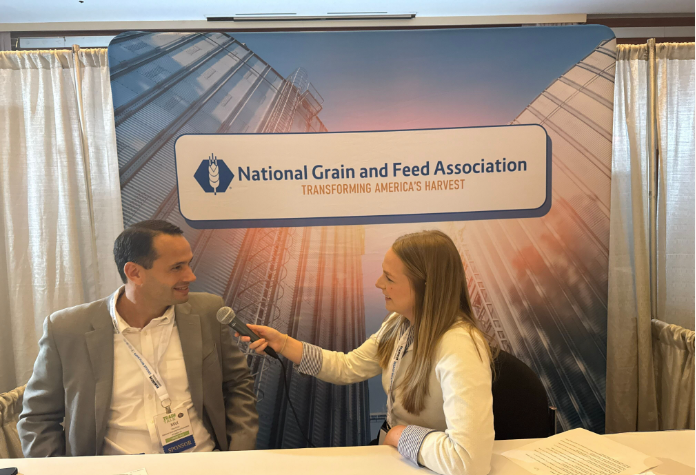
While the American farmer is often the face of agriculture, a massive economic engine hums quietly in the background between the farm gate and the grocery store shelf. Max Fisher, Chief Economist and Treasurer at the National Grain and Feed Association (NGFA), recently sat down to discuss the immense scope of the grain and feed sector and the critical policy issues facing the industry as it heads into 2026.
According to Fisher, the NGFA represents the crucial middle ground of the agricultural supply chain—entities that exist “beyond the farmer and before the retailer.” This includes grain elevators, processors, the biofuels industry, exporters, and flour millers.
Fisher revealed that a recent assessment of the industry uncovered a deeper economic footprint than previously imagined.
“We knew that we have just under 10,000 facilities scattered throughout the United States,” Fisher said. “We found out that it’s about $400 billion a year worth of economic activity—about 1% of the GDP—plus a little over a million jobs.”
Connecting the Dots for Consumers
Despite its size, Fisher admitted the sector often remains “somewhat invisible” to the general public, who may not connect the dots between raw production and the final consumer product. However, he emphasized that the industry’s success is inextricably linked to the producer.
“Without farmers producing the grain and feed, our industry doesn’t exist,” Fisher explained. “We know that the farmers take on a tremendous amount of risk in order to raise those crops.”
Because of this symbiotic relationship, the NGFA remains a staunch supporter of a robust Farm Bill, specifically advocating for strong crop insurance and Title 1 programs. “We’re supporters of the Farm Bill just to make sure that in the event that extreme weather challenges happen… the farmer is going to be in business the following year to go at it again,” Fisher added.
Pushing for Transportation Efficiency
One of the NGFA’s most persistent legislative goals involves updating surface transportation regulations—specifically regarding truck weights. Fisher outlined a proposal to increase weight limits on interstate highways from 80,000 pounds on five axles to 91,000 pounds on six axles.
Fisher argued that the addition of a sixth axle improves safety by providing an extra set of brakes and reducing stopping distances, while drastically improving efficiency.
“The efficiency that you would gain on transportation is just enormous,” Fisher said. “It’s literally going from a payload of about 50,000 pounds… to around 61,000, which is about a 20% increase.”
He noted that such a change would help U.S. agriculture lower the cost of providing goods both domestically and to the global market.
Trade and Future Challenges
Looking toward 2026, trade remains a dominant focus. Fisher noted that the industry is closely watching the implementation of trade deals, particularly with China, where about a million metric tons of soybeans are currently on the books.
However, challenges loom on the horizon. Fisher highlighted a moratorium on ship building fees—a policy intended to stimulate U.S. ship building but one that hurts the competitiveness of grain exporters operating on thin margins. That moratorium is set to expire in November 2026.
“That will be a very important issue that we will be working on over the next year,” Fisher noted, adding that the association aims to work with the administration to find alternative ways to support domestic ship building without penalizing ag exports.
Despite compressed margins and recent consolidation within the industry, Fisher remains optimistic about the future of demand.
“I feel like we’ve got the price levels down to where we’re building demand right now,” Fisher concluded. “Hopefully we’re going to come out of this in the not-so-distant future.”