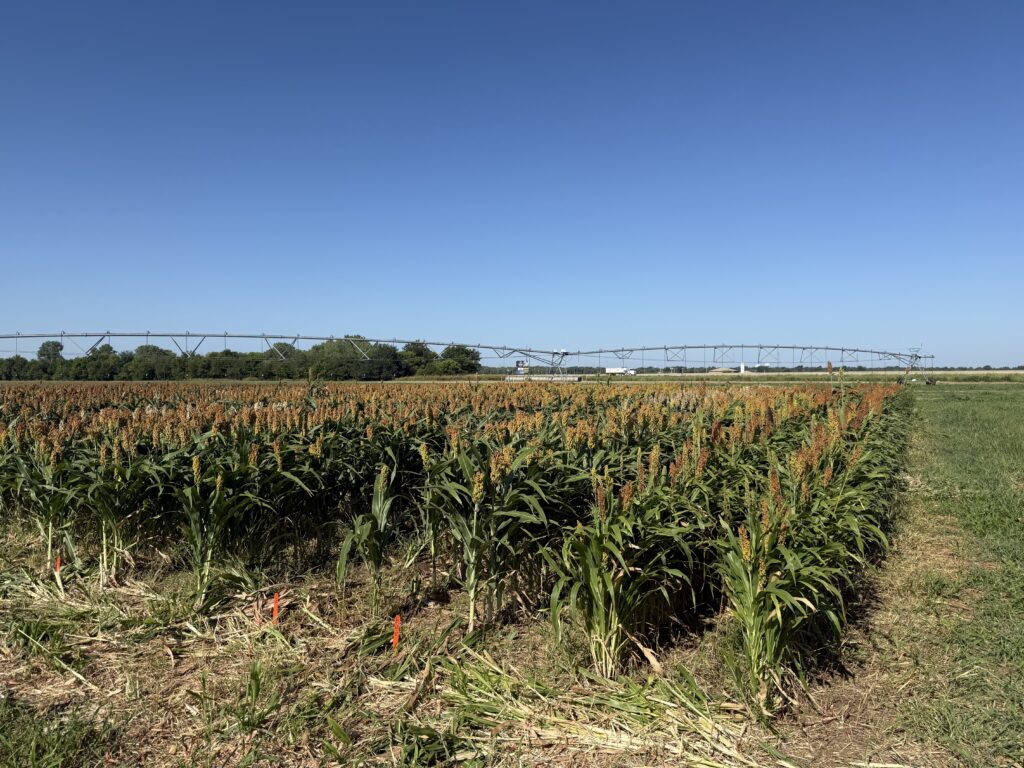
Oklahoma crop disease concerns this growing season are being driven less by foliar diseases and more by problems developing below the soil surface, according to OSU Extension Pathologist Dr. Maira Duffeck. Speaking with Oklahoma Farm Report intern Presley Strickland during Oklahoma State University’s Summer Demo Day, Duffeck said drought conditions have shifted the disease challenges producers should be watching for in both corn and sorghum.
Dry Conditions Favor Stalk Rot and Root Rot
Although Oklahoma has experienced a relatively dry growing season, Duffeck explained that disease issues are still present—just not the ones many producers might expect. “We have been pretty dry throughout the growing season, but some of disease that we are seeing right now is stalk rot and root rot diseases,” Duffeck said.
She explained that the pathogens responsible for these diseases infect plants much earlier in the season. “The pathogen that causes this disease… already infected the plants in the beginning of the season. So when the plants are small, they’re emerging from the field… that pathogen infects the plants. But then the expression of the symptoms of the disease is just being seen now.”
Rather than affecting an entire field uniformly, Duffeck said producers should look for isolated trouble spots. “What we’re observing is a lot of patches in the field that look drier than the rest of the crop. Most of the crop is still green… but those patches in the field are looking dry. They are stunt, and they are not producing yield in the same way that they should be.”
She encouraged growers to investigate those areas carefully instead of relying on visual observations alone. “You need to dig up some plants, open up the stem, look at the root system, and see if you don’t see any signs of the pathogens that’s causing this.”
Drought Changes the Disease Picture
According to Duffeck, Oklahoma’s ongoing drought has significantly influenced which diseases are becoming problematic. “We are going through a drought right now, what’s not uncommon for us in Oklahoma, so we don’t see a high pressure of leaf spot diseases.”
Instead, she said producers are dealing with diseases below ground. “We tend to see more diseases in what we call below ground… things that affect the roots and the stem are more problematic for us right now.”
Leaf diseases, she explained, require a much different environment. “Leaf spots, we need more high humidity, frequent rains to disseminate the spores… so leaf spots for us right now is not a concern in most of the crops.”
However, she cautioned that later-planted corn could still face problems if weather patterns change. “We need to watch for our late planted corn. In some years, the conditions in August… are more susceptible for southern rust than the early planted corn.”
She added that regular scouting remains essential. “We need to watch and scout the fields because at certain years it’s worth it to spray fungicides to manage that southern rust in some late planted corn.”
Hybrid Resistance Can Vary
When asked whether certain corn hybrids offer better disease resistance, Duffeck said differences do exist, although they are not always clearly identified by seed companies. “We have been seeing that even if the companies doesn’t show in the label… sometimes they are. We can see that… some are more susceptible and others more tolerant for some diseases.”
Without documented resistance ratings, she recommends producers assume susceptibility. “We need to assume that most of the hybrids are susceptible when the company doesn’t provide us that information.”
Southern rust remains a disease that requires close monitoring. “We know that for southern rust, for example, in corn, we need to consider that all the hybrids are susceptible.”
She said weather conditions and incoming spores determine whether fungicide applications become necessary. “If we have the right weather conditions, and we see that we have the spores… migrating from the eastern part of the United States or from Texas… we need to scout the fields frequently to determine if you should spray a fungicide or not.”
Stalk rot and root rot are more difficult to evaluate because infections occur so early in the season. “Most of the pathogens that cause stalk rot diseases infect the plant early on in the season.”
Drought stress later allows those infections to become visible. “The drought is a condition that ended up favoring the development of stalk rot and root rot diseases.”
Because these pathogens survive unevenly throughout fields, comparing hybrid performance can be challenging. “The disease is going to occur in patches in the field… it’s very difficult for us to evaluate the susceptibility, the tolerance, or the resistance of those hybrids.”
Staying Ahead of Disease
Duffeck encouraged producers to stay informed by using Oklahoma State University’s disease reporting resources. “We have the ePest alert. If you type OSU Extension ePest Alert, you can sign up for alerts.”
She said the service provides timely updates on disease activity across the state. “That’s where I publish the disease that we are seeing around the state and how should we manage for them as well. So it’s a great resource… for keeping ourselves informed regarding what are the diseases that are occurring in Oklahoma in field crops right now.”