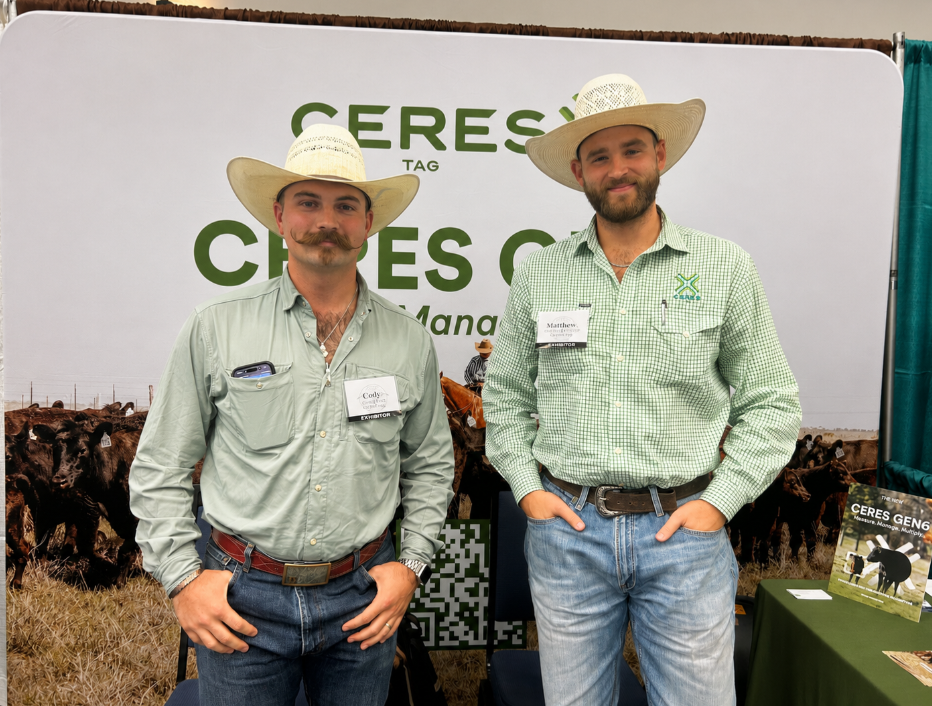
From monitoring grazing behavior to tracking reproductive performance and locating cattle in remote pastures, new livestock technology is giving cattle producers more information than ever before. During an interview with Associate Farm Reporter Carli Davenport, Matthew Randerson, Sales Lead at Ceres Tag, explained how the company’s solar-powered ear tags collect valuable data that can help improve herd management while reducing labor and production costs.
Direct-to-Satellite Technology Eliminates Infrastructure
Randerson said Ceres Tag is different from many livestock monitoring systems because it communicates directly with satellites, eliminating the need for cell service, base stations or other infrastructure. “Ceres Tags are a direct-to-satellite, solar-powered platform, and so that is all done through our tags,” Randerson said. “Our tags automate performance and health data as well as location for cattle, and that’s all done with no infrastructure whatsoever. So no base stations, cell towers, anything like that.”
He added that the system relies on advanced algorithms to automatically generate performance metrics for producers. “We have advanced algorithms on our platform that allow for these performance metrics to be automated and measured.”
Monitoring Cattle Behavior Around the Clock
The technology uses an accelerometer built into each ear tag to monitor the animal’s movements throughout the day. “The tag has an accelerometer in it, and so we’re able to measure movement of the animal’s ear, head, and jaw,” Randerson explained.
Those movements provide insights into several important behaviors. “Some of the data that that leads to is minutes spent grazing, resting, ruminating, drinking, and walking, as well as reproductive data as well,” he said. “So estrus alerts, calving alerts, as well as pasture feed intake, which is dry matter intake for grazing cattle.”
The continuous data collection gives producers a clearer picture of how individual animals are performing without requiring additional equipment in the pasture.
Turning Data Into Profit
According to Randerson, one of the biggest advantages of the technology is helping producers identify cattle that make the most efficient use of available forage. “Pasture feed intake, being able to select for efficient animals and seeing which animals are effectively turning your pasture into pounds of weaned calf,” he said.
He noted that while cattle may appear identical, they often consume very different amounts of forage.
“We see cattle that look the same, but we know that they’re not all eating the same amount,” Randerson said. “Finally, being able to have a way to measure things like that is really where you can start to make a difference and select for cattle that are truly utilizing your resources in the environment you put them in.”
Gen Six Adds Reproductive Monitoring
Randerson highlighted the company’s newest product, the Ceres Tag Gen Six, which was introduced earlier this year and includes expanded reproductive monitoring capabilities.
“We were super excited to launch that last February in Nashville,” he said.
The newest generation includes reproductive algorithms designed to help producers better manage breeding herds.
“That includes a suite of reproductive algorithms, including estrus alerts and calving alerts,” Randerson said. “As you can imagine, those are two really important metrics for any cattle producer.”
He explained that the system can provide valuable information throughout the breeding season.
“Being able to understand first heifer maturity, as well as, like I mentioned in my presentation, whenever you’re doing an AI protocol, understanding who’s coming back in the cycle after you AI your cattle, and understanding who the sire is and who’s going to be bull bred,” he said. “It’s all things like that that allow producers to increase their bottom line and save time, as well as reproductive drugs.”
Simple Setup for Producers
Despite the advanced technology, Randerson said getting started with the system is straightforward.
“Setup is super easy, especially with Gen Six,” he said.
After creating an online account, producers simply scan the QR code included with each box of tags.
“You scan your QR code, and that associates those tags with your account,” Randerson explained.
The tags are then activated using solar power before being applied.
“Once that’s done, you simply just put the tags out in the sun, and they charge up. Once those tags are charged, they activate, and then you just run cattle through the chute and tag them in the ear.”
Wyoming Rancher Recovers Every Animal
One of the most memorable success stories Randerson shared came from a Wyoming producer grazing cattle on Bureau of Land Management (BLM) property.
“We’ve had producers who are pretty accustomed to going on BLM land, and they’ve accepted that they’re going to lose cattle every year whenever they put animals out because there’s no way of tracking them,” Randerson said.
The vast landscapes make gathering cattle expensive and time-consuming.
“Whenever you’re on land as vast as that, it takes a lot of time, energy, money, all these things to gather animals,” he said.
With satellite-generated location updates every six hours, producers can quickly locate missing livestock.
“Whenever you have automated location every six hours, and there’s zero infrastructure needed for it, it really gives you the ability to go and collect every single animal.”
Randerson said one producer saw dramatic results after adopting the technology.
“We had a producer who I believe was losing around 30 cows every year, and they were running 300 on government land,” he said. “They actually got tags, deployed them, and they were able to get every single cow and bull that they deployed that year on that BLM land. That was super awesome for us to hear.”
As precision livestock technology continues to advance, tools like Ceres Tag are providing producers with more detailed information about cattle health, reproduction, grazing behavior and location, helping ranchers make more informed management decisions while improving efficiency across their operations.