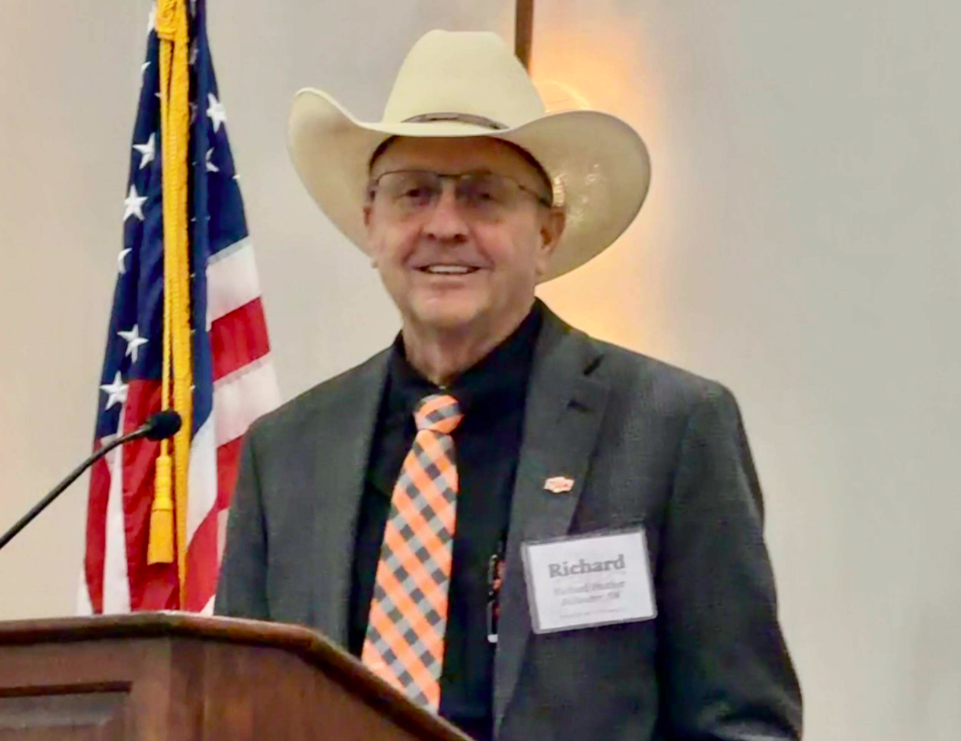
In today’s Beef Buzz, senior farm and ranch broadcaster Ron Hays speaks with Dr. Richard Prather, the new dean of the College of Veterinary Medicine at Oklahoma State University, about his veterinary career, the shortage of large-animal veterinarians, and his vision for serving Oklahoma’s rural livestock producers.
A Second-Generation Veterinarian
Dr. Richard Prather’s path into veterinary medicine began with his father, a veterinarian in southern Oklahoma. “My life as a vet. I’m a second generation,” Prather said. “My father was a veterinarian in Southern Oklahoma, and tragedy took him from us early. But the veterinary community really embraced my family and I.”
Prather said the support his family received from the veterinary community shaped his career and his appreciation for the profession. “Everything I have and am I owe to the veterinary profession,” he said.
Prather met his wife while attending veterinary school at Oklahoma State University and said the mentors he encountered throughout his career played a major role in shaping his approach to veterinary medicine.
One of those mentors was western Oklahoma veterinarian John Kirkpatrick. “He knew how to deal with people,” Prather said. “Everybody knew him and loved him. He was endeared to them, and he set us on the right course of good science, good relations with the people that we’re working for, and with the end goal of trying to make them successful in living in rural Oklahoma.”
Serving the People of Rural Oklahoma
Prather spent his veterinary career with Ellis County Animal Hospital in Shattuck, Oklahoma, a small community he said represents the character of rural Oklahoma. “I tell people we live in a county that has no traffic lights,” Prather said. “They’re salt of the earth kind of people.”
He emphasized the sacrifices made by Oklahoma livestock producers and said Oklahoma State University has an important role to play in helping them meet the challenges ahead. “The sacrifices that they make and the effort that they put into their operations is second to none,” Prather said.
“We really want to get the message out to the consuming public just how much they care about their livestock, how well they care for the livestock, and how much effort Oklahoma State will be putting into giving them the tools that they need going forward to survive in the changing times we have ahead of us.”
Building a Win-Win-Win for Agriculture
Prather said his vision for veterinary medicine at OSU is centered on creating benefits for veterinarians, the university and, most importantly, the livestock producers they serve. “The lifestyle of living in rural Oklahoma, even those hard moments when it’s bitter cold out there and you’re helping that heifer get in to where you can manage a difficult calving, the end result is worth it all,” he said.
For Prather, one of the greatest rewards of veterinary medicine is helping bring new life into the world and then watching those animals develop. “There’s nothing more satisfying than bringing a new life into this world and watching and caring for that as it matures and gets older,” he said.
His experiences around the world have also reinforced his appreciation for American agriculture and the food system. “We have all that at our fingertips, and we have the safety and the security that we enjoy in this country,” Prather said. “Preserving that lifestyle is what the win-win is.”
Addressing the Large-Animal Veterinarian Shortage
One of the biggest challenges facing rural agriculture is access to large-animal veterinarians, something Prather has experienced firsthand. “In our western Oklahoma region, I can count on two hands the number of practices that were once thriving practices, good practicing veterinarians that are now standing idle, nobody to fill those shoes,” he said.
The shortage can create additional burdens for livestock producers who may have to travel farther or handle difficult veterinary situations themselves. “That’s a problem because then that leaves the people that we’re talking about here deficient,” Prather said. “They have to drive further. They have to manage things on their own, that normally they would depend on somebody with a little more education to help them out through some of those difficult challenges.”
Prather said one of his primary goals as dean will be finding ways to place veterinarians in underserved rural communities. “That’s going to be our goal going forward: is to try to serve and be more rural and regional at putting veterinarians back into these underserved areas,” he said.
Looking 50 Years Into the Future
Prather takes over as dean as Oklahoma State University moves forward with a new veterinary teaching hospital, a project he described as both exciting and challenging. “Excited and has what keeps me up at night,” Prather said.
“We have the mandate going forward of trying to think 50 years down the road, what does this need to be for the generation of those young people that were sitting there on the front row, as well as meet the need of the moment,” he said.
Prather said OSU is bringing together teams representing multiple areas of veterinary medicine, along with outside stakeholders and academic experts, to help develop the new facility. “We’ve got one shot at it, and we want it to be the best,” he said.
Getting Everyone Rowing in the Same Direction
As OSU works to strengthen its veterinary program, Prather said success will depend on people working together toward a common goal. “It boils down to people, people that have a common goal and they’re rowing in the same direction,” he said.
He pointed to the land-grant mission of Oklahoma State University, which includes education, research and extension. “Our primary charge is to educate, to research, and then carry that information through extension to those that need it,” Prather said.
“If we can get everybody rowing the boat in that same direction, that’s how we’ll build a premier teaching hospital and a premier system that’ll serve all the needs and challenges that we’ll face going forward.”
Passing Veterinary Medicine to the Next Generation
Ultimately, Prather said his goal is to give the next generation the same opportunities and appreciation for veterinary medicine that he has experienced throughout his career. “To hand off to the next generation the wonderful career that I’ve enjoyed,” Prather said. “It’s my turn to turn around and say, ‘Look what all this profession did for me, for my family, and for those around us that we were able to serve.’”
He hopes to leave the profession stronger for those who follow. “My goal is to be able to hand that same or better level of appreciation to the next generation that follows us,” Prather said.
Dr. Richard Prather became dean of the Oklahoma State University College of Veterinary Medicine on June 30, bringing four decades of experience as a rural Oklahoma veterinarian to the position.
The Beef Buzz is a regular feature heard on radio stations around the region on the Radio Oklahoma Ag Network and is a regular audio feature found on this website as well. Click on the LISTEN BAR above for today’s show and check out our archives for older Beef Buzz shows covering the gamut of the beef cattle industry today.