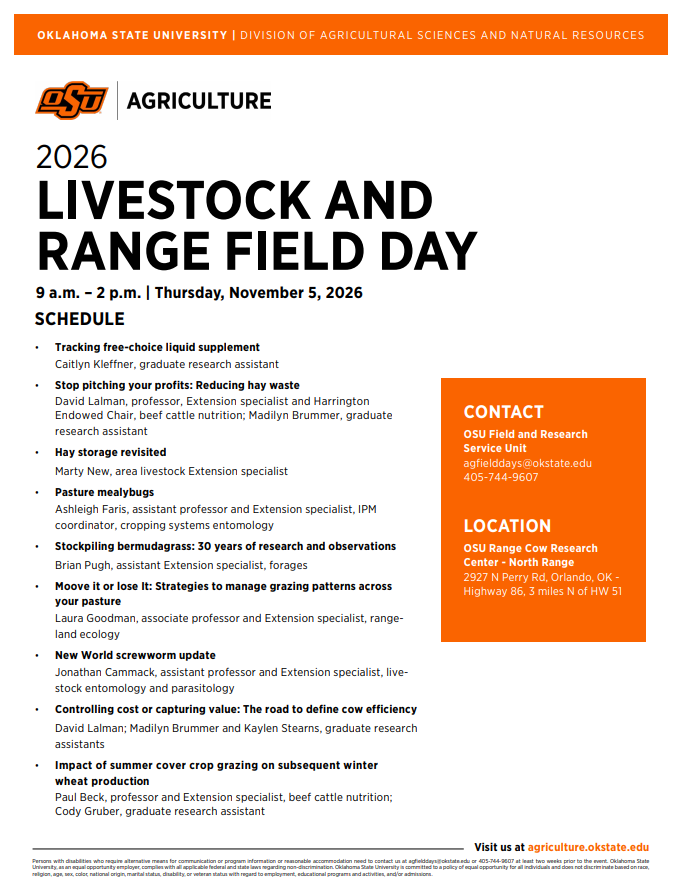

In today’s Beef Buzz, senior farm and ranch broadcaster Ron Hays speaks with Oklahoma State University Extension Beef Cattle Specialist Dr. David Lalman about reducing hay waste and proper hay storage. Lalman will be among the presenters at OSU’s Livestock and Range Field Day on November 5 at the university’s Range Cow Research Facility near Orlando, Oklahoma.
Choosing the Right Hay Feeder Can Reduce Waste
One of Lalman’s topics will focus on reducing hay waste through different feeding methods and feeder designs. OSU will demonstrate several types of hay feeders during the field day, giving producers a chance to see how different options can affect the amount of hay cattle waste.
Lalman said the most important consideration is choosing a feeder that keeps cattle from pulling hay out or allowing it to blow away. “Really, the main thing is just to use a style of feeder that minimizes the amount of hay that can either blow out or be drug out by the cows when they’re consuming it,” Lalman said. “That’s where most of the waste comes from.”
For producers who prefer rolling hay bales out rather than using a feeder, Lalman said that approach also has advantages and disadvantages. “Other people might have the opportunity or the desire, the preference to roll hay out, and so we’re going to talk about some research on that subject,” he said. “And certainly, it is advantageous, but it has its drawbacks. You have to do that nearly every day if you’re going to feed hay that way.”
Proper Hay Storage Makes a Difference
Beyond feeding methods, Lalman said how hay is stored can have a major impact on its quality and the amount of usable forage producers have available over time.
He said OSU research has identified several straightforward storage practices that can help producers protect their investment. “Things like lining your hay bales up the right way. That’ll make a difference in making sure that they stay dry and the quality of the hay does not deteriorate too rapidly,” Lalman said.
One recommendation is to position hay bales north to south to improve exposure to sunlight and airflow. “You want that sun shining in the morning on one side of the bale, and you want it shining on the west side of the bale in the evening, and that dries it out and minimizes the rate of deterioration,” he said.
Lalman said hay can deteriorate significantly over the course of a year in an average Oklahoma weather year if it is not stored properly, particularly when bales are not placed in a well-drained area with good airflow.
With good-quality hay bringing approximately $60 to $80 per bale in many locations, reducing waste and protecting hay quality can quickly translate into meaningful savings. “If you can minimize the hay loss on each of those bales, that adds up to some real money pretty quickly,” Lalman said.
OSU Research Looks at Cow Efficiency
Lalman will also discuss cow efficiency, which he said is a major focus of OSU’s current beef cattle research program. Researchers have spent six years collecting data on retained replacement heifers, looking at how efficiently individual animals consume forage and mineral.
During the field day, producers will get to see a specialized system OSU uses to measure individual animal intake of long-stem grass hay. “We’re testing those replacement heifers, yes, in a dry lot, but we have a specialized system that we’ll show off on Thursday that measures or has the capability to measure individual animal long-stem grass hay intake,” Lalman said.
He explained that many traditional efficiency tests use processed mixed diets that include concentrated feeds and higher-quality forage than what commercial cows typically receive. “Most efficiency tests are done with some sort of a processed mixed diet with some concentrate and processed forage, a better-quality diet than our cows get to see most of the time,” Lalman said.
OSU researchers want to get closer to evaluating cattle under conditions that reflect how cows actually make a living in a pasture. “We’d rather be out in the pasture doing that work, but getting a big step closer to where that cow has to make her living,” he said. Lalman said the research has already produced some interesting findings as OSU continues to learn more about identifying and developing efficient cows.
The Beef Buzz is a regular feature heard on radio stations around the region on the Radio Oklahoma Ag Network and is a regular audio feature found on this website as well. Click on the LISTEN BAR above for today’s show and check out our archives for older Beef Buzz shows covering the gamut of the beef cattle industry today.