
Wildfire mitigation and soil water retention remain high priorities across the state, prompting the Oklahoma Conservation Commission to expand programs targeting invasive species and infrastructure resilience. Farm Director KC Sheperd recently sat down with Trey Lam, executive director of the Oklahoma Conservation Commission, to discuss the ongoing efforts to manage invasive red cedars, mitigate wildfire hazards, prepare soils for incoming moisture, and maintain crucial flood control dams across Oklahoma.
Following an intense wildfire season, Lam pointed out that eastern red cedars serve as significant fuel loads that intensify burns and disperse embers far ahead of active fire lines. To combat this hazard, the Commission is deploying multiple management strategies. Prescribed fire serves as the primary tool. Landowners receive professionally written prescribed burn plans and assemble the required personnel, equipment, and optimal weather conditions to consume built-up fuel before an uncontrolled blaze occurs. Lam noted that a previous burn conducted on the south side of Karsten Creek Golf Club successfully stopped advancing flames during fires around Stillwater.
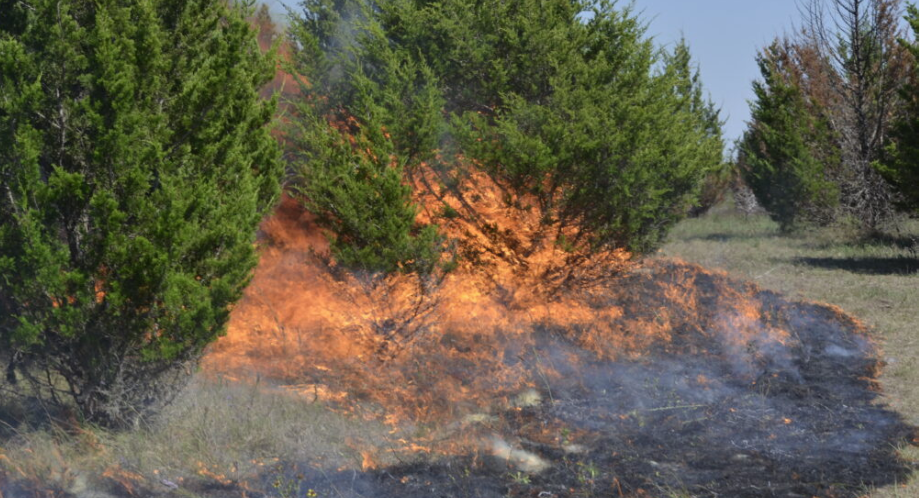
Another major initiative focuses on establishing brush-free zones around communities. In many rural and suburban towns, neighborhoods back directly up to dense cedar thickets. During wildfires—such as the blaze in Caddo County—burning cedars generate heavy black smoke and shoot embers up to a quarter of a mile away. By collaborating with adjacent landowners, the Commission creates 100- to 300-foot buffer zones that allow emergency vehicles access and create space to stop advancing fires before they reach residential structures.
Beyond fire risks, red cedars place a heavy burden on Oklahoma water resources during periods of drought. As part of the Terry Peach North Canadian Watershed program, the Commission operates a 5,000-acre research project in Woodward County. By using soil moisture probes to compare cleared areas against uncleared plots and native rangeland, researchers discovered that removing cedars returns approximately 50,000 gallons of water back into the soil. With roughly 15 million acres of cedar across the state and an estimated 7% annual expansion rate reported by Oklahoma State University, widespread eradication could significantly enhance water flow into local springs, streams, and reservoirs like Canton Lake.
Landowners seeking to remove cedars can access financial and technical assistance through state cost-share programs administered by local conservation districts. The programs rotate through targeted geographic areas each year, assisting landowners with the costs of mulching, cutting with chainsaws, or pulling trees from the ground.
Lam also addressed preparations for shifting weather patterns, particularly anticipated rains from an incoming El Niño cycle following extended dry conditions. When heavy rain falls on hard, bare dirt, the surface quickly seals over, resulting in rapid runoff rather than absorption. Maintaining ground cover—such as crop residues or growing summer vegetation—helps deflect rainfall impact, slows water movement, and directs moisture down into root channels.
When surface runoff does occur, Oklahoma relies on a network of 2,107 upstream flood control dams. While these structures currently have capacity due to drought, many are around 50 years old and require routine upkeep to address wind and wave erosion, deteriorating pipes, and aging risers. Lam noted that the Oklahoma Legislature provided $3 million in funding over the past year to repair front slopes and prevent catastrophic breaches that could threaten downstream properties and lives.
Looking ahead to seasonal activities, Lam emphasized several key conservation initiatives available to the public. In addition to cedar control efforts under the Terry Peach program, the Commission matched a $100,000 state investment with wildlife funding to assemble roughly $3 million for wetland restoration. These wetland projects aid aquifer recharge and support local wildlife habitats. Producers are also encouraged to participate in the Soil Health Improvement Program (SHIP). Landowners interested in cedar management, wetland restoration, or soil health practices should reach out to their local conservation district office for application details.