Wed, 14 Sep 2022 11:47:14 CDT
By Mandy Gross
More than 300 Oklahoma State University Ferguson College of Agriculture faculty, staff, students and alumni as well as New Frontiers donors helped celebrate a significant milestone in the c…

Sep 14
Wed, 14 Sep 2022 11:47:14 CDT
By Mandy Gross
More than 300 Oklahoma State University Ferguson College of Agriculture faculty, staff, students and alumni as well as New Frontiers donors helped celebrate a significant milestone in the c…
Sep 14
Wed, 14 Sep 2022 11:44:02 CDT
The automated facility is a unique collaboration between the U.S. Department of Agriculture and an institute of higher learning.
Texas Tech University and the U.S. Department of Agriculture (USDA) today…
Sep 14
Wed, 14 Sep 2022 11:39:34 CDT
Today, Rep. Glenn “GT” Thompson (PA-15), Republican Leader of the House Committee on Agriculture, issued the statement below following an announcement from Secretary Tom Vilsack that the U.S. Department of Agriculture (USDA) has awarded billions to “Partnerships for Climate-Smart Commodities” projects via the Commodity Credit Corporation (CCC):
“The Biden Administration is unilaterally spending billions of dollars without Congressional input. While I am sure there are worthy projects, USDA is abusing the authorities of the Commodity Credit Corporation to stand up a ‘pilot program’ while ignoring the significant issues facing farmers and ranchers. It’s as though Secretary Vilsack is intent on having Congress once again limit his ability to use the CCC.”
Sep 14
Wed, 14 Sep 2022 11:04:29 CDT
This statement can be attributed to John Piotti, president and CEO of American Farmland Trust.
“The announcement made by Secretary Vilsack today of an unprecedented $2.8 billion investment in Partne…
Sep 14
Wed, 14 Sep 2022 11:01:56 CDT
Quantifying the climate impact of incorporating sorghum and other tools into rotations while serving as a trajectory for the sorghum industry’s continuous environmental improvement throughout this decade and the next is the focus of a five-year, up to $65 million project by National Sorghum Producers.
Funding for the project was provided by a grant from the U.S. Department of Agriculture through its new Partnerships for Climate-Smart Commodities. USDA announced award recipients Sept. 14 for pilot projects totaling $2.8 billion to create market opportunities for commodities produced using climate-smart practices.
“This is a watershed day for the sorghum industry,” NSP CEO Tim Lust said. “Sorghum is and always will be The Resource Conserving Crop™. This award affirms that fact in historic fashion, and we appreciate USDA for the opportunity to realize sorghum’s potential as a climate-smart commodity. For the first time, participating farmers will be fully recognized and fully compensated for the good work they do to improve the impact of agriculture on the environment. We couldn’t be more excited to come alongside them in this important effort.”
Rather than focusing on soil carbon sequestration alone, the NSP project will create a pathway for the impact of all practices to be quantified, tracked and verified with the intent to monetize these practices in ecosystems services markets of all kinds with an initial focus on low carbon fuel markets.
Payments will be made to producers to introduce sorghum along with a suite of additional practices, and a strong measurement and quantification program will accompany these payments in order to highlight the climate impacts of associated practices.
The program will center specifically on enabling farmers to take advantage of added value under the California Low Carbon Fuel Standard (LCFS) as this market requires the most rigid quantification, monitoring, reporting and verification systems and already consumes up to one-third of the U.S. sorghum crop annually.
“The most important aspect of any program to incentivize climate-smart agricultural practices is robust demand from ecosystem services markets,” NSP sustainability strategy consultant John Duff said. “The LCFS is the most reliable and longest-standing such market, and building our program around its rigorous data requirements will enable a five-year beta test of our industry’s readiness for meeting the needs of ecosystem services markets for the coming decades.”
The target geography of the project includes portions of six states and covers an average of 67 percent of the sorghum industry, or 4.4 million acres annually. The area includes more than 20,000 sorghum farmers and a region vitally important to U.S. agriculture.
Irrigated agriculture in this area, which is highly threatened, is particularly important. Sorghum has a key role to play in prolonging irrigated agriculture in the region. Furthermore, the U.S. High Plains is the world’s leading region for nitrogen use efficiency and mitigation of nitrate leaching, volatilization and runoff. Sorghum is a primary tool in these mitigation efforts, and incorporating the crop into rotations in this region can improve the carbon footprint of U.S. agriculture overall.
“NSP’s project is building on significant work to enhance climate-smart agricultural production in sorghum-based crop rotation systems at-scale,” NSP Sustainability Director Adam York said. “The U.S. sorghum industry has piloted numerous initiatives in recent years with key conservation non-governmental organizations, such as Pheasants Forever and Quail Forever, to partner with our farmers and identify targeted solutions for working lands conservation. Through NSP’s Partnerships for Climate-Smart Commodities project, our efforts will reach new levels of collaboration to deliver on-farm resiliency and profitability throughout this sensitive and important region.”
Timely consultation and technical delivery to farms is vital to the success of this project. As farmers choose to implement novel approaches to benefit their landscapes, such as improved biodiversity practices, local conservationists and biologists in our partnership network steeped in wildlife habitat conservation will be integral to helping farmers deliver more sorghum products with positive biodiversity impacts.
“The Habitat Organization is excited and proud to partner in the effort to expand climate-smart sustainability practices while benefiting farm profitability and conservation,” noted Brent Rudolph, Director of Sustainability Partnerships for Pheasants Forever and Quail Forever. “Working side-by-side with sorghum producers is a wonderful fit for this important USDA program.”
The project will also include a robust diversity and community outreach program that will focus on in-reach and outreach to underserved communities in the project target area with a primary focus of creating opportunities for underserved farmers to participate in climate-smart sorghum production and realize the benefits of ecosystems services markets.
“Kansas Black Farmers Association (KBFA) is working with NSP to create climate-smart agriculture best practices that will help the BIPOC farmers in our membership increase sustainable productivity, strengthen farmers’ resilience, reduce agriculture’s greenhouse gas emissions and increase carbon sequestration,” KBFA Executive Director and President JohnElla Holmes, Ph.D., said. “In Kansas, sorghum is an important crop for our farmers and researching ways to increase this crop’s production will be life changing. In addition, it strengthens our farmer’s ability to sustain, increase and maintain their farms and delivers environmental benefits. We are excited to work with NSP on this grant.”
In addition to National Sorghum Producers, project partners and supporters include Kansas Black Farmers Association, Pheasants Forever and Quail Forever, Donald Danforth Plant Science Center, Salk Institute for Biological Studies, Sustainable Environmental Consultants, United Sorghum Checkoff Program, Arable, Galvanize Climate Solutions, Kansas State University, Texas Tech University, Conestoga Energy Partners, Kansas Ethanol, Pratt Energy, Western Plains Energy, White Energy, American Coalition for Ethanol, Peoria Tribe Of Indians of Oklahoma, Women Managing the Farm, Kansas Agri-Women, Nu Life Market, Pinion, Kansas Department of Agriculture, New Mexico Department of Agriculture, Kansas Water Office, Archer-Daniels-Midland Company, Kashi, RIPE, Trust in Food™, Colorado State University, Prairie View A&M University, Texas A&M University, Oklahoma State University, Argonne National Lab, National Cotton Council, Field to Market, Danone, Colorado Sorghum Association, Kansas Grain Sorghum Association, New Mexico Sorghum Association, Oklahoma Sorghum Association, Texas Grain Sorghum Association, Bayer Crop Science, CoBank, High Plains Farm Credit, ServiTech and No Chaff Group.
The project is subject to completion of a contract with USDA. Learn more at SorghumGrowers.com/climatesmart.
Sep 14
Wed, 14 Sep 2022 10:42:31 CDT
Senior Farm and Ranch Broadcaster, Ron Hays, is visiting with Kansas State University Livestock Market Economist, Dr. Glynn Tonsor talking about beef demand. Tonsor works a lot on the demand equation for th…
Sep 14
Wed, 14 Sep 2022 10:29:18 CDT
“America’s dairy community applauds USDA’s support for the robust efforts dairy farmers are leading to develop and implement climate-smart solutions that will benefit the entire food chain,…
Sep 14
Wed, 14 Sep 2022 10:11:44 CDT
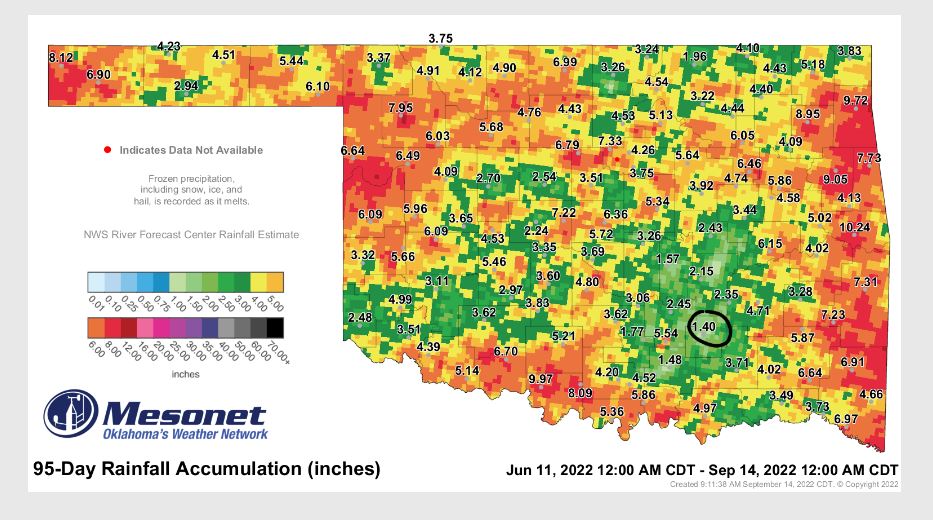
Warmer Temperatures have moved back into Oklahoma with little chance of rain. State Climatologist Gary McManus said parts of the state have only received a little over an inch of rain in the last 95 days. McManus says statewide, since June 11, the average rainfall is the 6th driest since at least 1921.
Chances for rain over the next week or so are dismal at best. McManus says we have an opportunity for some storms today and tomorrow, but those chances aren’t great and primarily confined to far NW OK and the Panhandle.
Keep in mind there could be some chances of Severe weather if storms fire up, especially with severe winds, which are standard in this type of atmospheric setup. McManus said he did have hopes for a big upper-level system to push through the heat dome and give us some rain chances next week, but those hopes are less likely now. The seven-day forecast calls for highs in the Lower 90s with lots of sunshine and nightly temperatures dipping into the upper 60s and lower 70s. With winds from the Southwest.
To read more from Gary McManus, click here
Sep 14
Wed, 14 Sep 2022 09:56:25 CDT
National Cotton Council Chairman Ted Schneider said the U.S. cotton industry applauds USDA for promoting sustainable farming practices through its Partnership for Climate-Smart Commodities – including the new Climate Smart Cotton Program led by the U.S. Cotton Trust Protocol.
The Louisiana producer stated that, “The U.S. cotton industry is committed to sustainability and to protecting the environment. The $90 million of funding allocated to the U.S. Climate Smart Cotton Program is a historic investment that will further enhance our industry’s voluntary environmental stewardship efforts to reduce greenhouse gas emissions, soil loss and water and energy use, while increasing land efficiency and soil carbon.”
He said this project announced today will provide technical and financial assistance to more than 1,000 U.S. cotton producers, including historically underserved cotton producers, to advance adoption of climate smart practices such as no-till, cover crops and nutrient management on more than a million acres, producing more than four million bales of Climate Smart Cotton over five years.
Schneider said the new project will be led by the industry’s three-year old sustainability initiative – the U.S. Cotton Trust Protocol® – a voluntary program where its American cotton producer participants “commit to providing sustainably-grown cotton to not only meet the needs of brands and retailers in the fashion and textile industries but ultimately protect and preserve our planet.”
The Climate Smart Cotton Program is a collaborative effort with Cotton Incorporated and the NCC’s export promotion arm, Cotton Council International; the Soil Health Institute; the Soil and Water Outcomes Fund; Alabama A&M University; North Carolina A&T University; Texas A&M University’s AgriLife Research; and Agricenter International in Memphis. The NCC also is grateful for Target’s support of the project through cost-share funding.
“The U.S. cotton industry is honored to partner with USDA on this very important environmental enterprise,” Schneider said. “We look forward to working with Secretary Vilsack on future climate-smart programs not only to build and expand market opportunities for U.S. cotton but be global leaders in mitigating the impact of climate change through voluntary and innovative conservation practices.”
Sep 14
Wed, 14 Sep 2022 09:55:12 CDT
The Food and Agriculture Climate Alliance (FACA) commends USDA for its consideration and selection of pilot projects through its Partnerships for Climate-Smart Commodities.
The more than 80 member organizations of the Food and Agriculture Climate Alliance represent farmers, ranchers, agribusiness, forest owners, state departments of agriculture, and nongovernmental organizations that support voluntary, incentive-based climate solutions.
FACA appreciates USDA’s use of Alliance recommendations as a guidepost when developing Partnerships for Climate-Smart Commodities and commends Secretary Vilsack and Under Secretary Bonnie for their meaningful inclusion of early adopters and small and underserved producers in the program. The Alliance is pleased that the projects selected recognize differences between regions, farm size and forest type, and diversity of production in the United States.
FACA supports innovative and voluntary solutions to reduce greenhouse gas emissions, increase carbon sequestration and storage, build climate resilience, and drive sustainability across the supply chain. The newly announced projects will help advance climate-smart production practices, measure and verify associated GHG benefits and increase demand for commodities produced using forward-thinking and sustainable methods.
The Alliance continually works to build on our recommendations and looks forward to engaging with USDA and Congress on future climate-smart programs.