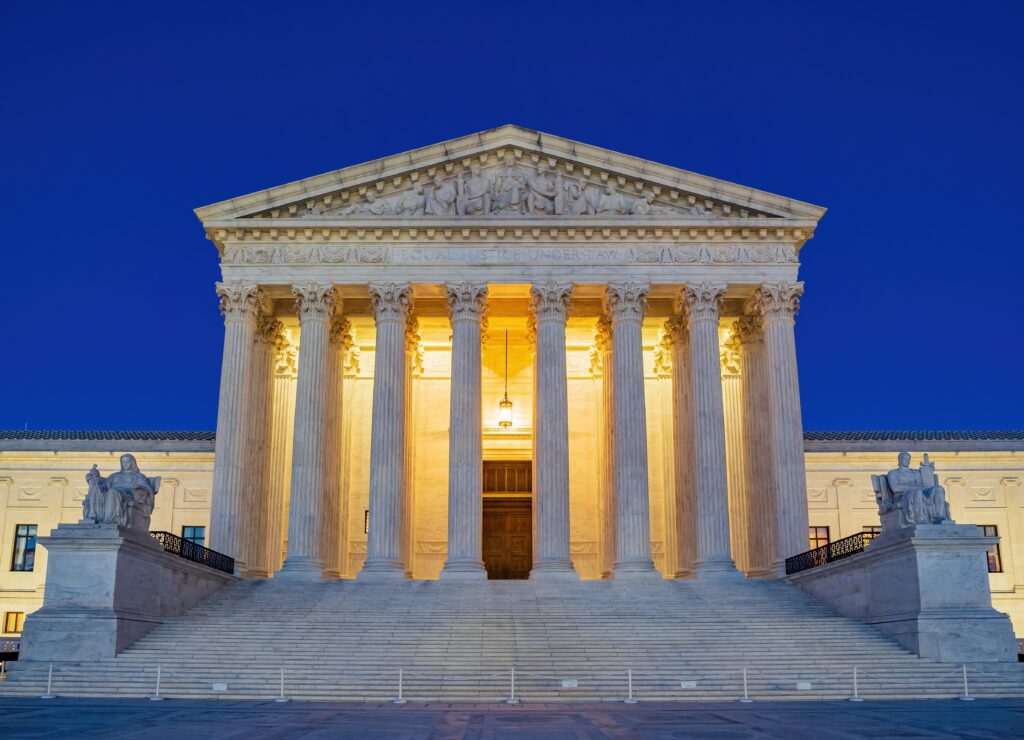
In a landmark 6-3 decision issued Friday morning, the U.S. Supreme Court ruled that the administration overstepped its constitutional authority by unilaterally imposing sweeping global tariffs under the International Emergency Economic Powers Act (IEEPA).
The ruling, authored by Chief Justice John Roberts, effectively dismantles the “reciprocal” tariff framework established in 2025, which had placed duties on nearly every trading partner. Justices Clarence Thomas, Samuel Alito, and Brett Kavanaugh were the lone dissenters.
The Core of the Decision
The Court’s majority found that while the IEEPA of 1977 grants the President broad powers to regulate international commerce during a national emergency, it does not provide a “blanket license” to levy taxes. The ruling emphasized that the U.S. Constitution explicitly grants the power of the purse—including the authority to set duties and tariffs—to Congress, not the Executive Branch.
“The statute neither mentions tariffs nor provides the procedural safeguards required for such a massive shift in economic policy,” the Court noted.
What This Means for Agriculture
For the U.S. agriculture industry, which has been caught in a cycle of retaliatory trade measures and market volatility, the ruling offers a moment of significant recalibration:
- Export Markets: Major commodities, particularly soybeans, wheat, and cotton, have faced suppressed demand and lower prices as key buyers like China shifted to South American competitors in response to U.S. trade policy. Today’s ruling could lead to a softening of retaliatory barriers from trading partners.
- Input Costs: Farmers have struggled with elevated costs for machinery, fertilizer, and parts—many of which were inflated by the 10% to 25% global duties. The removal of these tariffs is expected to provide some relief to the bottom line of production operations.
- The Refund Question: Legal experts suggest the ruling may allow importers to seek billions of dollars in refunds for tariffs already collected, though the process for reclaiming those funds remains complex and will likely lead to further litigation.
Analysis from Jonathan Coppess
Jonathan Coppess, an agricultural policy specialist and lawyer at the University of Illinois, notes that the decision represents a strong, across-the-board understanding of constitutional limits. He explains that:
- Tariffs are Taxes: The Court views tariffs fundamentally as taxes, and only Congress has the constitutional authority to raise them.
- Lack of Explicit Delegation: For the executive branch to implement tariffs, there must be a clear and explicit delegation of power from Congress, which was missing in this case.
- Checks and Balances: The executive branch faces significant judicial skepticism when it attempts to “read into” statutes powers that aren’t explicitly stated.
Coppess mentions that while the Court acknowledged broad executive discretion during wartime—citing the Youngstown Sheet & Tube case from the Korean War—it remained firm that peacetime actions require distinct legislative authorization.
Future Outlook
While the ruling strikes down the broad application of the IEEPA for tariffs, it does not strip the President of all trade tools. The administration may still attempt to utilize Section 232 (national security) or Section 301 (unfair trade practices) to maintain certain duties. However, these pathways require more rigorous investigations and offer less speed and flexibility than the emergency powers used previously.
Industry leaders, including the National Cattlemen’s Beef Association (NCBA) and the National Association of Wheat Growers, have expressed that while trade stability is welcome, the focus now shifts to how the administration will pivot its “America First” economic agenda within these new legal boundaries.
During his press conference today, February 20, 2026, President Trump reacted strongly to the Supreme Court’s 6-3 ruling that struck down his sweeping global tariffs.
Key Statements from the TRUMP Press Conference
- Reaction to the Ruling: Trump called the Supreme Court’s decision a “disgrace” and expressed that he was “absolutely ashamed” of certain members of the court for not having the “courage to do what’s right for our country”.
- Criticism of Justices: He slammed the justices who voted against him as “a disgrace to our nation” while praising the dissenting justices—Brett Kavanaugh, Clarence Thomas, and Samuel Alito—for their “strength and wisdom”.
- Alternative Plans: He stated that the administration has “very powerful alternatives” to reinstate the measures, claiming these methods could be “even stronger than the IEEPA tariffs”. He specifically mentioned Section 232 of the Trade Expansion Act of 1962 and Section 301 of the Trade Act of 1974.
- Impact on Rivals: Trump claimed that foreign countries that have been “ripping us off for years” are “ecstatic” and “dancing in the streets” following the ruling, but he warned they “won’t be dancing for long”.
Read the full decision below