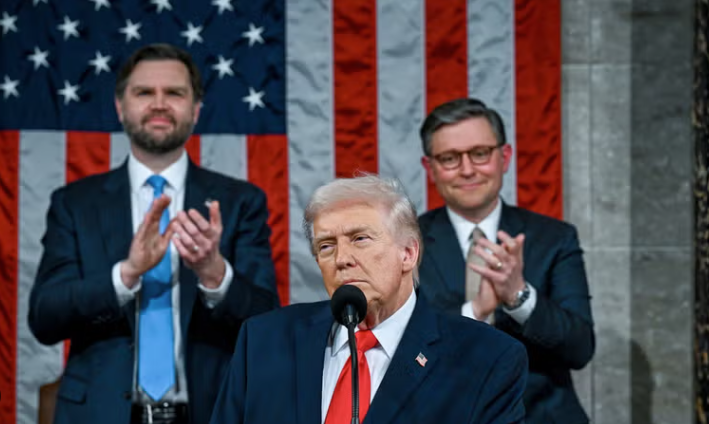
On February 24, 2026, President Donald Trump delivered his State of the Union 2026 address to a joint session of Congress. Lasting approximately 1 hour and 48 minutes, it was the longest State of the Union address in U.S. history.
Key Mentions of Agriculture and Producers
The “Backbone of America”
The President referred to American farmers and ranchers as the “backbone of our country” and an “indispensable national asset.” He used this framing to transition into his administration’s goal of achieving “food security,” which he linked directly to national security, stating that a nation that cannot feed itself is not truly sovereign.
Economic and Trade Policy
- Tariffs as Aid: He discussed using a portion of the revenue generated from tariffs to provide economic assistance to farmers. This is intended to offset costs associated with trade market fluctuations and high input prices.
- Input Costs: He claimed that his administration’s energy policies (specifically “Drill, baby, drill”) are successfully bringing down the costs of fertilizer and fuel, which are primary drivers of inflation for ag producers.
- The “Death Tax”: He emphasized the permanency of the $15 million individual estate tax exemption (indexed for inflation), arguing that this allows family farms to stay within families rather than being sold to pay taxes.
Regulatory and Legal Actions
- Farmer and Rancher Freedom Framework: While much of this was detailed by the USDA recently, the President alluded to this initiative during the speech, promising to protect producers from “politically motivated lawfare” and “weaponized government agencies.”
- WOTUS and Environmental Rules: He touted the repeal of several environmental regulations, specifically mentioning a more “balanced” approach to the Waters of the United States (WOTUS) rule to provide more regulatory certainty for landowners.
Energy and Biofuels
- Ethanol and E15: He reiterated his support for year-round access to E15 gasoline, arguing that expanded ethanol markets provide essential economic opportunities for corn and grain farmers while lowering prices at the pump for consumers.
Specific Program Mentions
- Farmer Bridge Assistance (FBA) Program: He mentioned that payments for this program are scheduled to be released by February 28, 2026, to help row crop producers (including wheat, corn, and cotton) manage current market volatility.
The “Record High” Price of Beef
The President cited specific data to underscore the urgency of the situation, noting that ground beef prices averaged $6.69 per pound in December 2025. He referred to this as the highest level since the Department of Labor began tracking these prices in the 1980s. He stated that “hard-working Americans” must be able to “afford to feed themselves and their families.”
The “Contracting National Herd”
He addressed the supply shortage directly, stating that the U.S. cattle herd has fallen to a “record low” of 86.2 million head. He identified the primary causes for this decline as:
- Natural Disasters: “Years of drought” and “widespread wildfires” that have devastated grazing lands.
- Disease Prevention: He mentioned necessary restrictions on cattle imports from Mexico following detections of the New World Screwworm, which further constrained domestic supplies.
National Security and Ranchers
The President used the address to reinforce the “critical role” of the American rancher, labeling them the “backbone of our food supply” and stating that their prosperity is vital to the “national security of the United States.”
The Argentina Agreement
He detailed his recent Proclamation to temporarily increase the tariff-rate quota for lean beef trimmings from Argentina.
- Quantity: He specified an additional 80,000 metric tons for the year 2026.
- The “Lean vs. Prime” Distinction: He emphasized that these imports are specifically for “lean trimmings” to be blended for ground beef, rather than the high-quality cuts produced by domestic ranchers.
- Reciprocity: He noted that as part of the deal, Argentina has agreed to open its markets to U.S. poultry and simplify regulations for U.S. beef and pork exports.
Regulatory and Market Action
He spoke about his administration’s efforts to “stop price fixing, anti-competitive behavior, and foreign influence” within the meatpacking industry. He claimed that by “halting Biden-era regulations,” he has already saved agricultural families and consumers billions of dollars in regulatory costs.
Economic Policy and Inflation
The President focused a significant portion of the speech on the economy, characterizing the current period as a “turnaround for the ages.”
- Inflation: He stated that inflation has fallen and that core inflation reached 1.7% in the final quarter of 2025.
- Energy and Gas Prices: He touted a surge in domestic energy production (“Drill, baby, drill”) and claimed gasoline prices are below $2.30 per gallon in most states.
- AI Infrastructure: A major policy announcement included the “Ratepayer Protection Pledge,” which requires large technology companies to generate their own electricity for AI data centers to prevent rising costs for residential consumers.
- Tariffs: Despite a recent Supreme Court ruling striking down certain tariff policies, the President referred to the decision as “unfortunate” and asserted he would use alternative legal authorities to maintain them.
National Security and Foreign Policy
The address highlighted several military and diplomatic initiatives:
- Iran: The President reiterated that the U.S. had “obliterated” Iran’s nuclear weapons program and stated that while he prefers diplomacy, he remains committed to preventing Iran from obtaining a nuclear weapon.
- Ukraine: He stated his administration is “working hard” to end the conflict between Russia and Ukraine.
- Drug Interdiction: He cited a military campaign in the Caribbean and Pacific that included 44 strikes on suspected drug-smuggling boats since September 2025.
Immigration and Domestic Issues
- Border Security: The President claimed the U.S. currently has the “strongest and most secure border” in history, citing a drop in illegal crossings.
- Public Safety: He highlighted a joint operation in Washington, D.C., which he stated resulted in over 8,700 arrests and the removal of more than 80 homeless camps from federal lands.
- Health Care: He promoted the “TrumpRx” program, asserting it provides access to lower-cost prescription drugs.
Ceremonial Moments
The President presented the Congressional Medal of Honor to Royce Williams, a 100-year-old Korean War veteran. He also recognized the gold medal-winning U.S. men’s Olympic hockey team and presented the Presidential Medal of Freedom to goalie Connor Hellebuyck.+1
The Democratic response was delivered by Virginia Governor Abigail Spanberger, who focused on the continued high cost of living for many families, while Senator Alex Padilla provided a response in Spanish.