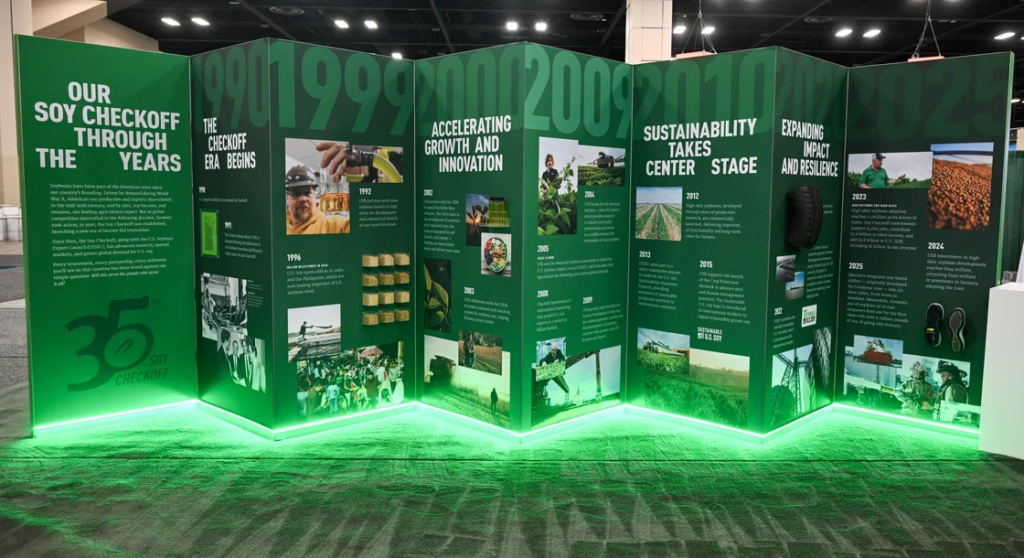
For 35 years, U.S. soybean farmers have invested together with a singular purpose: to build a stronger, more resilient future for U.S. Soy. Through the Soy Checkoff, those collective investments across food, feed, fuel, industrial, exports and sustainable production, have transformed the soybean industry. It’s created entirely new categories for demand and advanced production—delivering measurable results back to the farm.
As the United Soybean Board (USB) marks its 35th anniversary, farmer-leaders reflect on how strategic, farmer-directed investments have reshaped the soybean industry for the better—and how that momentum is continuing to accelerate.
When the Soy Checkoff was first established under the 1990 Farm Bill, U.S. soybean production totaled approximately 2 billion bushels annually. Today, that number exceeds 4 billion. Over that same period, Soy Checkoff investments helped create new fuel markets, expand exports to more than 90+ countries, strengthen U.S. infrastructure and differentiate soybean varieties to meet evolving global demand.
“At its core, the Soy Checkoff is about farmers believing in their own future,” said Sandy Ludeman, 1991-1992 USB Chair, Minnesota farmer and this year’s recipient of the Tom Oswald Legacy Award. “In the early days, USB very carefully and strategically began directing farmer investments across international marketing, domestic demand, new uses and production research. Through this initial work, we were confident we could change the entire trajectory of our industry, and we’ve done that over the last three decades. Those early investments in markets like China, in biodiesel and in soy-based products created opportunities that simply did not exist before, ultimately creating long-term value for soybean farmers and the agriculture industry as a whole.”
One of the most significant examples of farmer-driven innovation is biodiesel—a category born from Soy Checkoff research and market development. That initial investment has since expanded into renewable diesel and broader biofuel applications, including partnerships with railroads, maritime shipping companies and the home heating industry—fundamentally reshaping the soybean oil market. And, while the 2000s brought new challenges, from trans-fat concerns to biotech scrutiny, farmers leaned into innovation, rather than retreating. It’s led to biofuels being U.S. soy’s fastest growing demand channels.
“We faced moments that could have threatened demand, but instead we chose to lead,” said Ike Boudreaux, 2008 USB Chair and Louisiana farmer. “Through the Better Bean initiative and the development of high oleic soybeans, USB strategically used checkoff resources to protect the edible oils market and create differentiated products for customers. At the same time, we invested in mapping the soybean genome, building coalitions to combat soybean cyst nematode and developing early warning systems for soybean rust. Those weren’t small bets—they were long-term investments in farmer resilience and designed to protect yields and strengthen profitability for farmers.”
Soy Checkoff-supported research has strengthened soy inclusion in poultry, pork, dairy and aquaculture diets; launched the U.S. Soy Center for Animal Nutrition & Health; and expanded soy-based industrial applications to more than 1,000 consumer products—replacing petroleum-based materials, plastics, PFAS or “forever chemicals” and formaldehyde in products ranging from tires and turf to asphalt and firefighting foam. To maintain global competitiveness, farmers have also invested in infrastructure and export capacity—supporting inland waterway improvements, port expansion at the Pacific Northwest and Gulf, and partnerships that serve developing, emerging and mature markets across the globe.
For current USB Chair and Kentucky farmer Brent Gatton, this milestone is proof of what happens when farmers act collectively. “Because of what farmers have built together over 35 years, we’ve been able to create entirely new markets and categories like biodiesel, expand exports around the world and develop tools that protect yield on the farm,” said Gatton. “The Soy Checkoff isn’t just about dollars invested from the half-million U.S. soybean farmers – it’s about giving them the power to shape their own future and delivering lasting impact.”
Looking ahead, USB remains focused on accelerating new uses, strengthening infrastructure such as the Port of Houston, scaling biofuel adoption across transportation sectors and continuing to drive both volume and value for U.S. soybean farmers.
“At a time of economic uncertainty and tighter margins, farmers need their Soy Checkoff working harder than ever,” Gatton added. “Our responsibility is to ensure every investment delivers real opportunity and lasting value on the farm. Together, farmers built this legacy, and together we will continue shaping a stronger, more competitive future for U.S. Soy.”