
Bermuda grass (Cynodon dactylon) is one of the most resilient and productive warm-season perennial grasses used in pastures and hay systems and has been used for conservation management throughout the southern United States. However, Bermuda grass is an introduced species that requires significant attention and maintenance. Those who planted Bermuda years ago are now looking to incorporate soil health principles on their property. This can provide some challenges, but adaptations are being used to meet soil health principles throughout Oklahoma.
Understanding Soil Health in Bermuda Grass Systems
Soil health refers to the soil’s ability to function as a living ecosystem that sustains plants, animals, and environmental balance. Soil health and ecosystem function can be accomplished in Bermuda grass systems, but may provide some challenges. Earth’s systems have a natural function within the local ecosystem, with native plants and animals forming a symbiotic relationship for thousands of years. When introducing non-native plants to the area (like Bermuda), they can become invasive and unlikely to provide an ecosystem function. Bermuda grass was initially planted many years ago, before the larger impact on the local ecosystem was assessed. Bermuda was initially used to prevent erosion on sites and adapted easily to most landscapes; however, it provides little additional ecosystem function.
Today, many farmers are trying to reverse the impacts of Berumuda on local ecosystems. Some are trying to convert Bermuda pastures to native rangeland, but the practice can be costly. Others are gradually introducing soil health principles to the Bermuda grass system. The following principles and general concepts have been applied to these pastures, resulting in improvements in function and ecosystem services.
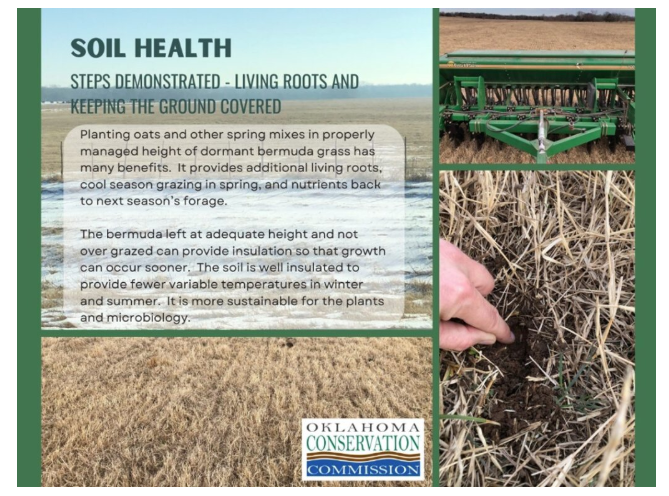
- Keep the ground covered — Grazing Bermuda to an appropriate height above 4 inches from the ground, limiting bare soil, and proper grazing ensures deep roots and temperature regulation
- Always keep a living root — Introduce native plants in the cool season. Bermuda tends to choke out competition during the summer, while cool-season plants tend to survive. It can also provide additional grazing or expand grazing time (reducing hay requirements) and provide additional food for microbes and other plants.
- Incorporate diversity — The cool-season mix mentioned above can help with improving diversity. As many begin reducing inputs to their Bermuda, they may see more native plants appear in the system. Bermuda grass responds aggressively when maintained regularly. We have seen areas where native plants or diversity can appear in less-maintained Bermuda fields. These extra plants provide ecosystem functions and potential benefits to livestock.
- Minimize soil disturbance — Overgrazing, continuous inputs, overhaying, and other practices may result in compacted or bare soil.
- Livestock — When managed correctly, livestock can provide additional benefits to plants and land. Plants respond positively to being grazed, but only when done in a conservative manner. It can trigger growth and sugar production, but if overgrazed, it can stress the plant and damage it. When setting up a rotational grazing system, we recommend getting out into the field regularly to evaluate plants, livestock, and weather rather than setting a fixed rotation schedule (every other week, month, etc.). Plants should be tall enough to continue growing without struggle. Standard recommendations are 4 or more inches for Bermuda (taller is optimal) and 8 or more inches for native plants.
According to the Oklahoma State University fact sheet on forage grazing:- “A general rule of thumb for estimating cattle rotation based on forage growth potential is to move the cattle before the residue height is less than 2 inches with 4 inches of growth being preferable. Cattle should not be rotated into a pasture until forage height reaches at least 6 inches with 10 inches of growth being preferable. Pasture rotations should not be based on calendar date alone. Movement between pastures should be based on current environmental conditions as well as forage growth rate. This means that grazing time may vary from as few as 1 day to 2 days up to 7 to 10 days per pasture.”
- Context — Though these are general guidelines to help when moving to a more regenerative (soil health) system in Bermuda grass, all farms have their own context to work into the system. Farmer goals, capabilities, and economic decisions all need to be considered.
As society moves to understand soil health and ecosystem function, communication is key. Farmers are simultaneously trying to feed the world while meeting the needs of nature. Many farmers are using creative solutions, such as introducing pollinator plots within field boundaries, spraying less, and learning to work with nature. These concepts are not new, but are being adapted for the next generation of farming needs.
If you would like a free consultation with a soil health expert, please contact our Soil Health team.
Author: Amy Seiger, Urban & Small Farm Program Director