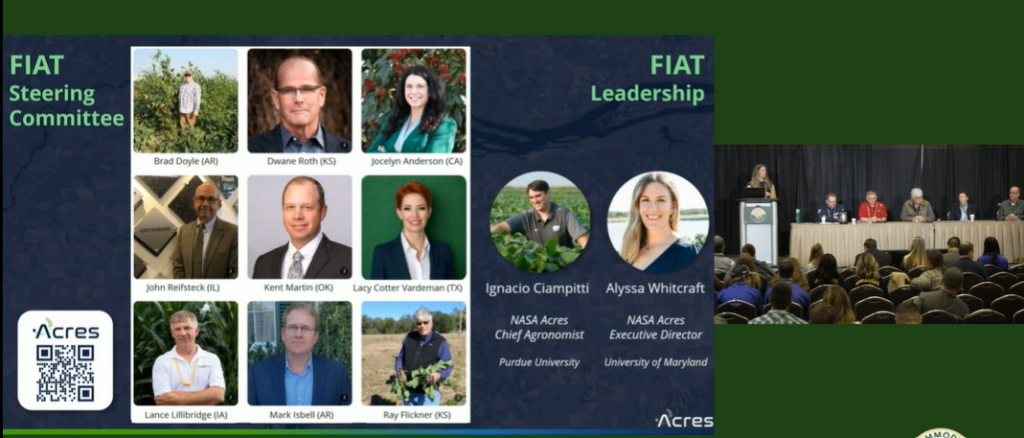
The relationship between space-age technology and the daily operations of a working farm is becoming increasingly intertwined. Through the NASA Acres Farm Innovation Ambassador Team (FIAT), the research model is undergoing a radical shift: moving away from studying agriculture about farmers to co-developing solutions with them.
NASA Acres, a consortium focused on U.S. agriculture, utilizes satellite Earth observation (EO) data to address pressing agricultural challenges. However, the data is only as valuable as its practical application in the field. FIAT serves as the essential link, connecting producers directly with researchers to ensure satellite products are field-ready and supportive of real-world decision-making.
Co-Developing Field-Ready Solutions
The core mission of FIAT is to move beyond theoretical science. By pairing researchers with the FIAT Steering Committee and diverse producers, the program ensures that the models created in the lab actually work when they hit the soil.
“The satellite data is fantastic, but we have to make sure it translates to what is happening on the ground,” said Dwane Roth, NASA Acres FIAT Steering Committee Member. “By working together, we are taking that eye in the sky and making it a tool that can help us manage water, soil health, and our bottom lines more effectively.”
Ignacio Ciampitti, NASA Acres FIAT Co-lead, emphasized that this partnership is a two-way street. “We aren’t just handing over data. We are co-creating. The farmers provide the ground-truth information that allows us to refine our models. This collaboration ensures the science is grounded in the reality of modern production agriculture.”
The Producer Perspective
For producers like Lacy Cotter-Vardeman, co-owner of Cotter Ranch and Vardeman Farms and founder of the Sandhills Area Research Association, being part of FIAT means having a seat at the table where the future of agricultural technology is designed.
“Having that direct line to the researchers at NASA Acres allows us to voice the specific challenges we face in our unique environments,” Cotter-Vardeman said. “It’s about taking high-level satellite imagery and turning it into actionable insights that help me decide where to allocate resources or how to better protect my land.”
Lance Lillibridge, NASA Acres FIAT Steering Committee Co-chair, noted that this level of involvement is unprecedented. “Farmers are the original innovators. When you combine that boots-on-the-ground experience with NASA’s capabilities, you get tools that are actually useful, not just interesting to look at on a screen.”
Shaping the Future of Data Use
As the program grows, the focus remains on scalability and accessibility. Alyssa Whitcraft, Executive Director of NASA Acres, believes that FIAT is the blueprint for how federal science agencies should engage with the industry.
“We are reshaping the traditional research model,” Whitcraft said. “By building these farmer-scientist partnerships, we are ensuring that the investment in satellite technology yields direct benefits for the people feeding the world. This is about co-developing the future of agriculture, one field at a time.”