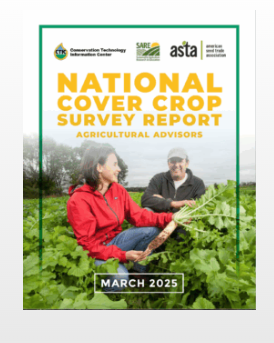
National Cover Crop Survey Seeks Farmer Insights for 2025-2026 Research Series
Farmers across the United States—whether they use cover crops, formerly used them, or have never planted covers—are invited to share their insights on cover crops in the National Cover Crop Survey being conducted by the Conservation Technology Information Center (CTIC), SARE, and the American Seed Trade Association (ASTA). This is the 8th survey in the research series, which began in 2012.
The anonymous survey takes about 15 minutes to complete. Farmers who complete the survey can enter a drawing to win one of three $100 Visa gift cards.
Data collected through the surveys has a powerful impact throughout agriculture, according to Rob Myers, a University of Missouri professor and regional director of the North Central Region SARE program.
“The National Cover Crop Survey is a tool that helps policy makers, agribusiness, commodity organizations, cover crop advocates, farmers and others understand how farmers think about cover crops and make decisions around adopting the practice,” Myers explains. “Previous surveys have been used in Congressional testimony, cited in academic research, used by educators to help share information to help farmers succeed with cover crops, and more.”
For example, data from previous surveys informed SARE’s report Cover Crop Economics, which addresses how and when cover crops improve profitability.
“This year, we’re equally interested in not only hearing from farmers who actively use cover crops, but also from those who no longer use them and who have never planted them at all,” says Ryan Heiniger, CTIC executive director and a 4th generation Iowa farmer who uses cover crops. “Additionally and new this year, we’ve added more questions about grazing livestock on cover crops to explore return on investment and the practice’s potential as a contributing solution to help rebuild the nation’s cattle herds.”
Andy LaVigne, president and CEO of ASTA, adds that the CTIC/SARE/ASTA cover crop surveys help seed companies predict market demand for cover crop seed and spot trends in the use of various cover crop species. That helps seed growers supply the steadily evolving market for cover crop seed.
“Understanding the demand and opportunities in the field helps seed companies keep in step with the market,” LaVigne notes. “Over the years, we have seen new species and varieties of cover crops come into the market, and we have identified trends in how farmers have used various cover crops to achieve a wide range of benefits.”
The 2025-2026 National Cover Crop Survey is open until March 31. Visit the SARE website to view reports from past surveys.