U.S. pork exports trended higher year-over-year in January, led by another outstanding performance from leading market Mexico, according to data released by USDA and compiled by the U.S. Meat Export Federation (USMEF). January beef exports were lower than a year ago due to the prolonged lockout in China, but export value per head of fed slaughter was more than $415 – the highest since March and reflecting solid demand in other markets. Beef variety meats were a major bright spot, with export value topping the previous monthly high reached in December.
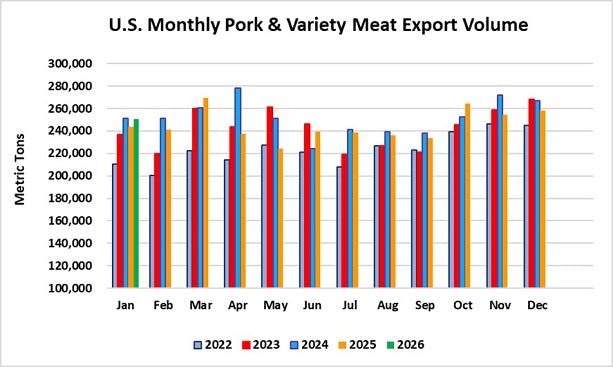
January pork exports totaled 250,861 metric tons (mt), up 3% from a year ago, while value increased 4% to $692.1 million. In addition to Mexico, exports were larger year-over-year to Japan, South Korea, Canada, Central America, Colombia, the Dominican Republic, the ASEAN and Taiwan.
“Very impressive start to the year for U.S. pork in Mexico and other Western Hemisphere markets, but strengthening demand in Asian destinations is especially encouraging,” said USMEF President and CEO Dan Halstrom. “The U.S. industry continues to capitalize on consumers’ growing demand for convenience-oriented products at both retail and foodservice, and this is reflected in our recent export results.”
Beef exports totaled 92,558 mt in January, down 10% year-over-year. But value fell just 3% to $780.1 million, as exports have commanded higher prices. However, prices are still not being maximized to the degree that would be possible with China back in the mix. When excluding China from the January results, exports increased 5% in volume and climbed 16% in value. January beef shipments trended higher year-over-year to Korea, Japan, Taiwan, the Caribbean, the ASEAN and South America, with export value also increasing to Mexico, Canada and Central America.
Beef variety meat exports were especially strong in January, increasing 6% from a year ago to 27,511 mt, while value soared 46% to a record $126 million.
“Beef variety meat value reaching new heights for the second consecutive month is great news for cattle producers and for the entire supply chain,” Halstrom said. “With cattle numbers being tight, it is more critical than ever to maximize the value of every animal. And while much of this export growth was driven by tongues and skirts going to Japan, demand was strong in a wide range of markets.”
Broad-based growth for January pork exports
Coming off a fifth consecutive record year, pork exports to Mexico remained on a roll in January, increasing 3% from a year ago to 107,902 mt. Export value climbed 8% to $238.7 million. As USMEF has previously reported, U.S. pork faces a potential headwind in Mexico due to antidumping and anti-subsidy investigations on U.S. hams and shoulders. Led by the National Pork Producers Council and USMEF, as well as individual company participation, the U.S. industry has responded in great detail to the Mexican government’s requests for information, demonstrating that U.S. export growth is demand-driven and refuting concerns about dumping or subsidization.
Pork exports to Japan totaled 27,910 mt in January, up 22% from a year ago and the largest since May. Export value was $103.8 million, up 14%. With the U.S. and Japan continuing to work on a reciprocal trade deal, Prime Minister Sanae Takaichi is set to visit the White House next week. USMEF does not expect any impact on red meat market access in Japan, as the U.S. continues to benefit from the U.S.-Japan Trade Agreement reached in President Trump’s first term. But a reciprocal deal could further solidify general trade relations between the two nations.
Pork exports to Colombia set a value record in 2025 and nearly matched 2024’s record volume, but shipments slowed toward the end of the year. That trend was reversed in January, as shipments climbed 16% year-over-year to 9,853 mt, valued at $30 million (up 13%). While Colombia was once primarily a destination for raw material for further processing, exports have expanded in recent years to include a range of value-added products.
Other January results for U.S. pork exports include:
- Similar to Colombia, pork exports to Central America were record-large in 2025 but slowed near the end of the year. Led by growth in leading market Honduras, January exports to the region edged slightly higher than a year ago in both volume (14,651 mt, up 1%) and value ($47.6 million, up 2%).
- January exports to South Korea increased year-over-year for the seventh consecutive month, climbing 3% in volume (16,691 mt) and 9% in value ($57.5 million). This growth was achieved even as cheaper Spanish pork became available in the market, due to African swine fever (ASF) related restrictions other trading partners have imposed on Spain.
- In the Dominican Republic, Brazilian pork has made inroads in the market, but demand continues to grow, U.S. market share has rebounded, and domestic production is still battling ASF and other challenges. January exports to the DR reached 8,108 mt, up 25% from a year ago, while value climbed 26% to $24.2 million.
- The U.S. and Taiwan recently announced a reciprocal trade deal that includes market access gains for U.S. pork, including lower tariffs. While those benefits have not yet been implemented, January exports totaled 1,346 mt, up 181% from the low year-ago volume. Export value more than tripled to $3.6 million (up 205%).
- Pork exports to Canada were strong in January, increasing 6% from a year ago to 16,243 mt. Export value climbed 7% to $63.1 million.
- Despite retaliatory duties, sluggish demand and ample domestic supplies, China continues to be the largest destination for U.S. pork variety meats. January variety meat exports to China totaled 24,139 mt, up 3% from a year ago, though value declined 11% to $52 million. Global variety meat exports increased 6% to 47,129 mt, including gains in Mexico, the Philippines, Canada, Guatemala, Korea and the DR. Export value fell 3% to $97.3 million, mainly due to the decline in China.
- Pork export value averaged $62.07 per head slaughtered in January, up 6.5% from a year ago. Exports accounted for 28.5% of total January pork production and 24.9% for muscle cuts only, up from the respective January 2025 ratios of 27.1% and 23.8%.
Beef variety meats shine in January, but China remains absent
As noted above, January exports of U.S. beef variety reached 27,511 mt, up 6% from a year ago and the highest since September 2021, while export value reached a record $126 million (up 46%). Shipments to Japan soared 88% to 6,137 mt (also the highest since September 2021), while value climbed $54.7 million – up 84% and the highest since November 2021. Variety meat exports also increased year-over-year to Korea, Taiwan, Peru, Chile and South Africa. Exports to Mexico were down slightly in volume but still increased in value.

Total beef and beef variety meat exports to Japan reached 19,956 mt in January, up 5% from a year ago, valued at $149.5 million (up 7%).
The U.S. and Taiwan have completed a reciprocal trade deal that removes barriers for U.S. beef, though these favorable terms have not yet been implemented. Beef exports to Taiwan raced to an outstanding start to the year, reaching 5,631 mt valued at $63 million. This was 79% higher in volume and 63% higher in value than the low totals posted in January 2025.
January beef exports to leading value market Korea totaled 19,482 mt, up 4% from a year ago, while value increased 6% to $192.6 million. This marked the first month in which U.S. beef entered the market duty-free under the Korea-U.S. Free Trade Agreement, with tariffs having phased to zero over 15 years. Pre-FTA, Korea tariffed U.S. beef at 40%. Australia is expected to trigger its safeguard on exports to Korea by mid-year. Retailers are looking to secure more U.S. beef to minimize the impact of higher tariffs on Australian beef in the second half.
Other January results for U.S. beef exports include:
- Beef exports to the Middle East were down 12% from a year ago to 4,488 mt, mainly due to lower variety meat shipments to Egypt, but export value still increased 1% to $21.7 million. Exporters serving the region received positive news this week when Saudi Arabia confirmed that it will eliminate burdensome regulations that have hampered U.S. exports for more than a decade. Saudi Arabia was once a $30 million per year market for U.S. beef with tremendous potential for further growth – possibly in the $100 million to $150 million range – but took less than $10 million in U.S. exports last year. The military conflict with Iran has impacted exporters’ options for shipping to the Middle East, which will be reflected in later months’ export results.
- Beef exports to Central America set a value record in 2025, topping $200 million for the first time despite a slight decline in volume. This trend continued in January, as exports to the region soared 22% in value ($19.2 million) on slightly lower volume (1,910 mt, down 1%). January exports to Guatemala were nearly $10 million, up 33%.
- Led by growth in the Dominican Republic and the Bahamas, January beef exports to the Caribbean reached 2,962 mt, up 7% from a year ago, while value soared 30% to $32.1 million.
- Fueled by larger shipments to Indonesia and Vietnam, January beef exports to the ASEAN increased 24% from a year ago to 2,303 mt, while value was 7% higher at $16.8 million. While U.S. exports to Indonesia have recently rebounded after being effectively locked out of the market, the current level of business only scratches the surface of Indonesia’s tremendous potential. As USMEF has previously reported, a recently announced reciprocal trade deal with Indonesia includes substantial market access gains for U.S. beef. More details are in this USMEF statement.
- Though small volumes of still-eligible pipeline product continue to be exported to China, U.S. beef remains effectively locked out of the world’s largest import market. January exports to China were minimal, down 94% from nearly 16,000 mt last year, while value was down 97% from $135 million. China’s newly implemented beef safeguards will also have major effects in the global beef market later this year, likely pushing more Brazilian and Australian beef into the U.S. and international markets.
- Beef export value per head of fed slaughter averaged $415.15 in January, up 12% from a year ago and the largest since March 2025, prior to losing access to China. Exports accounted for 12.8% of total January beef production, up slightly from a year ago. The ratio of muscle cuts exported was 9.6%, down from 10.2% in January 2025.
January lamb exports down slightly from a year ago
Coming off a robust performance in 2025, January exports of U.S. lamb muscle cuts totaled 238 mt, down 7% from a year ago, while value fell 1% to $1.44 million. Exports increased year-over-year to the Bahamas, Japan, Taiwan, Costa Rica and Panama, but shipments to Mexico trended lower and no exports were reported to Canada.
Complete January export results for U.S. pork, beef and lamb are available from USMEF’s statistics web page.
NOTES:
- Export statistics refer to both muscle cuts and variety meat, unless otherwise noted.
- One metric ton (mt) = 2,204.622 pounds.
- U.S. pork and beef currently face retaliatory duties in China. In February 2020, China announced a duty exclusion process that allows importers to apply for relief from duties imposed in response to U.S. Section 301 duties. When an application is successful, the rate for U.S. beef can decline to the MFN rate of 12% and the rate for U.S. pork can decline to 37% (the MFN rate plus the 25% Section 232 retaliatory duty, which remains in place). But China imposed an additional 10% retaliatory duty on U.S. pork and beef on March 10, 2025, and additional retaliatory duties were announced in April 2025. China’s new retaliatory duties were first announced at 34% but were later increased to 84% and further increased to 125%. The additional tariffs pushed China’s effective duty rate on U.S. pork and pork variety meat to 172% and the rate for beef and beef variety meat increased to 147%. These rates were temporarily lowered to 57% for pork and 32% for beef on May 14, 2025, when the U.S. and China agreed to a temporary de-escalation to allow for further negotiations. The rates were further lowered to 47% for pork and 22% for beef on Nov. 10, 2025.
- Beginning March 4, 2025, U.S. sausages entering Canada were subject to a 25% retaliatory duty. This duty was removed effective Sept. 1, 2025.