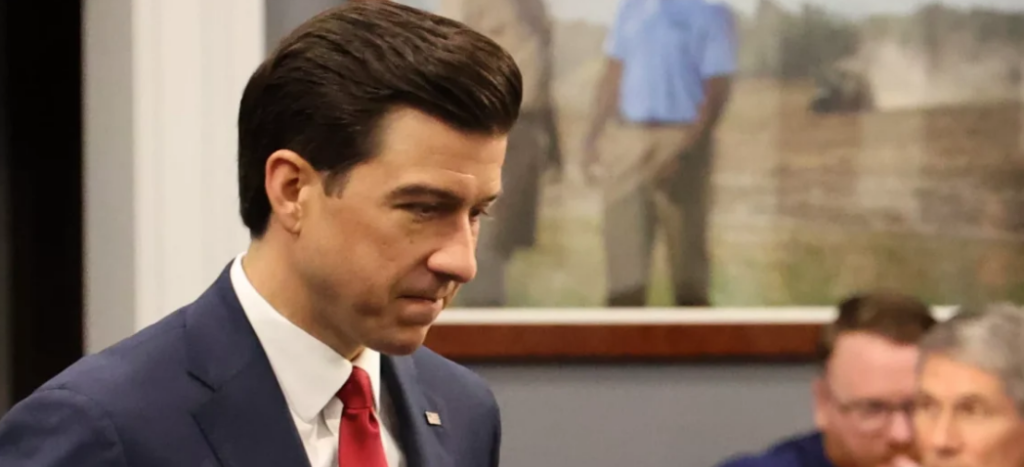
Late last summer, Luke Lindberg was confirmed as USDA Under Secretary for Trade and Foreign Agricultural Affairs, a position of great importance to wheat farmers and the entire U.S. agriculture industry.
He got off to a fast start.
One month into his tenure, Lindberg announced a three-point plan that led to the America First Trade Promotion program, which provides supplemental funding to support U.S. agricultural exports, and also created a new type of “rapid response” trade mission designed to help U.S. farmers take advantage of new trade deals.
Prior to his Aug. 2 confirmation, U.S. Wheat Associates (USW) joined dozens of other ag organizations in signing a letter of support for Lindberg. In part, the letter stated, “Throughout his career, Mr. Lindberg has been a proponent of using trade to strengthen U.S. agriculture. As President and CEO of South Dakota Trade, Mr. Lindberg collaborated with local and regional agriculture groups and led several international trade missions to help South Dakota producers and agricultural partners navigate the global trade landscape. Prior to that, as Chief of Staff and Chief Strategy Officer at the Export-Import Bank of the United States he managed day-to-day operations, and advanced strategic initiatives including opening new markets for American producers.”
Lindberg, who holds degrees in Government and Politics, Public Policy, and Business Administration from the University of Maryland, recently answered some questions about his first six months on the job posed by USW Vice President of Policy and Communications Dalton Henry.
Following is the brief “Q and A” between Linberg and Henry.
HENRY: You’ve been in the job for almost 6 months now. What’s surprised you most about taking over the Trade and Foreign Ag job at USDA?
LINDBERG: The swiftness with which President Trump and the team at the U.S. Office of Trade Representative (USTR) have negotiated Agreements on Reciprocal Trade (ARTs) has been extraordinary. From an ag perspective, the ARTs now represent more than 50% of all mouths to feed in the world. Needless to say, the fast pace of new trade deals has been energizing to me as implementation unfolds, and we begin to see the benefits to our farmers, ranchers, and producers.
HENRY: You have a pretty unique background for the position. Have to think that both your roles at South Dakota Trade and EXIM have influenced the way you look at USDA’s role in promoting exports?
LINDBERG: My experiences at both EXIM and South Dakota Trade were perfect foundational roles for my position at USDA. EXIM has many extraordinary ‘tools’ in its toolkit to promote U.S. exports, and to help level the playing field and fill gaps in private sector financing. I know EXIM President John Jovanovic is working hard to revitalize America’s economy – including its ag economy – and to make EXIM move even faster and deliver smarter results for American farmers. Regarding my time in the Mount Rushmore State, South Dakota was 1 of only 2 states without a trade office, thus the impetus for launching South Dakota Trade under the guidance of former Governor Kristi Noem. So, I know first-hand the critical importance of having a state trade office to promote exports. For example, many in South Dakota were unaware of the value of trade missions and thinking beyond our domestic borders for generating sales and, during my tenure, I witnessed an extraordinary transformation on this front. This naturally bolsters my enthusiasm as Under Secretary and as a champion of U.S. ag exports!
HENRY: One of the really unique things about the TFAA position is that while you are heavily involved in trade policy, most actual negotiations take place with USTR. How do you see USDA working to advance agriculture’s interests in more formal negotiations?
LINDBERG: USDA remains steadfast in its commitment to advancing the Trump Administration’s ambitious trade agenda and overcoming barriers to trade. This work is done in partnership with numerous agricultural stakeholders, including U.S. Wheat Associates, and with our U.S. government partners. As an example, I am extremely fortunate to have a strong working relationship with Ambassador Julie Callahan, our very talented and knowledgeable chief ag negotiator at USTR. Ambassador Callahan and I have regular ‘check-ins’ to ensure coordination on many fronts, and key members of my team are also in regular contact with USTR staff. On my domestic and international travels, I have had numerous opportunities to hear from U.S. producers, which have informed my conversations with USTR and other government agencies. We have also hosted ‘producer roundtables’ in Washington to ensure that we hear directly from groups like you, our most important stakeholders.
Lastly, I want to highlight our Foreign Ag Service (FAS) staff who are located in our embassies and consulates abroad. They have technical expertise and deep knowledge of local markets and have been an essential resource in ensuring USTR’s negotiations lead to positive outcomes for U.S. farmers. We all share a goal of securing the best possible outcomes, and they will also play a critical role in the implementation of these new trade deals. We are all working towards a goal of bringing prosperity for our hardworking farmers and producers!
HENRY: Despite only being in the job for 6 months, you have already been getting miles under your belt with visits to several of our top wheat markets. Any major takeaways from those trips and how U.S. commodities are being received?
LINDBERG: We all know that at the core of agricultural trade, it is the business-to-business relationships that help translate market access into real sales (dollars in farmers’ pockets!) and a material reduction in our trade deficit. As I always say, the new trade deals are critical, but it takes ‘boots on the ground’ to make deals happen!
During my travels, I have seen so much potential to expand markets for American agricultural products, which we all know are the best in the world. In every country I have traveled – including Mexico, Japan, Malaysia, and Indonesia, to name a few – I have seen huge and growing populations with a rising middle class who are looking for quality product offerings. In these markets, U.S. agricultural products enjoy a great reputation for safety, quality and value. USDA is helping to open the door so our producers can capitalize on these opportunities now.
In November 2025, USDA hosted the largest agribusiness trade mission in Mexico. Mexico is consistently the number one export market for U.S. wheat, with exports in 2024 totaling over US $1 billion. While in Mexico City, I visited Bimbo Bakery of Grupo Bimbo, which imports nearly $400 million in U.S. ingredients in 2024, including wheat. We view Mexico as a consistent and stable market for U.S. wheat, and we will ensure that the market stays open, fair, and transparent for U.S. producers.
The next top four export markets for U.S. wheat are in Southeast Asia: the Philippines, South Korea, Japan, and Taiwan. We view Southeast Asia as a continuing growth market for U.S. agricultural exports, including wheat. An example is Indonesia, where I recently returned from a trade mission. Indonesia is forecast to import record volumes of wheat in 2026, a total of 13 million tons. However, the United States is not a top supplier of wheat to Indonesia and competes with Australia, Ukraine, and other exporters, so we definitely have room to grow. As with all trade missions, the goal is to create opportunities for U.S. producers to meet with buyers, demonstrate the superiority of our offerings, and ultimately sign deals and foster long-term relationships. During the trade mission to Indonesia, we were pleased to highlight the recent commitment between U.S. Wheat Associates and Indonesian millers to purchase 1 million tons of U.S. wheat annually.
HENRY: USW was extraordinarily pleased with the announcement last month about Food for Peace awards and the level of commodities that USDA will be using in those activities. Do you see opportunities to further expand the role of USDA in using commodities in international food assistance?
LINDBERG: I too was pleased, and I am optimistic about a further expansion of our role in using U.S. commodities in international food assistance. We are the most generous country in the world, and our farmers, ranchers, and producers make the best food in the world, thus a perfect combination for future expansion.
HENRY: USDA is mid review of export credit programs. Any insight or advance thinking on your end about adjustments that could be made to that program to expand its attractiveness to U.S. customers?
LINDBERG: The export credit guarantee program (GSM-102) remains a critical tool for ensuring U.S. exporters and commodity traders stay competitive globally while helping reduce the trade deficit. My team is committed to making the program responsive and efficient to industry needs and accessible to our customers. In direct response to feedback from agricultural partners, we announced on Feb. 3, 2026 the availability of an 18-month bullet payment option—an important step to enhance flexibility and attractiveness for participants. We plan to announce additional program changes in the very near future.