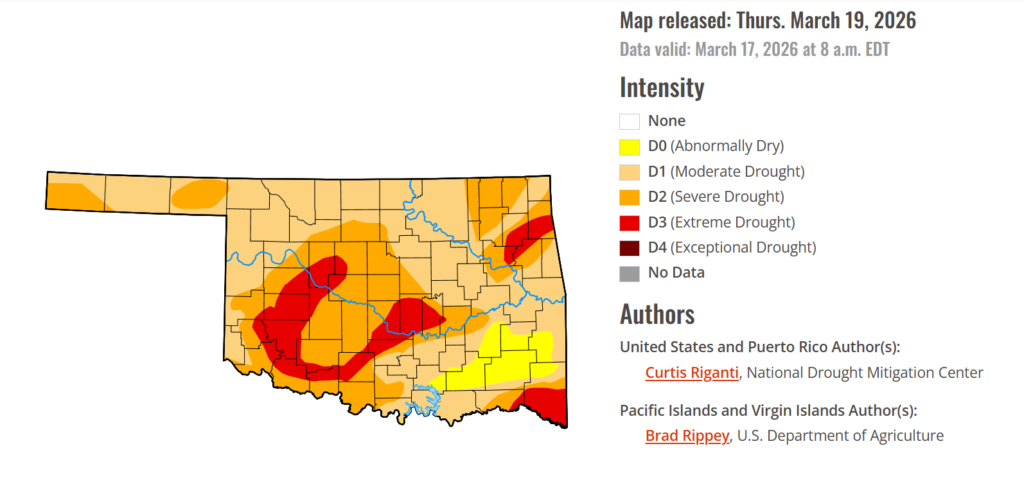
To view the latest Oklahoma drought map, CLICK HERE.
Drought continues to tighten its grip across Oklahoma, with nearly the entire state experiencing some level of dryness and conditions gradually worsening week by week. Even as exceptional drought remains absent, expanding moderate-to-extreme conditions and a lack of meaningful rainfall in the outlook are raising fresh concerns as spring approaches.
According to the latest Oklahoma Drought Monitor report, exceptional drought remains at 0 percent, unchanged from the start of the calendar year.
Moderate drought to extreme drought conditions in the current period indicate that 94.29% of the state is affected by drought. Compared with last week’s 93.97%, drought conditions have expanded again by 0.32%.
Extreme Drought conditions have grown slightly this week, now covering 13.50% of the state, up from 13.24% last week, affecting mainly Blaine, Tillman, Pottawatomie, Seminole, McClain, Garvin, Stephens, Kiowa, Washita, Delaware, Ottawa, Mayes, Cherokee, McCurtain, and parts of surrounding counties.
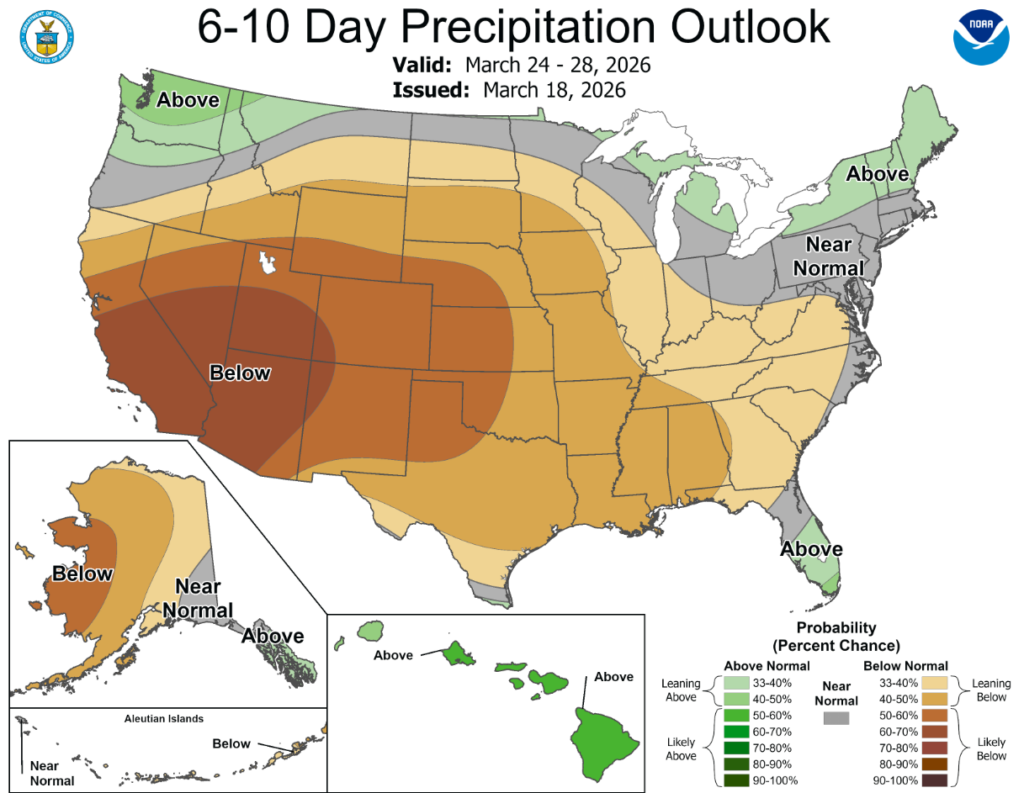
According to the 6-to-10-day precipitation outlook map, eastern Oklahoma is leaning below 40-50% chance of precipitation while western Oklahoma is leaning below 50-60% chance of precipitation through March 28th.
This week, a powerful storm system crossed from the Great Plains into the Great Lakes, bringing widespread rain and thunderstorms to parts of the Midwest, and a historic blizzard to portions of the Upper Midwest, especially in northern Wisconsin and Michigan near Lake Superior. Total precipitation amounts exceeded 2 inches in a large area of the western Great Lakes, while lighter amounts, mostly 0.5-3 inches of precipitation, fell across parts of the southern and eastern Contiguous U.S. Improvements to ongoing drought and dryness occurred across large portions of the Midwest, parts of the lower Mississippi River Valley, and in the Northeast outside of northern New England. Heavy rain and, in some areas, mountain snow, fell across parts of the Northwest, locally improving drought conditions. However, significant deficits in snow still exist in many parts of the West, including the Pacific Northwest, which limited the longer-term benefits of the precipitation that fell. Much of the Southwest, and the central and southern Great Plains, missed out on precipitation, and instead dealt with a dry, warm and windy week. Precipitation deficits, and lack of snowpack in the mountains, continued to worsen amid high evaporative demand, leading to widespread worsening of abnormal dryness and drought, especially in South Dakota and Nebraska, southwest Kansas, southern Colorado, New Mexico, Arizona, Nevada, and parts of Oregon that missed out on precipitation. A kona low delivered heavy precipitation to all of Hawaii this week, leading to widespread 1- and local 2-category improvements to ongoing drought conditions from Molokai eastward.
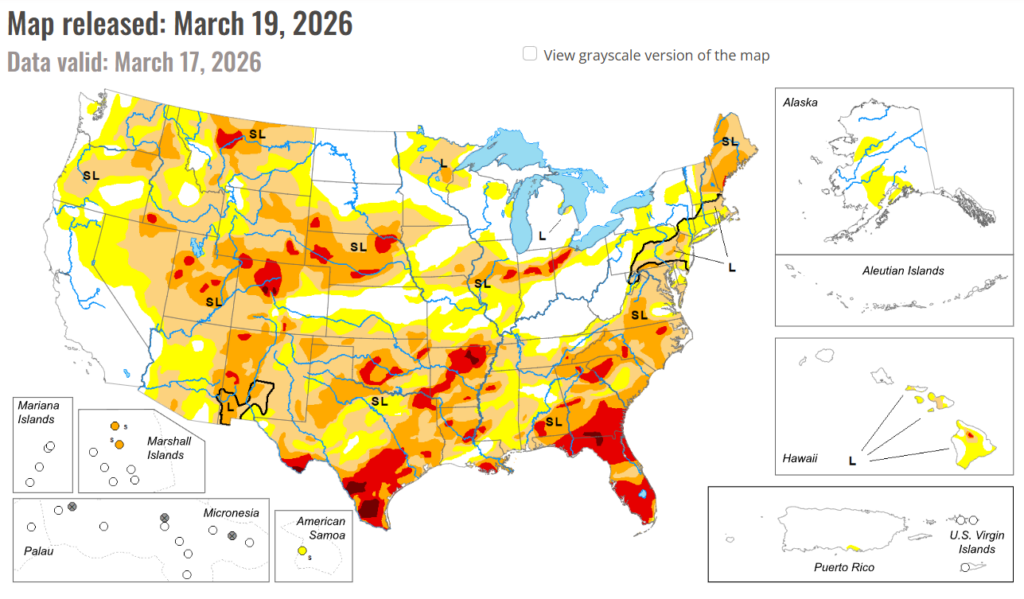
In The South: A strong low pressure system traversed the Great Plains into the Midwest with it, bringing widespread strong winds, locally heavy rain and a powerful blizzard to the Upper Great Lakes. Weekly precipitation amounts ranged from 2-3 inches, locally more, from central and northern Illinois to eastern Wisconsin, the central and eastern Michigan Upper Peninsula, and much of the Michigan Lower Peninsula (excluding southeast areas) and northern Indiana. Improvements occurred across much of Illinois, Wisconsin, most parts of Michigan that still were experiencing drought or abnormal dryness, and parts of Missouri, Iowa, western Kentucky, Indiana and northeast Ohio. Longer-term precipitation deficits and paltry streamflow still exist in parts of Illinois, Indiana and Ohio, though recent precipitation has alleviated conditions in some areas, so widespread improvements were made this week. The impact of recent precipitation on soil moisture and streamflow in the Midwest will continue to be monitored in the coming weeks. Recent precipitation and improvements in soil moisture and precipitation deficits led to the aforementioned local improvements in Missouri, Iowa and northwest Kentucky. Weekly temperatures were 3-9 degrees below normal in northwest Minnesota, as cold air wrapped around the powerful storm system, while temperatures in the southern half of the Midwest were 3-12 degrees warmer than normal for mid-March.
In the High Plains: In the southern half of the High Plains region, warmer-than-normal weather continued this week amid mainly dry and frequently windy conditions. Degradation in drought conditions was widespread across Nebraska and southern parts of South Dakota. A deadly wildfire in western Nebraska, the Morrill Fire, has burned a record amount of land for Nebraska wildfires. This fire, and others across Nebraska, occurred amid weather conditions favorable for fire growth and a background of worsening drought conditions. The Great Plains of southwest Kansas and southeast Colorado also saw worsening drought and abnormal dryness this week, as precipitation deficits continued to mount along with warmer-than-normal temperatures this winter and early spring. Large precipitation deficits and above-normal evaporative demand over the last several months led to extreme drought development in parts of the Black Hills in southwest South Dakota. Colder temperatures and some precipitation kept conditions unchanged (and mostly free of drought or abnormal dryness) in North Dakota and northern South Dakota.
In the West: Current drought conditions in the West continued to be headlined by snow drought this week. The Sangre de Cristo Mountains and portions of the San Juan Mountains in southern Colorado and northern New Mexico saw widespread worsening conditions this week. Overall dry and warm conditions worsened both precipitation deficits and snowpack conditions in these areas. Some snow-water monitoring sites in the region have seen near-full or full melting of snowpack. Degradations to ongoing drought and dryness were also widespread in Arizona this week, where warmer-than-normal temperatures combined with dry weather to worsen short-term precipitation deficits, increase evaporative demand and support low streamflow levels. High-elevation parts of Arizona that usually have snow on the ground in mid-March are also suffering from snow drought. This combination of drier- and warmer-than-normal weather and snow drought may set the state for drought conditions to worsen in the coming weeks if weather conditions remain warm and dry. Warmer-than-normal and dry weather occurred this week in Nevada, worsening conditions in some areas, especially in the north, where impacts are being reported as a result of unusually warm and dry weather over the last several months and meagre mountain snow. Due to locally heavy precipitation or lack thereof, a mix of small-scale improvements and degradations occurred in Oregon. Amid the snow drought, localized degradations occurred in southwest Idaho, while heavier mountain snows improved snowpack in some mountain ranges in parts of western Montana, leading to localized improvements. The effectiveness of this locally renewed snowpack in improving soil moisture will be analyzed further in the weeks ahead.
To view the 6-10 Day Precipitation Outlook Map, click here.
To view the 6-10 Day Temperature Outlook Map, click here.
To view the Monthly Drought Outlook Map, click here.