On October 2, 2025, the U.S. Department of Labor (DOL) issued an Interim Final Rule (IFR) that introduced several modifications in the determination of adverse effect wage rates (AEWRs) applicable to H-2A workers hired by U.S. farmers. The new methodology departs from relying on wage data from the Farm Labor Survey (FLS) and will instead set new AEWRs from wage information collected under the Occupational Employment and Wage Statistics (OEWS) survey of the Bureau of Labor Statistics.
This article pursues the arguments presented in our previous SAT article, which shows discrepancies in domestic-H-2A wage differentials at the national level due to the more aggregated nature of the old AEWRs. The previous BLS-based AEWR setting mechanism was riddled with the aggregation issues pertaining to geography, commodity and job type, and static annual AEWR levels.
The new AEWR setting scheme that H-2A employers are using this year resolves some of these aggregation issues. Specifically, state-level AEWRs are now set using the OEWS survey data, thus resolving issues associated with regional aggregation under the old system. In addition, there will now be two wage tiers for H-2A workers established according to the workers’ skill levels.
- Level 1 – Entry Level AEWRs apply to positions with neither formal education nor specialized training requirements; and
- Level 2 – Experienced Level AEWRs are set at higher rates “commensurate” to the skills, education, training, and/or experience requirements for such positions.
Finally, an adverse compensation adjustment (downward) is also available for employers that provide housing for their H-2A workers. The adjustment rate is determined as the “equivalent hourly rate based on the weighted statewide average of Fair Market Rents for a four-bedroom housing unit available from the Department of Housing and Urban Development.” (Congressional Research Service, 2025)
The new AEWR methodology’s intention to address wage aggregation issues is noteworthy. However, analysts and industry experts only acknowledge its partial resolution of the old system’s imperfections. Issues concerning how the OEWS survey is conducted and addressing job and commodity wage differentiation still exist. The wage data used in the survey comes from state unemployment insurance (UI) records. Because most farms are not included in those records, the survey mainly captures farm labor contractors and businesses that support agriculture rather than farms themselves. This can bias the results toward states with more labor contractors and may leave out states where farms are exempt from UI reporting.
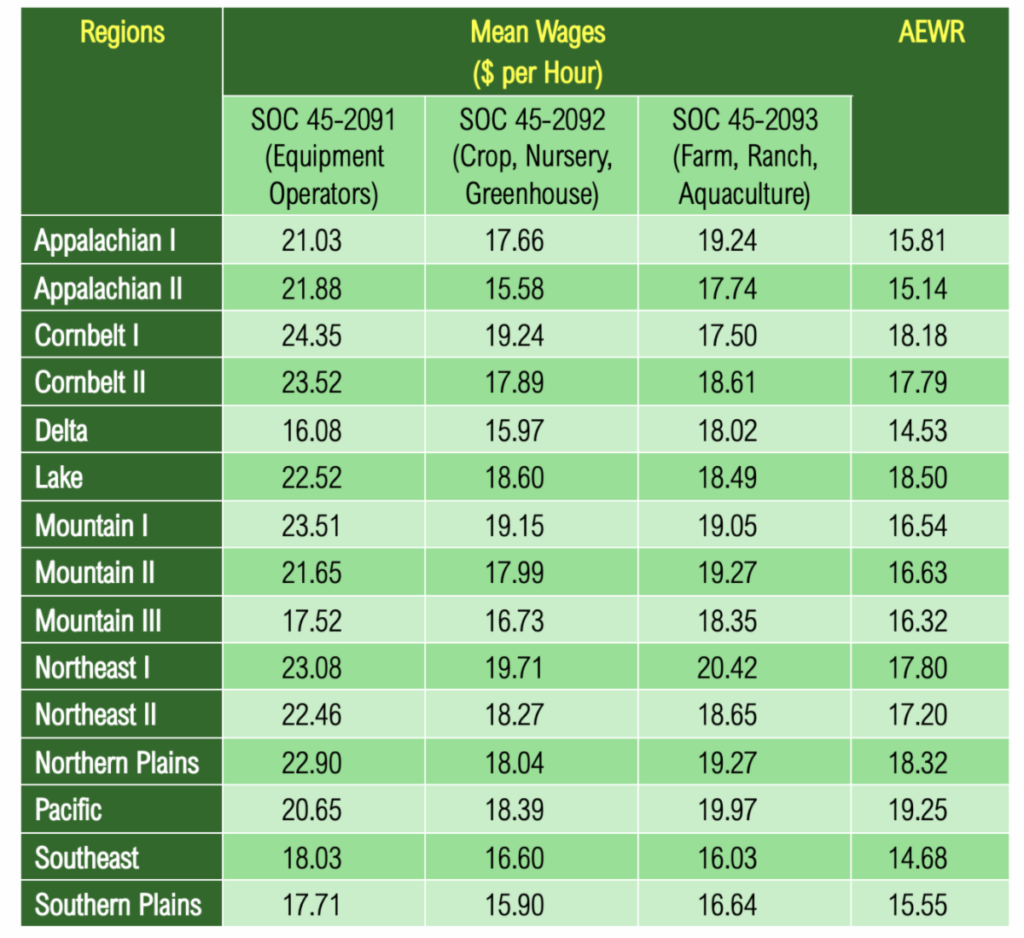
While the new two-tier wage system is based on skill level, it is still calculated by averaging wages across several different farm job types. This means wages for crop workers, livestock workers, and equipment operators are combined into one state average, even though those jobs typically pay different rates. In practice, crop and nursery workers, who make up most H-2A employees, are usually paid less than livestock workers and equipment operators. Because their wages are averaged together, the AEWR can end up higher than typical crop worker pay. Some argue that setting a separate AEWR specifically for crop and nursery workers would better reflect actual farm labor markets.
All told, the recent changes in the AEWR setting policy are crucial, but merely intermediate steps in aligning AEWRs to wage market equilibrium conditions. Meanwhile, the DOL must continue to evaluate the need for further reforms that scrutinize and consider possible business and economic repercussions of unresolved “wage aggregation” areas in the AEWR determination scheme.
Table 1. Mean Wages for Selected Standard Occupation Classification (SOC) Codes and Adverse Effect Wage Rates (AEWRs), By Farm Labor Region, Fiscal Year 2024,