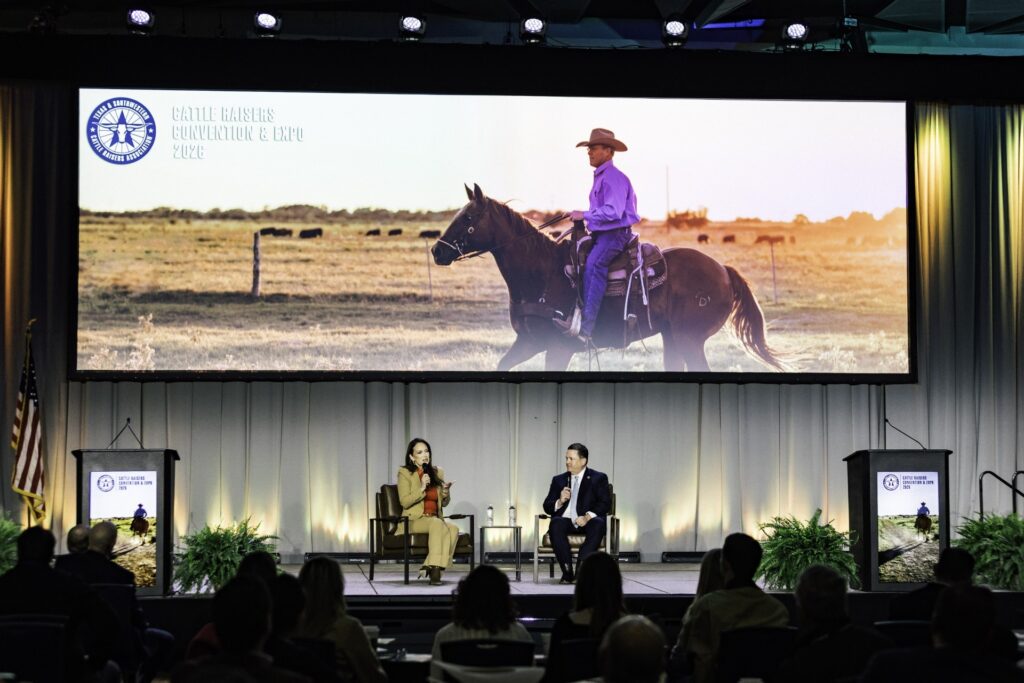
US Secretary of Agriculture Brooke Rollins spoke to the Texas and Southwestern Cattle Raisers Association (TSCRA) during their annual convention on Saturday, March 28, 2026. Secretary Rollins says the ranchers gathered in Ft. Worth and she called them ‘Her people.” She admitted that “clearly the farm economy is still struggling- it’s going to take a little bit to get back to profitability” but is optimistic that better times are ahead.
Following her address, Secretary Rollins engaged in a media scrum to discuss pressing issues for the agricultural industry and spent time updating the media on the New World Screwworm. Rollins highlighted ongoing USDA work to prevent the spread of the New World screwworm, maintaining a firm stance on keeping the U.S.–Mexico border closed to livestock imports until the threat is mitigated. She did, for the first time, offer details on how she might see the Mexican cattle coming back to the US on a gradual basis. She also addressed the challenging times for farmers and ranchers dealing with input costs and the rapid expansion of AI data centers in rural areas. (Details on the her remarks on New World Screwworm will be featured in our Monday Beef Buzz)
Addressing High Input Costs
Secretary Rollins emphasized that reducing input costs, which surged under the previous administration, remains a top priority for the current administration. She noted significant progress in several areas before recent geopolitical events impacted the market:
- Labor Costs: Have seen a significant decrease of 47%.
- Interest Rates: The President is actively focused on continuing to bring these rates down.
- Fuel: Costs had dropped substantially until the recent conflict in Iran.
- Fertilizer: Prices have spiked by 30-40% recently due to disruptions in the Strait of Hormuz
While many American producers are shielded from direct supply shortages—as the U.S. does not source much fertilizer through that specific channel—the global price spike is the primary concern. Rollins shared that approximately 80% of farmers pre-ordered their fertilizer last fall, but the remaining 20% are now facing these sharply increased prices.
To mitigate these costs, the administration has taken several steps:
- Waived the Jones Act.
- Opened a fertilizer line from Venezuela.
- Maintained direct communication with American fertilizer companies to request price stability.
“The temporary nature of this is truly temporary, and those numbers will come down,” Rollins assured.
Balancing AI Data Centers and Rural Preservation
The Secretary also addressed the growing concern regarding AI data centers expanding into rural Texas. She acknowledged the tension between national security—staying ahead of adversaries like China in AI development—and the preservation of rural communities.
Rollins, whose mother is a Texas state legislator representing areas like Glen Rose and Cleburne, noted that this is a personal and local issue for her. Key points of the administration’s stance include:
- National Security: Ensuring America leads in AI technology is vital.
- Rural Protection: The Secretary emphasized that “preserving the way of life, which includes preserving rural America,” is essential to the country’s future.
- Land Ownership: She reiterated concerns over Chinese entities owning 300,000 acres of American farmland.
Rollins concluded that while AI development and rural preservation are not “mutually exclusive,” the government must move strategically to ensure the best parts of the country are protected.