Oklahoma State University engineering students made their mark on the future of agriculture in their senior year by contributing to research on a technology that could change the way farmers plant seeds.
“Usually, when you plant, you’ll plow the land beforehand, and the purpose of a no-till drill is so that you don’t have to plow,” said Harrison Reed Frazier, a biosystems and agricultural engineering senior set to graduate this week. “Right now, in Oklahoma, it’s a big deal to not plow before you plant because the dust here can cause your seeds to shift.”
Frazier was part of a research team called DJR Implements for his senior design project. Every OSU engineering student is required to participate in an engineering design project, most of which work with external industry clients to help solve a problem.
Logan Miller, owner of LL Implements, an agricultural equipment manufacturer based out of Oklahoma City, is building a no-till drill that attaches to a tractor and opens a furrow in the soil to plant seeds without disturbing the soil.
“On this technology, you have a part that opens the soil. You plant the seed, and then you close the soil right back up instead of opening every hole before you plant the seed,” Frazier said.
What Miller was missing was the technology to manage the distance at which the seeds are planted.
“Essentially, it’s the same concept as metering electricity or water – you’re controlling the flow of it,” Frazier said. “When you meter seeds, you’re controlling the distance between the seeds in the furrow. So, for corn, you’re going to have a larger distance in the row between the seeds than you would for wheat.”
Miller needed a seed metering system designed for his drill, which is where the DJR Implements team stepped in.
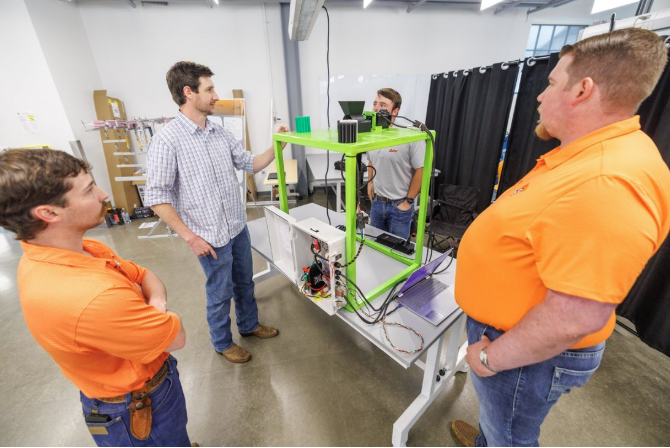
With a limited project budget, the team began by reviewing patents for other types of no-till machinery, as well as Miller’s patent. While the team did not have the time or budget to develop the technology for Miller in one school year, they were able to complete the project by presenting their client with all the information they learned from their research, as well as offer a proposal for potential technology solutions.
“Both systems we designed need more adjustments and refinement,” said DJR Implements team member Doug Harshbarger. “Although we did not get the designs running smoothly, I believe if testing and prototyping continue, it won’t be long before successful tests are acquired. Throughout the project, we encountered several setbacks, but we learned how to face and adjust to different circumstances that may arise.”
Team members said they learned a lot about a different sector of the farming industry and learned skills in 3-D printing.
“It’s been a good experience,” Frazier said. “It taught me a lot about project management. Managing something like this was something I had never done before.”
Miller said he is grateful the DJR Implements team was willing to take on the task of researching and designing seed metering solutions for his no-till seeder.
“Through their research, we were able to narrow down to two possible solutions for a seed metering system that I will be able to start building into my prototype,” Miller said. “Additionally, the test apparatus the team built will be useful for future projects testing seed metering systems. DJR Implements’ work provides an extra boost to the work I am doing to bring no-till implements to small-scale farms, who currently do not have this type of equipment available to them.”
OSU Ag Research is Oklahoma’s premier research and technology development agency in agriculture, natural resources and the life sciences.