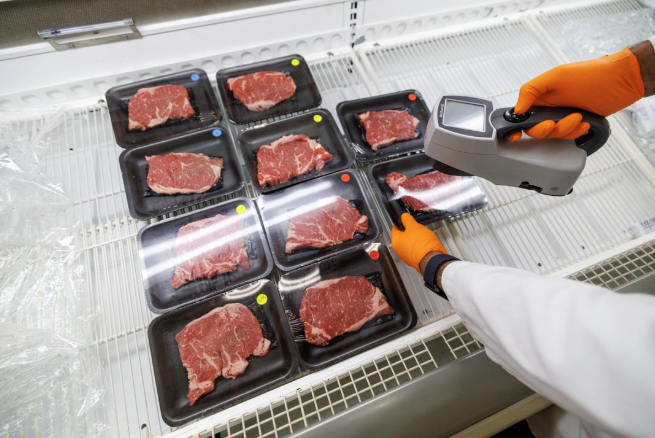
Oklahoma State University researchers are advancing industry understanding of dark-cutting beef through coordinated, interdisciplinary work across the OSU Department of Animal and Food Sciences and the Robert M. Kerr Food and Agricultural Products Center (FAPC).
Dark-cutting beef occurs when pre-harvest reduces muscle glycogen, resulting in a darker appearance and an elevated pH. Although the product remains safe and nutritious, the color difference can influence consumer perception and reduce value across the beef supply chain. Industry research, including work supported by the Oklahoma Beef Council and National Beef Quality Audit findings, has estimated the condition results in tens to hundreds of millions of dollars in annual losses for the United States beef industry.
Research funded by the National Cattlemen’s Beef Association, with support from the Oklahoma Beef Council and the University of Nebraska-Lincoln Department of Animal Science, allows OSU researchers to examine dark-cutting beef from multiple angles – from biological causes to consumer response and economic impact. The current research is evaluating the potential impact of high-pressure processing on the value of dark-cutting beef.
Within the OSU Department of Animal and Food Sciences, Ranjith Ramanathan, professor and Leo and Kathy Noltensmeyer Endowed Research Chair, continues to lead research on the biochemical mechanisms that contribute to dark-cutting beef, including muscle chemistry and stress-related factors that influence color.
“Meat color is one of the first things consumers notice, and it’s directly tied to complex biological processes in the muscle,” Ramanathan said. “Our research focuses on understanding those mechanisms, so the industry has a stronger scientific foundation to address quality challenges like dark-cutting beef.”
Complementing this work, Morgan Pfeiffer, assistant professor of meat science, and her graduate research team are conducting consumer-perception studies using the Tobii eye-tracking system to measure how shoppers visually engage with beef products and respond to color differences. The research includes work conducted in a simulated retail setting at FAPC, allowing researchers to observe how consumers interact with products in a real-world purchasing environment.
“Consumer perception plays a key role in how beef products are valued,” Pfeiffer said. “Using tools like eye-tracking, we can better understand how shoppers notice and interpret color differences, which helps connect product characteristics to real-world purchasing behavior.”
At FAPC, Rodney Holcomb, agricultural economist, is evaluating how quality-related challenges, such as dark-cutting beef, affect product value and how potential processing approaches, including high-pressure processing, may influence processor decision-making.
“Economic modeling helps bring clarity to complex decisions,” Holcomb said. “Processors need to understand how quality challenges – and potential strategies to address them – can impact their bottom line. Our role (at FAPC) is to provide applied analysis so industry partners can make informed, practical decisions.”
Holcomb said processors often face limited options when managing dark-cutting beef, with the product frequently sold at a discount, diverted to foodservice channels or used in further-processed foods, particularly when higher-value cuts, such as rib and loin, are affected. He also noted that evaluating potential solutions, including technologies like high-pressure processing, requires careful consideration of factors, such as processing capacity, cost and market acceptance.
Together, these research efforts are helping answer critical questions for the beef industry – why dark-cutting beef occurs, how consumers respond to color differences, including those influenced by processing methods, such as high-pressure processing, and what it ultimately means for product value. At the same time, they are identifying new questions around how quality challenges can be better managed across the supply chain.
As FAPC continues to expand its processing capabilities, including the planned addition of high-pressure processing technology, future opportunities may exist to further support applied research and industry needs in this area.
By combining economic analysis, biochemical research and consumer-behavior insights, OSU Agriculture is building a more complete understanding of dark-cutting beef that can help producers and processors make more informed decisions, and ultimately, improve economic outcomes.
The Robert M. Kerr Food and Agricultural Products Center at Oklahoma State University supports the growth of value-added food and agricultural businesses through technical assistance, research and educational programs that drive economic impact across the state.