

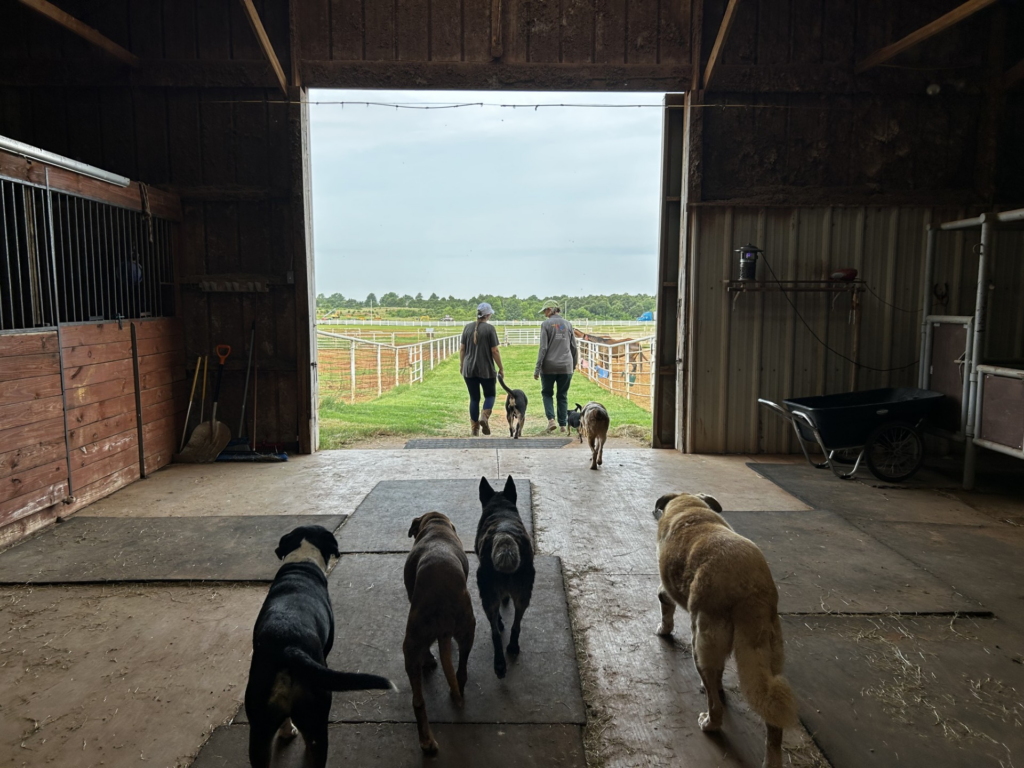
Horse and Hound Rescue has spent the last decade giving retired Thoroughbred racehorses a new purpose while also providing a safe haven for dozens of dogs in need. What began as a solution to a growing need within the racing industry has grown into a thriving rescue operation that has successfully placed hundreds of horses into new homes. Owner and operator Nelda Kettles said in an interview with associate farm reporter Carli Davenport that the rescue was founded in 2016 after she and her husband recognized a gap in aftercare for Thoroughbred racehorses leaving the track.
“The rescue got started in 2016. My husband and I raised and ran Thoroughbreds at Remington Park and knew there was a huge problem with what to do with a horse when it didn’t want to be a racehorse anymore,” Kettles said.
Rather than allowing those horses to fall through the cracks, Kettles created a rescue where owners and trainers could directly place retired racehorses. “What we did is we created the rescue for owners or trainers to directly bring us the horses that were either too slow or had an injury that they could not compete anymore,” she said.
A Rescue Focused on Thoroughbred Aftercare
Today, Horse and Hound Rescue is home to 42 horses and 55 dogs, making for a demanding daily schedule.
Kettles explained that unlike many equine rescues, Horse and Hound only accepts horses directly from the racing industry. “Just the race track,” she said. “We will only take a horse directly from track, from the owner or the trainer.”
Volunteer Allison Anderson described daily life at the rescue as unpredictable, requiring flexibility from everyone involved. “A day in the life is a little bit of anything and everything,” Allison said. “You start off with a game plan, and then you’re ready to adjust quickly and pivot.”
Some days begin by preparing stalls for incoming horses while others focus on rehabilitation or training. “We try to keep our barn empty—that’s the goal,” Allison said. “But life is not always like that. Horses are in the barn for rehab, or when they first come in to give them downtime.”
Volunteers help groom horses while trainers work to prepare the former racehorses for life beyond the track. “We have a trainer that goes out and works to get the horses to calm down and learn to stand at a mounting block, and things that they don’t really learn at the racetrack,” Allison explained. “They learn to go more than one direction at a gallop, so just getting those ground manners to help them become good citizens after they leave here and get adopted.”
The rescue’s canine residents also require constant attention. “We could have dog food deliveries, and then it’s all hands on deck to unload the pallet of dog food,” Allison said. “It’s a little bit of everything, but you’re never alone here. You either have a dog by your side or a horse at your shoulder.”
Accreditation Helps Ensure Quality Care
Kettles said one of the organizations that plays an important role in supporting the rescue is the Thoroughbred Aftercare Accreditation (TAA) program. “TAA is Thoroughbred Aftercare Accreditation,” Kettles said. “They are a group out of Kentucky that comes out and inspects the rescues, makes sure the horses are being taken care of, that the aftercare is doing what it is supposed to.”
As a nonprofit rescue, Horse and Hound relies heavily on grants and donations to continue its mission. “As any rescue, we operate on grants and donations, and they are a huge help to us in that mode, in that they do support us, and simply make sure we’re doing what we are expected to do,” she said.
A Favorite Adoption Story
Over the past 10 years, Horse and Hound Rescue has found homes for 630 horses, but one adoption continues to stand out to Kettles. She recalled placing a retired Thoroughbred with a family in Stillwater whose 32-year-old son, who had autism and Down syndrome, formed an immediate connection with the horse. “We adopted a horse probably eight or nine years ago to a lovely family in Stillwater,” Kettles said. “They had a 32-year-old son that was both autistic and Down syndrome, and he was nonverbal.”
She said the transformation was immediate. “When he got excited, he would basically scream and flap his arms. We put him on a big 17-hand Thoroughbred, he relaxed, he just simply sat there, and it was fantastic.”
The family ultimately adopted the horse. “His mother just led him around. They adopted the horse, and that’s my favorite story,” Kettles said. “We have adopted 630 horses in the 10 years we’ve been here, and that’s my favorite.”
How to Support the Rescue
For those interested in adopting, volunteering or supporting the rescue, Kettles encourages following Horse and Hound Rescue on social media, where the organization regularly shares updates on available horses and dogs. “We’re very active on our Facebook page. For the dogs, we do Mutt Monday, so every Monday we feature a different doggy, and then we post videos of the horses being ridden, of grooming, of kind of a little bit of anything and everything.”
She added that horse adoption profiles are available online, and the rescue is always looking for additional volunteers and adoptive families. “We love volunteers,” Kettles said. “If you want to adopt, we always are looking for adopters as well.”







