
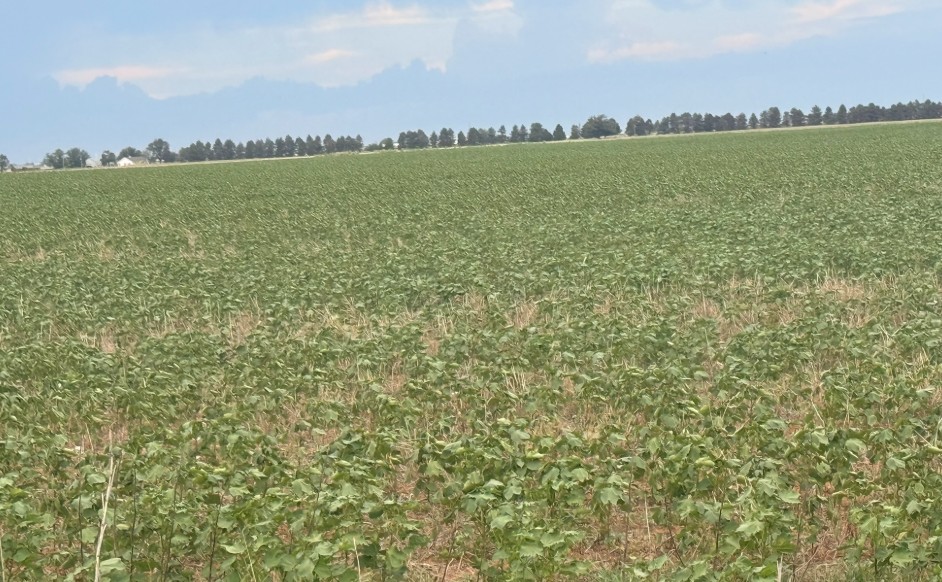
Cotton across the Texas High Plains is entering one of the most critical periods of the growing season as triple-digit temperatures and limited rainfall threaten both dryland and irrigated acres.
While scattered showers over the past several weeks have produced pockets of excellent cotton, agronomists say the crop remains highly variable across the region, with this week’s forecast expected to determine which fields continue to advance and which begin to decline.
Texas A&M AgriLife Extension Cotton Specialist Ken Legé described this year’s crop as a tale of extremes.
“Optimism is going to be somewhat subdued,” he said while reviewing crop conditions from research locations across the region at the Plains Cotton Advisory Group Meeting July 24.
Research plots from Martin, Gaines, Terry, Dawson, Hockley, Lamb, Hale and Moore Counties showed encouraging stands where timely rainfall or irrigation has supported crop development. Several locations have accumulated between 3.5 and 5.5 inches of rainfall since planting, allowing cotton to reach early bloom and maintain good growth despite challenging circumstances.
However, those favorable conditions are far from universal.
Spotty Rainfall Creating Winners and Losers
Perhaps the defining characteristic of the 2026 crop is the uneven distribution of rainfall.
Plains Cotton Growers Director of Field Services Mark Brown said reports from across the region continue to show dramatic differences over very short distances.
“I’m just amazed at how spotty these rains have been,” Brown said. “Somebody will get two inches, and then you can go a couple of miles down the road, and they might receive two-tenths of an inch.”
That variability has resulted in neighboring fields progressing at vastly different rates.
During a recent crop tour through Briscoe, Motley, Hall and Swisher Counties, Brown observed irrigated cotton ranging from approximately five to nine nodes above white flower across roughly 25 fields — an indication that much of the irrigated crop is entering early bloom in generally favorable condition.
Heat Becomes the Next Major Challenge
While rainfall has determined crop potential so far, agronomists believe heat will now become the dominant factor.
Forecasts call for daytime highs exceeding 100 degrees across much of the region, accompanied by nighttime temperatures in the upper 70s and low 80s.
Those warm overnight temperatures limit the crop’s ability to recover from daytime stress.
“We are experiencing heat stress to some degree,” Legé said. “Even with good water, you’re going to see some fruit abortion. You’re going to see some malformation. It’s going to challenge the crop.”
High temperatures also dramatically increase crop water use, with estimated evapotranspiration rates approaching four-tenths of an inch per day.
“Even if we do get a shower, it’s simply going to be air conditioning and very temporary,” he added.
Dryland Cotton Faces Greatest Risk
Legé expressed the greatest concern for dryland acres.
With little deep soil moisture remaining in many fields, the coming stretch of extreme heat could rapidly reduce yield potential.
“Dryland is going to go down hard this week,” Legé said. “Usually I’m very optimistic, but realistically, much of the area’s dryland is going to go down quickly because we know there’s not much soil moisture in the deep profile.”
Producers echoed those concerns, noting that some cotton has shown little growth for several weeks while waiting for rainfall.
Even so, growers cautioned against writing off the crop too early.
“Cotton is such a resilient plant that it can many times surprise you,” one producer noted, while acknowledging that prolonged heat without rainfall becomes increasingly difficult for the crop to overcome.
Irrigated Crop Generally Holding Together
Although irrigation cannot eliminate heat stress, producers reported that most irrigated cotton remains in comparatively good shape.
Several growers indicated they have maintained original stands throughout the season and are optimistic that continued irrigation can preserve yield potential, provided wells continue operating and no additional weather extremes develop.
Research plots under center pivots and drip irrigation generally showed cotton in early bloom with healthy fruiting, though specialists cautioned that the next seven to 10 days will provide an important test of how well even irrigated fields withstand sustained heat.
Outlook Depends on August Weather
While this week’s heat is expected to separate the strongest fields from the weakest, the season is far from over. Late-planted fields and stressed cotton still have opportunities to recover if August brings meaningful rainfall and more moderate temperatures.
For now, however, the Texas High Plains cotton crop remains a study in contrasts — excellent fields located just miles from struggling acreage, with rainfall continuing to determine the difference. As Brown summarized after touring fields across the region, “The crop is going to track based on the moisture that it’s receiving.”