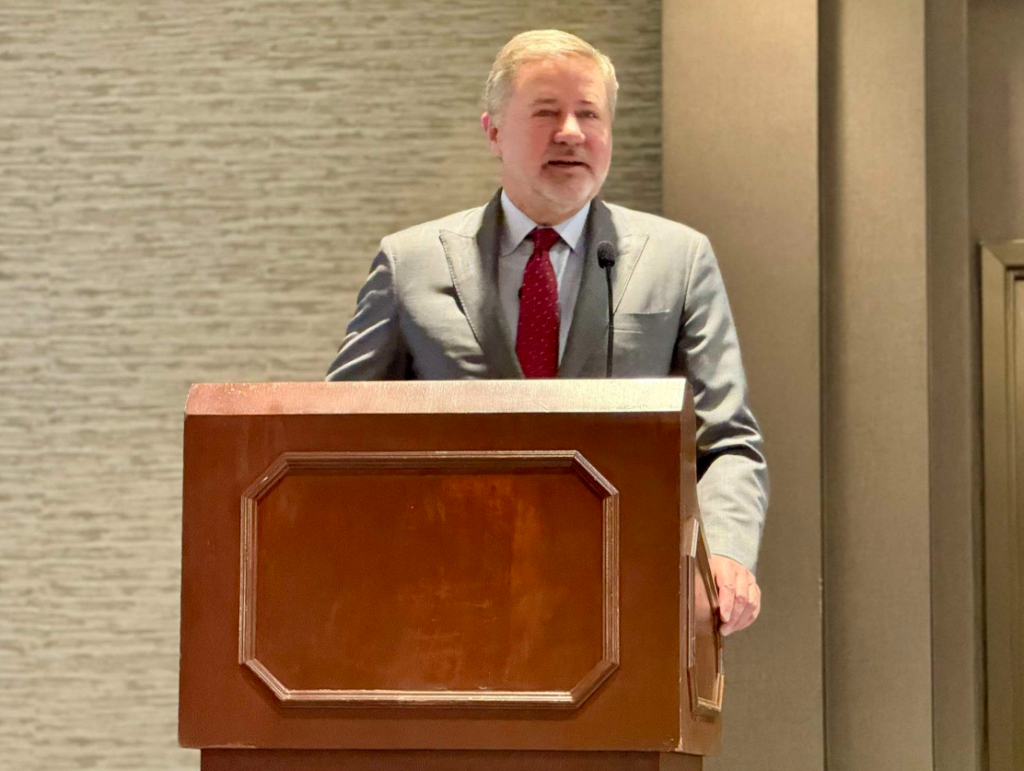
Attorney General Gentner Drummond has filed a motion for preliminary injunction to block construction of the proposed heavy-industrial aluminum smelting complex in Inola. The motion, filed Tuesday in U.S. District Court for the Northern District of Oklahoma, comes ahead of the Aug. 28 expiration of the Town of Inola’s moratorium on new construction at the site.
Drummond said he is taking legal action to protect Oklahomans and their natural resources.
“The people of Rogers County stand to lose their health, their herds and their livelihoods,” Drummond said. “The public interest lies in enforcing Oklahoma’s nuisance and environmental laws, protecting the health of Inola families and preserving the livestock economy and natural resources of the region.”
Drummond said construction should remain on hold while his lawsuit to block the project is decided in court. Drummond initially filed a petition in June to stop the smelter’s development. Behind the massive project are two corporate ventures, one of which is owned by the government of an Islamic foreign monarchy.
Emirates Global Aluminium (EGA), which is a state-owned enterprise of the United Arab Emirates, holds a 60 percent controlling interest in the project, meaning the controlling hand behind the project belongs not to Oklahomans, nor even to Americans, but to a foreign sovereign more than 7,000 miles away. Century Aluminum holds the minority 40 percent interest. The Delaware corporation is headquartered in Chicago.
In March, Century filed an Iran Threat Disclosure with the United States Securities and Exchange Commission (SEC), revealing that its largest stockholder, Glencore, has agricultural sales contracts with the Islamic Republic of Iran. EGA is owned by Mubadala Investment Company of Abu Dhabi and Investment Corporation of Dubai. Mubadala is a sovereign wealth fund in the United Arab Emirates that manages investments for its shareholder, the Government of Abu Dhabi, and has substantial partnerships with China.
“At a minimum, Oklahomans are entitled to fully vet the project, including the environmental impacts as well as ownership and governance ties,” Drummond wrote in the filing. “As the United States stood at the precipice of armed conflict with the Islamic Republic of Iran, Century was disclosing to the SEC, as it was federally required to do, that its largest shareholder – also its largest customer – had active contracts to sell agricultural products to entities owned by the Government of Iran. Yet, the defendants never disclosed this information to Oklahomans, even as they asked Oklahoma’s agricultural heartland to absorb the risks of their project.”
The proposed facility – Oklahoma Primary Aluminum – would be the largest primary aluminum production plant ever constructed in the U.S. with a planned capacity exceeding 750,000 metric tons of aluminum per year. Primary aluminum smelting generates hazardous waste streams, consumes significant amounts of electricity and water and is one of the most polluting heavy-industrial activities that exists. The process also causes fluoride to settle on hay and wreaks havoc on cattle, threatening Oklahoma’s single largest agricultural sector. The smelter would occupy about 633 acres along the Verdigris River, within about three miles of Inola’s schools, homes and farms in the Hay Capital of the World.
Along with the motion for preliminary injunction, Drummond filed a declaration from Dr. Ranajit (Ron) Sahu, an engineer and environmental expert. According to Sahu, not only would the smelter be the largest by production, it would also emit vast quantities of a wide range of pollutants.
Emissions of air pollutants projected in the smelter application include 87,182 tons per year of carbon monoxide, 316 tons per year of nitrogen oxide, 731 tons per year of particulate matter, 217 tons per year of volatile organic compounds, 187 tons per year of highly toxic air pollutants, including many carcinogens, and 425 tons per year of total fluoride compounds. Sahu said he believes the emissions would likely be higher. The Oklahoma Department of Environmental Quality has already suspended its review of the project’s air-permit application, finding, among other things, that the applicant’s own emission calculations exceed the very fluoride limits it proposes.
“The proposed plant would not only be the highest fluoride emitter among the seven primary aluminum plants reflected in the most recent National Emissions Inventory data for the U.S., it would also rank as the highest-emitting plant considering all industrial plants across all industries in the U.S.,” Sahu said.
The facility is projected to draw more power than many Oklahoma cities consume, placing extraordinary strain on the regional grid served by Public Service Company of Oklahoma and threatening the reliability and affordability of electricity for Oklahoma ratepayers.
The project is propelled by an extraordinary infusion of public money, including a federal award of up to $500 million and approximately $255 million in state performance-based rebates.
Drummond also asked the court to resolve the pending motion to remand in the case and return it to the District Court of Rogers County.
Read the motion for preliminary injunction.