

The New World Screwworm made it’s return to the southern part of the United States in early June of this year. If you had asked animal health officials as cases mounted in June, how many cases we might have across the southwest by Labor Day- most guesses would have been a hundred or more.
But that’s not what has happened. Once the first case was announced by US Secretary of Ag Brooke Rollins on June third in Zavala County- other cases were quickly found- including a calf in Tom Green County near San Angelo, Texas. That was less than 200 miles from Oklahoma and Oklahoma livestock leaders braced for a possible case this summer in the state. The pest has yet to show up north of San Angelo, Texas.
June ended with 30 cases of New World Screwworm confirmed- 29 in Texas and one in New Mexico. But things quickly slowed with only 14 cases found in Texas in July and as August ends- only three cases have been reported in the Big Bend area of Texas right on the Rio Grande River and the Mexican border- two sheep and one goat.
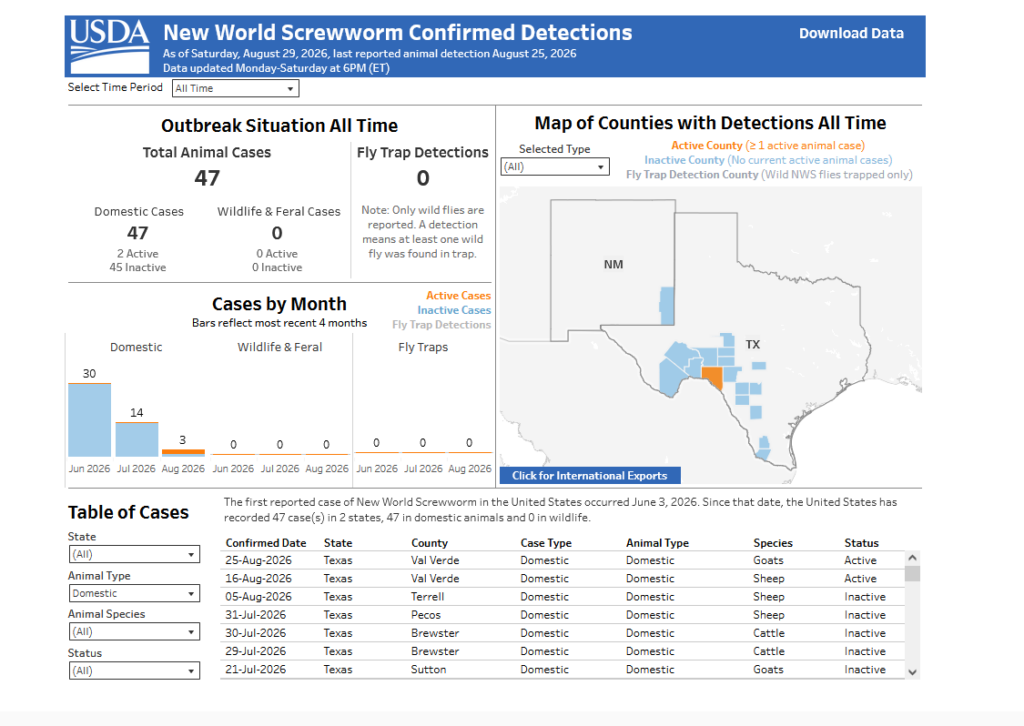
The decline and containment of New World screwworm (NWS) cases in the U.S. following the initial detections in early June are largely credited to a rapid, coordinated biosecurity deployment and joint eradication strategies led by the USDA (APHIS), state agricultural agencies, and livestock industry partners.
The response strategy relies on several key containment measures:
- Sterile Insect Technique (SIT) Releases: The primary biological weapon against NWS is the release of millions of factory-reared, sterile male flies over affected areas. Because female screwworm flies mate only once in their lifetime, mating with sterile males prevents reproduction, rapidly collapsing local fly populations.
- Strict Animal Movement & Import Controls: Border controls and strict movement restrictions were enforced along high-risk transport corridors. Restricting cattle shipments from areas with active transmission prevents infested animals from carrying fly larvae (Cochliomyia hominivorax) into uninfested regions.
- Quarantine Zones and Targeted Larvicide Treatments: Ranchers, veterinarians, and agricultural officials established local quarantine zones around positive detection sites, conducting mandatory animal inspections and treating open livestock wounds with protective topical larvicides.
Learn more about the response by USDA and other stakeholders to the New World Screwworm at www.Screwworm.Gov.