

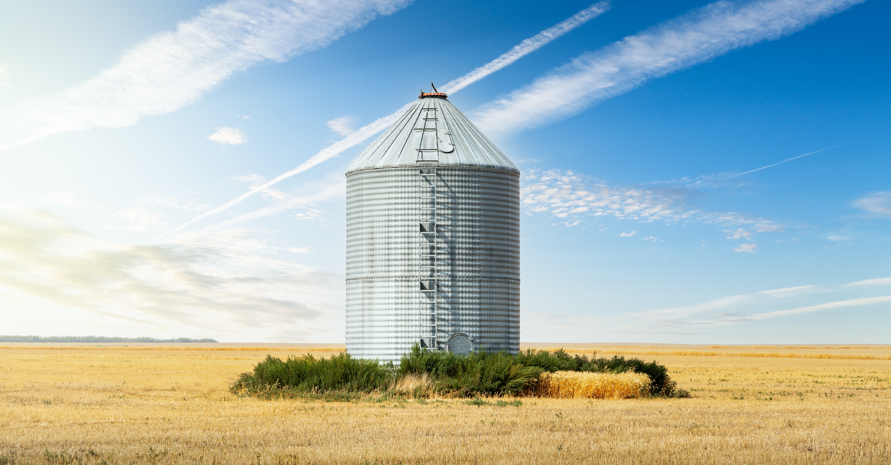
As grain bin safety becomes increasingly important with corn harvest approaching, Dr. Kevin Moore, an assistant professor in Oklahoma State University’s Department of Biosystems and Agricultural Engineering, is reminding farmers and farm families just how quickly a grain bin accident can become very dangerous. Moore spoke with Associate Farm Reporter Carli Davenport about the hazards of entering grain bins and the steps producers can take to reduce the risk of entrapment, engulfment, and other injuries.
Grain Bins Are Confined Spaces
Moore said one of the biggest concerns with grain bins is that they are confined spaces, which creates several inherent hazards. “One of the big challenges is you’re dealing with a confined space, and confined spaces can be hazardous for a number of reasons,” Moore said.
He explained that grain bins can be large enough for a person to enter, but often have restricted entry and exit points. “Getting in and out can be difficult,” Moore said.
Another major concern is the atmosphere inside the bin. “Hazardous atmospheres inside a confined space are always a concern,” Moore said. “So, do we have adequate oxygen inside that space? Are there any other gases that might be, you know, influencing a person that enters there?”
Grain itself also presents a serious hazard, particularly when it is moving. “There’s a risk of entrapment or engulfment, where someone can become trapped or buried within the grain itself,” Moore said.
He also warned about mechanical hazards, including augers and other equipment used to move grain. “There’s an auger that’s operating in the bin and someone getting a physical injury and getting stuck in an auger,” Moore said.
Flowing Grain Can Trap Someone in Seconds
The speed at which grain can move is one of the reasons Moore said producers need to take these hazards seriously. “When you have flowing grain, someone can become pulled into the grain in less than 15 or 20 seconds,” he said.
Moore said equipment used to handle grain has become faster over time, meaning some practices that may have seemed acceptable decades ago can now be much more dangerous. “Habits that someone might have in place from 30 years ago, activities that they might have found to be acceptable to them whenever they were working previously have become more dangerous just because we’re dealing with a lot more volume and a lot more speed,” Moore said.
His first recommendation is simple: avoid entering the bin whenever possible. “Anytime you’re looking at entering into a grain bin, you have a dangerous situation,” Moore said. “We want to avoid entering a grain bin if we can.”
De-Energize Equipment Before Entering
If entering a grain bin is necessary, Moore said all equipment that could create a mechanical hazard needs to be shut down and de-energized. “We want to make sure that we are de-energizing any of the equipment that would be used to move grain,” he said.
That includes augers, sweeps and other equipment. “We don’t want to be inside a grain bin when grain is being emptied from the bin,” Moore said. “We don’t want to have any of our augers or sweeps or things like that that are operating while someone’s inside the bin.”
Moore said producers should also inspect the grain and identify hazards before entering.
Often, the reason someone enters a bin in the first place is because the grain has gone out of condition and cannot be removed through normal processes. “We might be having to break up a large clump of moldy grain or something like that,” he said.
That situation can create additional risks. “You don’t want to enter into a bin with a large wall or pillar of moldy grain that could collapse and could cause someone to be engulfed quickly,” Moore said.
Never Enter a Grain Bin Alone
One of Moore’s strongest warnings is to never enter a grain bin alone. “You also don’t want to do it alone,” he said.
Moore said many situations become much more difficult because nobody realizes someone is missing until significant time has passed. “Most of the times, whenever we see people running into problems and having a long delay before they can be rescued, it’s because they’ve been working alone,” Moore said.
He explained that it could take hours for someone to realize that a person working inside a bin is missing. If someone must enter, Moore recommends having someone outside the bin who can remain in communication with them and call for assistance if something goes wrong.
Don’t Rush In to Rescue Someone
If someone becomes trapped in a grain bin, Moore said the instinct to immediately climb inside and help can actually make the situation worse. “You don’t want to just go in after someone whenever there’s been an entrapment,” Moore said.
He called that reaction potentially “the most dangerous and the worst decision that someone could make because we don’t want to introduce another victim.”
Moore said there have been cases where a family member or friend attempted to rescue someone who had become engulfed, only to become trapped themselves. “We end up with multiple casualties instead of one,” he said.
Instead, Moore said the first step should be calling for professional help. “Definitely call for help, make the call for some assistance from an emergency response group,” he said.
He noted that many rural fire departments have received training in responding to grain entrapments, with some departments also obtaining specialized rescue equipment. “That call to 911 is going to be a really important thing to be doing before you’re trying any other activities,” Moore said.
Protecting the Airway Can Be Critical
Moore also discussed research he conducted examining pressure on the torso during grain entrapment.
The study, titled “Grain Entrapment: Pressure on the Torso: Can You Breathe While Buried in Grain?”, used a rescue mannequin equipped with sensors.
“We were essentially looking at taking a rescue mannequin,” Moore said. “Outfitting it with some sensors on its chest and torso, and then putting it in different depths of grain within a bin to try to measure how much force we could record on the chest of the mannequin.”
The study examined several types of grain, including corn, wheat, soybeans and canola. Moore emphasized that the mannequin study could not replicate every circumstance involving a real person, but the researchers were examining whether the pressure from grain could affect respiration.
He said breathing difficulties during an entrapment can be caused by multiple factors. “Part of that’s just the fear response that’s happening when you’re buried,” Moore said. “There are, of course, the pressure of the grain that’s on you.”
He also said protecting the airway is particularly important for someone who becomes fully engulfed. “One of the things that we’ve seen anecdotally as well is some entrapment victims that were able to protect their airway had a higher likelihood of being rescued,” Moore said.
Moore said fully engulfed victims can aspirate grain into their airway and lungs. “Basically they’ve drowned in the grain,” he said. For that reason, Moore said respiratory protection can be an important consideration for anyone who has to enter a grain bin.
Good Grain Management Can Reduce Risk
Moore said grain bin safety begins before anyone ever enters the bin. “If you maintain the quality of your stored grain, you’re much less likely to have problems,” he said.
He explained that problems often arise when grain goes out of condition during storage. “Normally, whenever someone’s entering into a grain bin, it’s because their grain’s gone out of condition,” Moore said.
Maintaining proper moisture levels, managing stored grain and using ventilation can all help reduce the likelihood of problems. “Good quality grain is going to be much less problematic,” Moore said.
He said producers can encounter problems when, for example, wet corn is placed into a bin without adequate drying. “So maintain good quality grain. That’s sort of stage one,” Moore said.
If a problem does develop, Moore recommends looking for ways to address it from outside the bin. Ask yourself, “How do I limit my requirements for going into the bin?” he said. “If I can stay out of the bin, I’m going to be safe.”
Have a Plan Before Entering
If entering a grain bin is unavoidable, Moore said producers should have a plan in place before they go inside.
That includes de-energizing equipment, considering airflow and monitoring conditions inside the bin. “Turning the fans on, aeration fans, if you have them, just to help with airflow in the bin,” Moore said. “That’s going to make it more comfortable anyway.”
Producers should also have someone outside who can monitor the person inside and call for emergency assistance if necessary. “Never entering a bin alone,” Moore emphasized. “Always making sure that you’ve got someone that’s staying outside of the bin, someone that can call for help, someone that can, you know, maybe be monitoring your condition while you’re inside.”
Moore said producers should also check the air inside the bin when possible, although he acknowledged that specialized monitoring equipment may not be available to everyone.
Ultimately, his message heading into harvest is to take every precaution possible. “Definitely making sure that you know you’re very cautious if you’re going to go into a bin, and that you have a plan in place for how you’re going to do that safely,” Moore said.