

Grain and oilseed futures displayed weakness heading into the holiday weekend as markets moved lower to close out the week of trading. While the underlying fundamental drivers changed little, technical pressure from recent rallies and broader macroeconomic developments pushed prices down. Traders now look toward this Friday’s USDA Crop Production and WASDE reports, which carry the potential to inject fresh volatility into the market.
Wheat Market Outlook
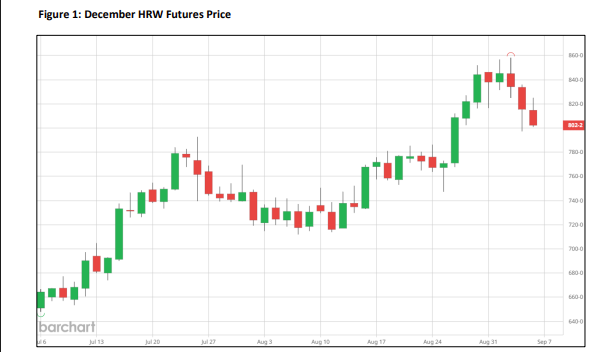
December Hard Red Winter (HRW) wheat futures fell for three consecutive sessions after touching a contract high, settling on Friday at $8.02 per bushel. Local cash delivery basis across Oklahoma ranges between -55 and -70 cents. Ongoing conflict in the Black Sea, developments in Iran, and summer crop production continue to serve as the main near-term price drivers, while global export competition dictates the longer-term trend.
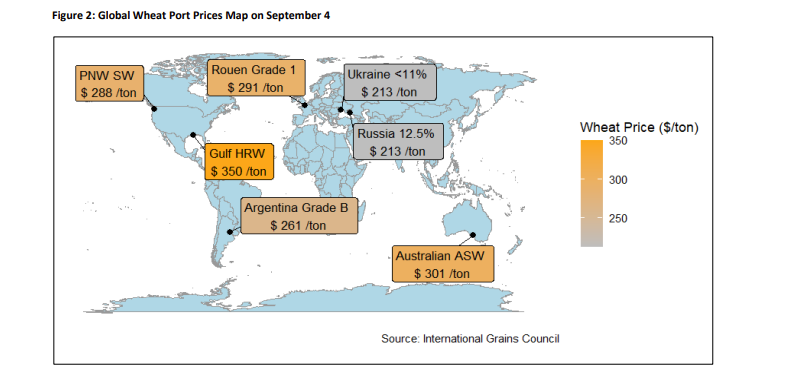
U.S. Gulf HRW prices remain elevated compared to global competitors. In the Black Sea, Russian shipments have shifted toward Baltic ports and alternative corridors, while Ukraine continues moving grain by truck and rail; both nations still lag normal export paces by substantial margins.
Because Gulf prices sit well above competitors, Asian buyers needing September through November deliveries have turned to the Southern Hemisphere. Australian and Argentinian prices were recently quoted at $1.34 and $2.42 per bushel below U.S. Gulf values, respectively, putting U.S. wheat at a distinct pricing and freight disadvantage into Asia and the Middle East. High global prices also prompted Saudi Arabia to cancel a recent tender, with upcoming tenders expected to signal whether buyers will accept current price levels.
Through August 27, total U.S. all-wheat export commitments stood at 315 million bushels, a 31 percent decline from last year. Outstanding sales are at 135 million bushels compared to 219 million bushels a year ago. At 41 percent of the USDA forecast, overall commitments sit eight percent behind the five-year average pace. The leading buyers for all U.S. wheat include Mexico (23 percent), the Philippines (13 percent), Japan (12 percent), and South Korea (10 percent).
For HRW specifically, marketing year commitments sit at 70 million bushels, down sharply from 190 million bushels at this point last year. Reaching USDA’s 210 million bushel projection will require new sales to average 3.6 million bushels weekly, well above the recent four-week average of 1.9 million bushels. Top HRW buyers include Mexico at 25 million bushels and Japan at 16 million bushels, followed by Taiwan (4.5 million) and Indonesia (3.6 million). While Southern Hemisphere crop prospects in Australia and Argentina look promising with limited downside, potential acreage reductions in the Black Sea for next season could offer support later in the marketing year.
Soybean Market Outlook
November soybean futures closed Friday at $13.10 per bushel, down six cents, with Oklahoma cash prices sitting between $12.19 and $12.34. The soybean complex held up better than wheat due to strong domestic crush demand, the Environmental Protection Agency’s resolution on 2025 small refinery exemptions, and weather watch in Brazil tied to possible El Niño conditions.
USDA’s July crush estimate came in at 221.9 million bushels, bringing the marketing year total through July to 2,436 million bushels. To meet the USDA forecast of 2,655 million bushels, August crush needs to hit 219 million bushels, keeping the current 2025-26 projection well on pace. Total soybean export demand also remains on track to hit expectations.
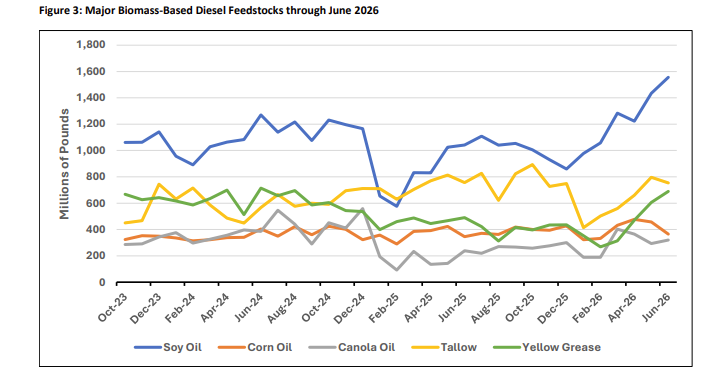
Domestic crush expansion continues to see support from the renewable fuels sector. The EPA finalized 2025 small refinery exemptions with a 100 percent reallocation announcement, maintaining supportive Renewable Volume Obligations (RVO) for 2026 and 2027 biomass-based diesel (BBD). Soybean oil usage for biofuel rose to 1,556 million pounds in June, capturing more than 39 percent of total BBD feedstock use. With current consumption outpacing the monthly rate needed to meet USDA’s 14,550 million pound projection, Friday’s WASDE report could see an upward revision in biofuel bean oil demand. Additionally, D4 RIN generation remains well behind the pace needed to meet volume mandates, lending underlying support to soy oil despite last week’s softer close.
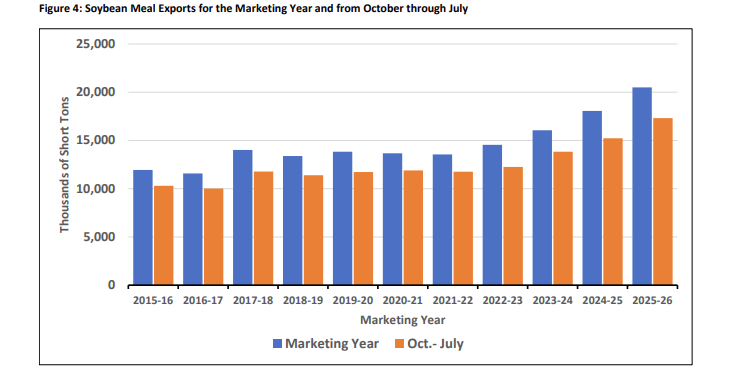
Soybean meal export demand also remains strong. Census data through July pegged meal exports at 17,317 thousand short tons, easily surpassing earlier sales expectations. Meeting the marketing year forecast will require averaging 1,591 thousand short tons per month across the final two months, well below the April-through-July monthly average of 1,718 thousand short tons.
While recent weekly sales have slowed, outstanding sales stood at 2,474 thousand short tons as of August 27. Strong foreign demand driven by expanding global livestock herds continues to favor high-protein U.S. meal. With USDA forecasting a record 22,700 thousand short tons for the 2026-27 marketing year, the combination of resilient meal demand and supportive biofuel policy points toward record crush levels over the coming year.







