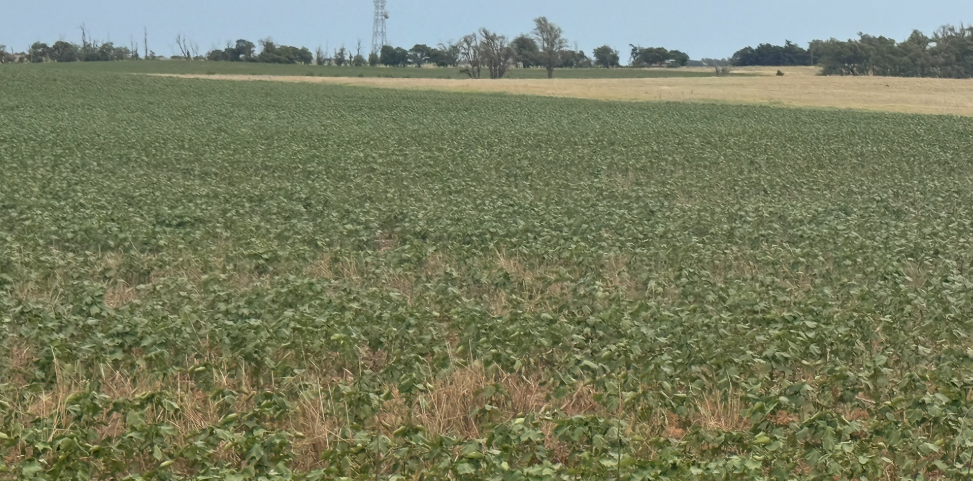
Severe heat and persistent drought have taken a heavy toll on the current Oklahoma cotton crop, leaving producers facing an uphill battle and prompting early harvest readiness across much of the state. Oklahoma State University Extension Cotton Specialist Jenny Dudak sat down with Farm Director KC Sheperd to provide an in-depth look at current crop conditions, key management steps, and upcoming research priorities for the season ahead.
Current Field Conditions and Crop Progress
The combination of prolonged drought and triple-digit temperatures has created significant challenges for cotton across the state. While dryland acreage and areas lacking irrigation water from district lakes have suffered substantially, small irrigated pockets with sufficient water—such as portions of the Carnegie, Hydro, and Fort Cobb areas—are still expected to make a crop.
Excess heat units, or growing degree days (GDUs), driven by 100-plus-degree daytime temperatures and warm overnight periods, rapidly accelerated maturity. In many fields, this accelerated progress pushed the cotton to what is technically considered harvest-ready as early as the middle of August. Dudak recommends that producers who determine their crop has failed contact their crop insurance adjusters immediately to schedule field visits and survey acreage in a timely manner.
Preparation for the Upcoming Growing Season
Looking ahead to next year’s crop, growers will need to evaluate variety selection and herbicide programs carefully. Drought and heat stress severely impacted OSU’s on-farm RACE trials, resulting in very limited variety performance data out of the university for the season. Producers are encouraged to coordinate directly with their seed representatives and review regional data to make well-informed planting decisions.
Monitoring the Cotton Jassid
Growers must also remain alert to potential pest challenges, specifically the cotton jassid, also known as the two-spotted cotton leafhopper.
- State Presence: The pest has been detected in Central Oklahoma nurseries, though it has not yet been documented in Oklahoma cotton fields.
- Impact and Symptoms: The cotton jassid is a sap-sucking leafhopper that targets cotton as well as alternative hosts like okra and hibiscus. The insect injects toxins into the foliage, causing leaf yellowing and a condition known as “hopperburn”.
- Winter Survival: Dudak noted that whether the insect can overwinter in Oklahoma will depend largely on winter temperatures and how cold the season gets.
- Management Resources: Growers are urged to scout fields early next season. OSU Extension has published guidance on the pest, and producers can also consult research and insecticide efficacy trials conducted by universities in the Mid-South and Southeast—including the University of Georgia and the University of Florida—where the pest has been managed for several years.
OSU Research Plans
Despite the difficult season, Dudak noted that studying the accelerated crop development and boll development under extreme heat stress provided valuable insights from a research perspective. For the coming year, OSU plans to expand its research portfolio with several key projects:
- On-Farm RACE Trials: Continuation of variety trials to rebuild localized yield and quality data for producers.
- Plant Timing by Population Trial: A small-plot study designed to determine the optimal planting window, identify cutoff dates for late planting, and evaluate replant population thresholds.
- Beltwide ELS Trial: Continued participation in the Extra Long Staple (ELS) trial alongside cotton specialists across the Cotton Belt, evaluating Pima varieties, hybrid varieties, and high-fiber-quality Upland cotton. The project will process samples through both saw gins and roller gins to analyze overall economic returns.