Recent highly publicized plans to allow up to an additional 300,000 metric tons (661 million pounds) of beef imports tariff-free have received much attention and have been the subject of considerable misinformation and disinformation. Reasonable and useful discussion about beef trade policy is appropriate when it is based on valid information rather than mistaken information and wild social media speculation.
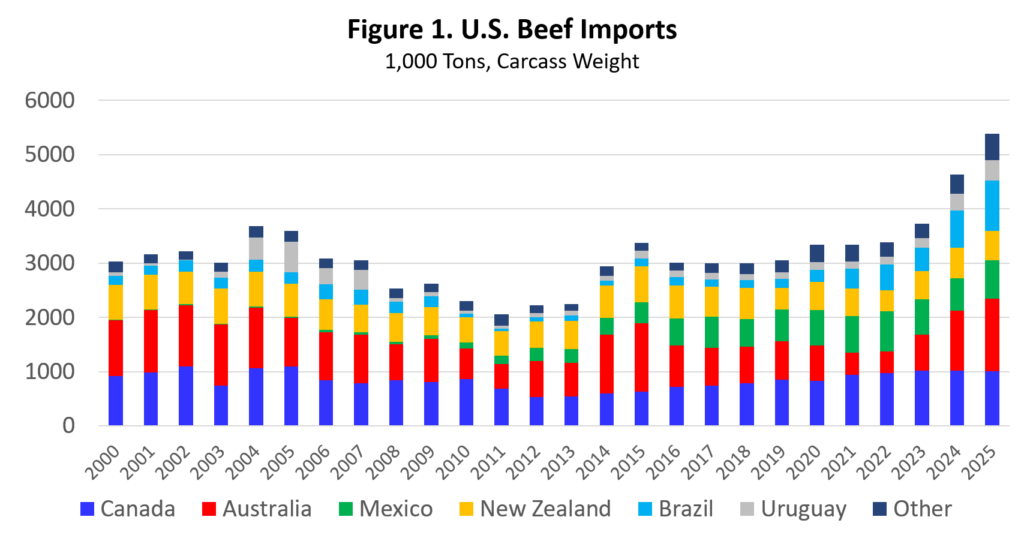
The U.S. has imported beef for many years to supplement certain products in the total U.S. beef supply (Figure 1). Through much of the period, the major sources were Australia, Canada, and New Zealand. More recently, Mexico has become a bigger source of beef imports. Beef imports have increased sharply since 2024 in response to declining total beef production. Brazil has increased rapidly and is currently the number two source of beef imports slightly behind Australia. For the first seven months of 2026, Canada, Mexico and New Zealand ranked three, four and five, in that order, followed by Uruguay, Argentina, Nicaragua, and Paraguay. Beef imports are up 12.9 percent year over year thus far in 2026.
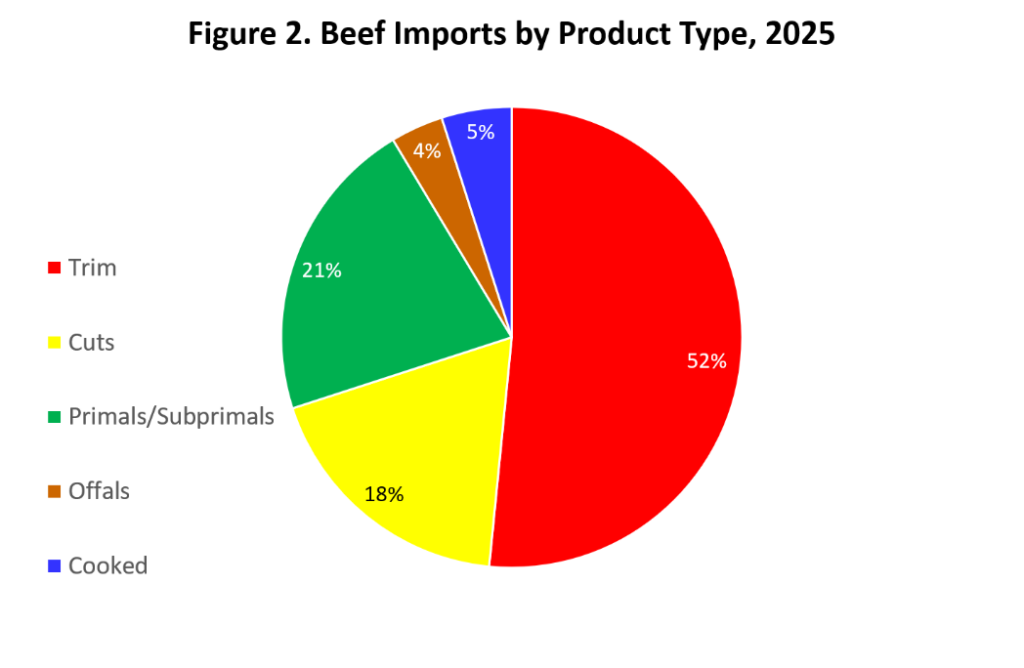
Most beef imports are used in food service with very little showing up in retail grocery stores. An estimated 68 percent of beef imports are lean trimmings and lean beef used primarily as ingredients for the U.S. ground beef industry (Figure 2). The U.S. does not directly import ground beef. Imported beef is most frequently used as an ingredient in ground beef formulations for quick service restaurants. Various fast-food restaurants may use imported beef in ground beef in very specific proportions with stringent specifications.
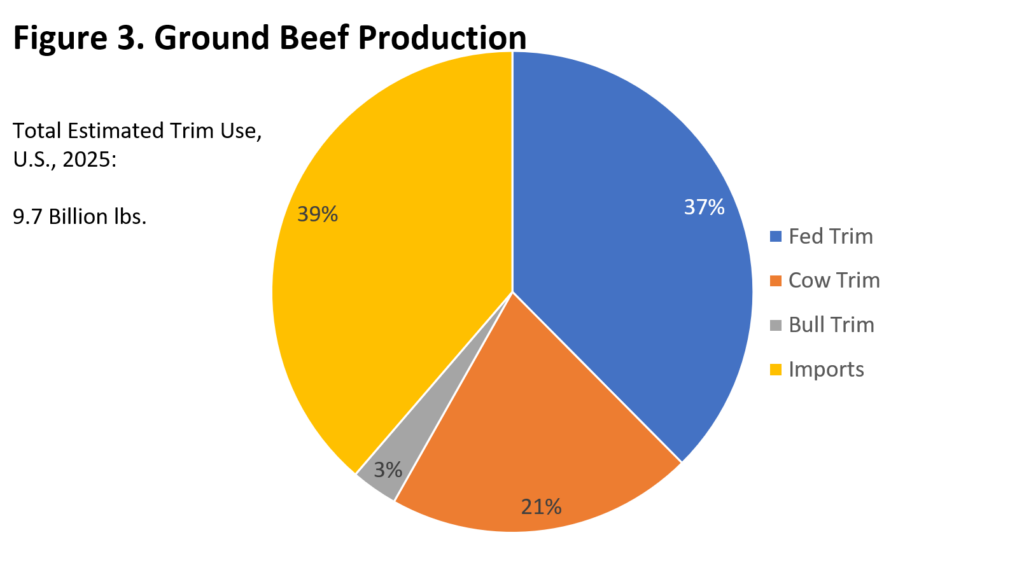
Imported beef currently makes up an estimated 39 percent of the total beef used for ground beef (Figure 3). This is a significantly higher percentage than average over the past twenty years due to the current reduction in domestic cow and bull beef supplies. See Cow-Calf Corner | April 27, 2026 | Oklahoma State University for a more detailed discussion of the ground beef industry.
Brazil will likely be the biggest beneficiary of the removal of over-quota tariffs this fall. Beef imports that would have been subject to the tariff will now enter the U.S. tariff-free. However, it is unlikely that beef imports will increase an additional 300,000 metric tons. Imported beef is used in specific markets and in specific ways that were being met even with tariffs. Reducing the tariffs may change the sources of beef imports with Australia and New Zealand likely losing market share to South America. Total beef imports will probably increase some beyond what would have happened anyway but not the full amount. Imported beef has little impact on ground beef in retail grocery stores and ground beef prices at retail are not expected to be much impacted by this policy change.
Derrell Peel, OSU Extension livestock marketing specialist, says beef demand is holding steady going into fall on SunUpTV from September 12, 2026. https://www.youtube.com/watch?v=D1nprnMk_Dk