The true value of artificial intelligence in modern production agriculture is rapidly shifting beyond static data analysis into dynamic decision support and direct, physical action in the field. During a recent Council for Agricultural Science and Technology (CAST) webinar, Alex Thomasson, Director of the Ag Autonomy Institute, and Andres Ferreyra, Chair of ISO/TC 347, outlined how AI is graduating from merely organizing spreadsheets to driving autonomous machinery and plant-level management. However, capturing the full economic promise of these emerging tools requires addressing critical digital infrastructure gaps, industry interoperability standards, workforce shortages, and data governance policies that directly impact farm-level adoption.
The Evolution Toward Physical AI
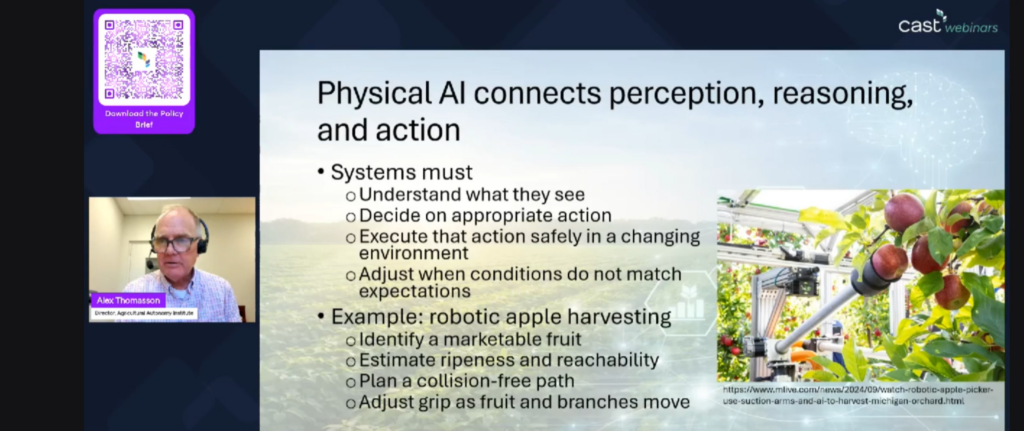
For three decades, precision agriculture centered on collecting, mapping, and displaying field variability across broad management zones. Today, AI systems interpret massive, nonlinear datasets to identify patterns, predict outcomes, and recommend field actions. Thomasson explained that the industry is now entering the era of “physical AI,” where artificial intelligence connects perception and reasoning directly to autonomous mechanical tasks.
While industrial robots function effectively in highly structured environments like automotive plants, agricultural production presents unique biological and environmental hurdles:
- Unpredictable field conditions: Varying soil moisture, shifting weather patterns, and localized pest pressures create a continuously changing work environment.
- Biological variability: Crops and livestock do not follow uniform, rigid parameters, requiring machine systems to adapt in real time.
- Complex real-time execution: Autonomous tools must detect targets, calculate trajectories, and execute mechanical actions at field speeds under variable light and ground conditions.
Creating Real-World Value Across Production Sectors
Despite these operational complexities, intelligent systems are already delivering tangible efficiency gains across multiple sectors:
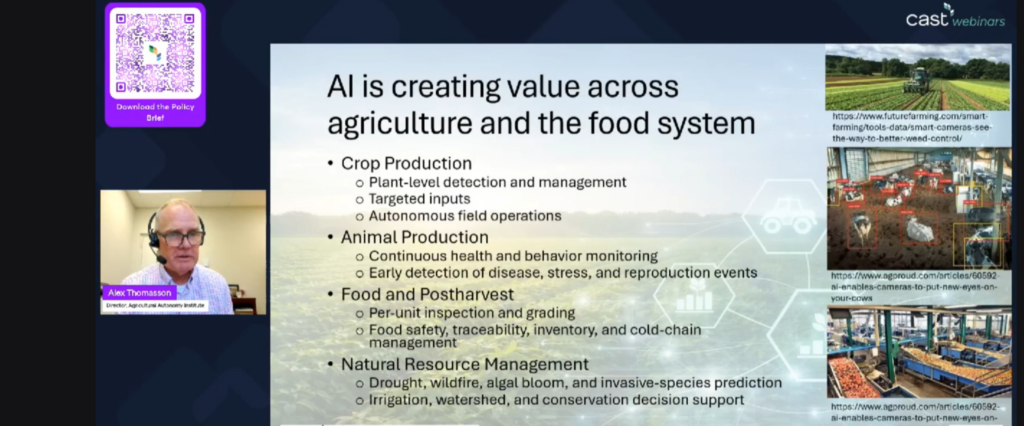
- Targeted crop management: AI-driven computer vision systems can distinguish tiny weeds from cash crops at standard equipment operating speeds. In soybean trials conducted by the University of Arkansas, targeted spot-spraying cut herbicide usage by roughly 50 percent compared to uniform broadcasting. Similar vision technologies are driving advances in laser weeding, selective fruit thinning, and robotic tree pruning.
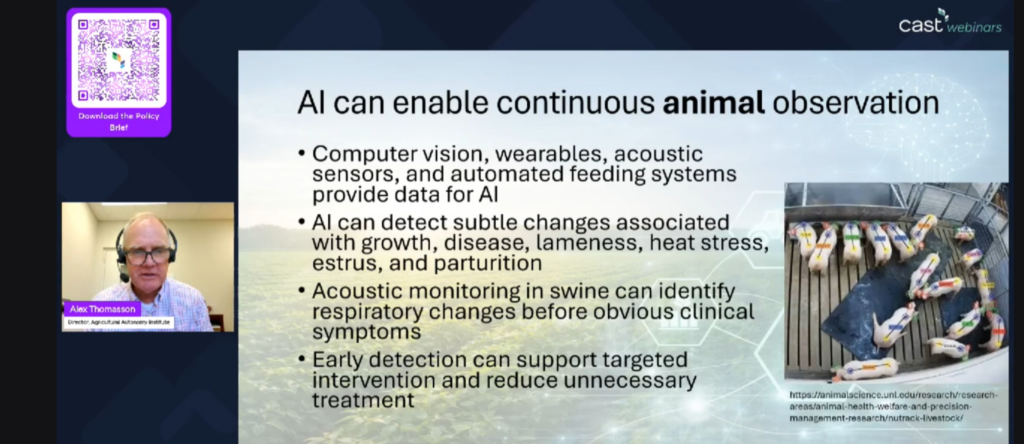
- Continuous livestock monitoring: On-animal sensors, automated feeding platforms, and continuous barn acoustic monitoring track herd wellness around the clock. Acoustic tools can flag early respiratory shifts in swine herds before visible clinical symptoms appear, allowing managers to administer targeted treatments and reduce overall medication use.
- Automated grading and processing: Optical sorting systems evaluate individual harvested units within milliseconds for color, size, and internal bruising, ensuring high-grade commodities reach premium markets while defective units are redirected.
- Natural resource forecasting: Large-scale AI platforms integrate satellite imagery, stream-gauge data, and regional weather feeds to deliver earlier warnings for drought severity, wildfire hazards, and invasive weed spread.
Infrastructure and Policy Hurdles to Widespread Adoption
Thomasson and Ferreyra stressed that software algorithms alone cannot ensure reliable farm operations. Broad implementation depends on addressing several foundational policy and infrastructure needs:
- Rural connectivity and edge computing: Cloud-based models require massive datasets, but field machines must execute split-second spraying or steering tasks offline. Hybrid systems that train extensive models in computing centers before pushing distilled software down to in-cab edge processors remain essential in areas lacking rural broadband.
- Resource demands of data infrastructure: The computational footprint supporting AI requires massive data center capacity, raising regional questions around power grid access, water use, and land planning.
- Interoperability and open standards: Closed, proprietary digital ecosystems risk locking producers into single-brand machinery fleets. Open protocols like ISO 11783 (ISOBUS) allow implements and tractors from competing manufacturers to share data seamlessly. Ferreyra emphasized that standardizing data structures also prevents AI agents from misinterpreting critical operational inputs.
- Data privacy and clear ownership: Producers need verified protections regarding who controls field-level information. Longstanding efforts like the Ag Data Transparency Evaluator and global management benchmarks (such as ISO 27001 and ISO 42001) highlight that true informed consent requires transparent, plain-language terms rather than overly complex legal agreements.
- Workforce training: As autonomous and algorithmic systems enter regular production, community colleges, Land-Grant extension networks, and equipment dealerships must prepare technicians, operators, and producers to calibrate, supervise, and service these specialized tools.
Adoption of autonomous technology will likely occur unevenly, expanding first in regions with reliable digital infrastructure and robust local technical support. Moving forward, independent field validation and transparent policy standards will prove vital to ensuring these tools protect farm profitability and operational freedom.