
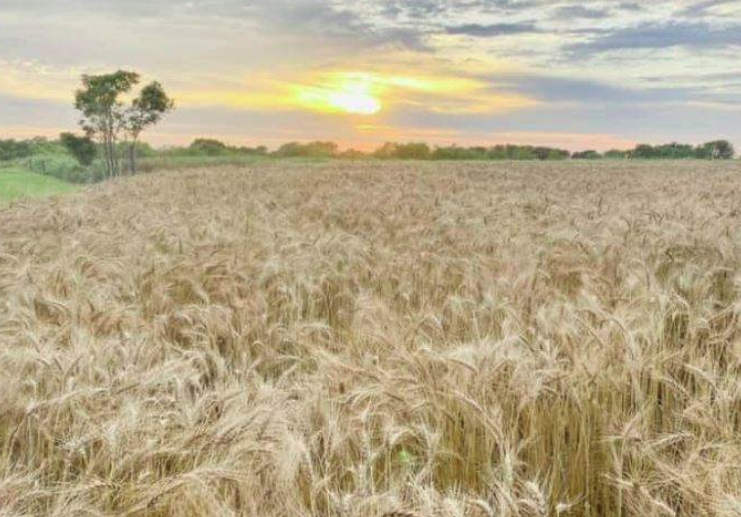
As Oklahoma heads toward the State Fair, dry conditions are creating uncertainty for producers considering planting wheat, particularly those hoping to establish wheat pasture. Oklahoma Wheat Commission Executive Director Mike Schulte said in a conversation with senior farm and ranch broadcaster Ron Hays that the state’s drought conditions have worsened, with many producers waiting for additional moisture before putting seed in the ground. “You look at the drought monitor last week; they had us at 42% in extreme drought. Now we’re up to 52% extreme drought even prior to these rains on Thursday,” Schulte said.
Schulte said there have been a few reports of producers planting wheat for grazing in southwestern and western Oklahoma, but those cases remain limited. “I have heard of some instances in Southwest Oklahoma and some other parts of Western Oklahoma, where there have been some producers that have been dusting some of the wheat in for grazing,” Schulte said. “But I think that’s still few and far between.”
Typically, wheat planting decisions would be getting more serious at this point in September, but Schulte said producers are largely taking a wait-and-see approach. “I think we’re probably in a wait and see mode,” he said. “Ground temperature is extremely warm just because of the harsh heat conditions that we’ve had this summer.”
Long Periods Without Rain Creating Concern
Schulte said the current situation is different from other hot and dry years because some areas of western Oklahoma have gone an extended period without meaningful rainfall. “In many instances, there’s parts of the western part of the state that hasn’t had a lot of rain since last November at planting time,” he said.
Schulte pointed to 2011 as an example of a year when Oklahoma experienced extreme heat, but said there was an important difference between then and now. “In 2011, we had certainly more days above 100 degrees than what we had this year, but we also had rains up until April and May before we got into those extreme hot days that summer,” Schulte said.
He said the lack of moisture has affected the condition of the soil itself, with more bare ground and warmer soil temperatures. “Certainly, going a longer time without moisture, I think, is really impacting us specifically just with the ground in itself,” Schulte said. “The ground is more bare. Also, ground temperature is higher, probably than what we saw in 2011.”
While the warm soil temperatures may create concerns, Schulte said Oklahoma has wheat varieties that can perform well when planted into warmer conditions. However, moisture remains the key factor. “We do have some wonderful wheats that do well in the beginning, even if the ground temperature is warmer,” he said. “But I think it’s just so different this year because we have gone such long periods without rain.”
Oklahoma Wheat Promotion Reaches International Buyers
While producers face uncertainty about the upcoming crop, the Oklahoma Wheat Commission continues working to promote Oklahoma wheat in international markets.
Schulte said the commission hosted the Latin American Buyers Conference in Santa Fe, New Mexico, at the end of July. The event is normally held in Mexico, the Caribbean or South America, but travel challenges led organizers to hold the conference in the United States. “We did have the Latin American Buyers Conference the end of July here in the United States,” Schulte said. “We did host that in Santa Fe, New Mexico, the end of July. We had over 30 companies present attend.”
Several major international shippers participated in the meetings, including C.H.S., Bunge, Cargill, A.D.M., Louis Dreyfus and The Andersons.
Schulte said the meetings focused on shipping issues, crop quality and what buyers could expect from the upcoming wheat crop. “One thing that was to our advantage, we did have a larger wheat crop last year, so we do have product that will be able to supply these markets that are extremely important to us as we move forward,” he said.
Global Wheat Consumption Could Outpace Production
Schulte said global wheat supplies and demand could create opportunities for wheat movement during the coming marketing year. “Last year we just had a large amount of wheat in the United States, but globally a large amount of wheat, and so we were really working hard to move that product,” Schulte said.
He said U.S. wheat was competitive in the global marketplace, helping move supplies into key markets. “When these meetings take place, those discussions are happening about how we can be the most efficient and how we can provide the best product that is best for the millers and bakers in these regions,” Schulte said.
According to Schulte, global wheat production is expected to be about 30.1 billion bushels, while consumption is projected at approximately 30.3 billion bushels.
“So we are going to start outpacing production with our consumption needs going into this marketing year,” he said. “It looks like, I think, we have seen the market react to that recently, and so there are going to be opportunities, I think, for movement as we move forward.”
Schulte also noted drought concerns in other major wheat-producing regions, including Canada, Australia and parts of South America.
2026 Oklahoma Wheat Quality Holds Up
Despite difficult growing conditions, Schulte said Oklahoma’s 2026 wheat crop showed strong quality in several areas. “Overall crop quality from being able to get an early start in southwest, central and in parts of northern Oklahoma, overall test weights were remarkably well for the crop,” he said.
Northern Oklahoma faced additional challenges with rainfall and getting wheat harvested, while drought severely affected major wheat-producing counties such as Blaine, Kingfisher and Canadian. “Typically, large wheat-producing counties where the drought just really, really hit us extremely hard,” Schulte said. “And so that did have an impact on our overall numbers.”
Schulte said some producers in western and central Oklahoma were still able to harvest wheat, although yields were limited. “There was still some, you know, 15 to 20 bushel wheat that was cut in those regions,” he said.
Farther north, conditions were more favorable. “As we got north of the 51 Highway corridor up past Hennessey into northern Oklahoma, there were those areas where we really did have decent yields and a decent crop, and so that really kind of bailed us out in the end,” Schulte said.
Schulte also said improvements in wheat genetics have helped varieties withstand difficult conditions. “The varieties we are planting today do hold up much better to the adverse conditions than what they did 20 to 25 years ago,” he said.
State Fair Bread Baking Competition Returns
The Oklahoma State Fair will also provide an opportunity to highlight wheat through the Oklahoma Wheat Commission’s long-running bread baking competition. Schulte said the competition has been part of the State Fair since 1965. “That competition has been going since 1965,” he said. “It really is a large competition at the state fair.”
The competition will take place Sunday, September 27, with entries beginning at 10:30 a.m. and judging beginning at 1 p.m. Schulte said entries must be submitted by 12:30 p.m.
He said the competition attracts both home bakers and culinary professionals. “Our home bakers, even our industry professionals that maybe are in the culinary world that enter, they take it extremely serious,” Schulte said. “So it’s really an exciting competition.”
To compete at the state level, participants must have won either grand champion or reserve champion at their local county fair.
New Wheat Learning Center Offers Consumer Resources
Schulte also highlighted a new resource from the Oklahoma Wheat Commission called the Wheat Learning Center portal. “We have now created a new wheat learning center portal on the Oklahoma Wheat Commission website,” he said.
The commission is encouraging producers, consumers and home bakers to use the resource for educational information, recipes and other wheat-related resources. “We are challenging the people, whether you’re a producer, a consumer, or a home baker, to subscribe on our Facebook, or you can sign into Instagram or on YouTube,” Schulte said.
He said the commission plans to provide additional consumer information throughout the fall, including seasonal recipes.