The release of the USDA Crop Production and World Agricultural Supply and Demand Estimates (WASDE) reports confirmed key fundamental drivers across grain and oilseed markets. Wheat and oilseed prices moved sharply lower following the release, while corn experienced more muted price movement.
Wheat Market Outlook
USDA projected higher global wheat production and ending stocks in the September WASDE, prompting a market sell-off despite deteriorating geopolitical conditions in the Black Sea and the Middle East.
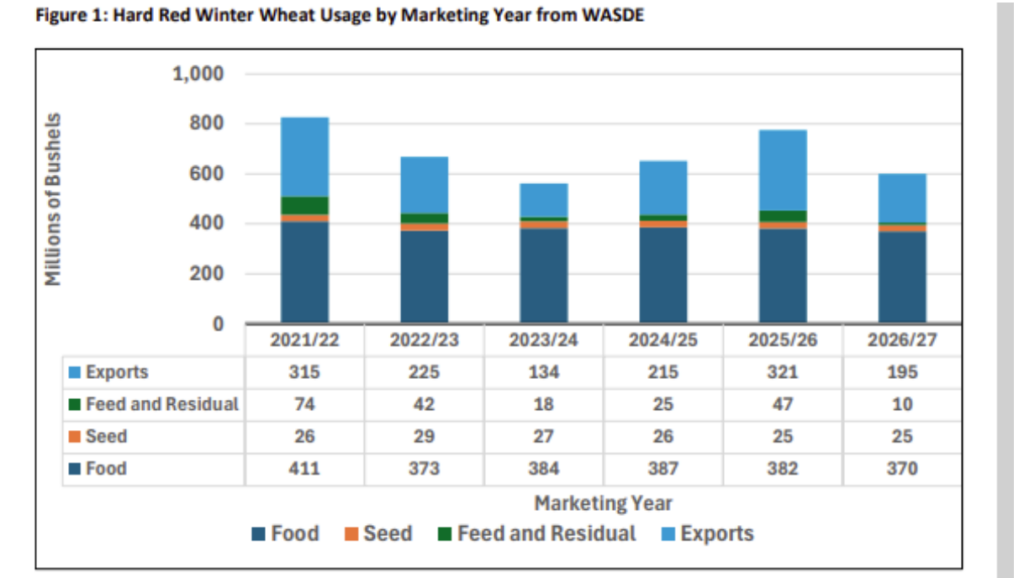
Export projections on the hard red winter (HRW) wheat balance sheet were reduced, confirming the recent slow pace of sales. Total U.S. wheat export projections held steady, as increased white wheat shipments offset reductions in HRW and hard red spring wheat. Black Sea export estimates also declined due to a slow shipping pace.
Potential demand on the HRW balance sheet fell by 15 million bushels due to lower marketing-year export expectations. Total HRW usage sits at 600 million bushels, down 175 million bushels from the previous marketing year. Total HRW supply dropped 293 million bushels year-over-year, aligning with the reduced usage and export trajectory.
Through September 3, HRW total commitments for the 2026-27 marketing year stand at 71 million bushels. With three months completed, exports require weekly net sales and shipments of 3.1 million bushels to reach USDA’s 190-million-bushel projection. Over the past month, net sales averaged 1.3 million bushels weekly. Elevated Gulf port prices relative to international competitors and sluggish global demand continue to weigh on U.S. sales potential. Expanded crop forecasts for southern hemisphere producers further pressure export prospects, even as regional conflict limits Black Sea grain flow.
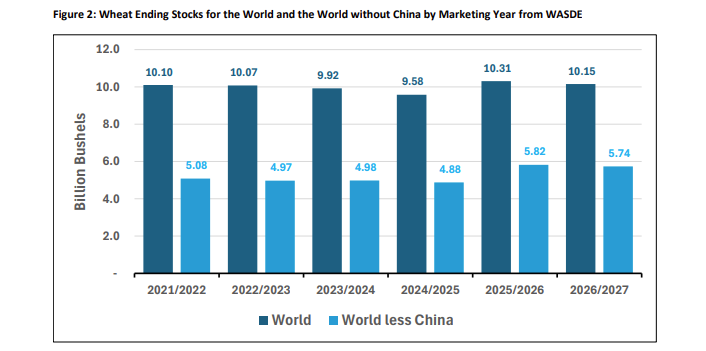
Global ending stocks without China rose by 112 million bushels from August, driven by higher beginning stocks, increased production, and lower export projections. While global domestic consumption estimates increased, the gains were concentrated in feed and residual usage across Australia, Ukraine, and Kazakhstan.
Worldwide wheat production was projected at 30.2 billion bushels, reflecting larger harvests in Australia, Canada, Ukraine, and Argentina. The 115-million-bushel global increase sets a bearish tone heading into the final quarter of the year. Global export forecasts declined on reductions for Russia, Ukraine, Egypt, and Kazakhstan.
December HRW futures dropped 20 cents on Friday and shed an additional six cents on Monday to close at $7.92 per bushel. Oklahoma cash basis ranges between -55 and -70 cents. Geopolitical friction and a slow planting start in the Black Sea region remain key variables that could alter production prospects. The USDA Small Grains report on September 30 will finalize winter wheat numbers and outline spring wheat yields and production.
Corn and Milo Market Outlook
December corn futures closed Monday at $5.33 per bushel, gaining three cents to recover Friday’s modest losses. Oklahoma cash prices range from $4.96 to $5.13. Corn avoided the sharp downturn experienced by wheat, supported by lower national yield projections and steady domestic ethanol and export demand.
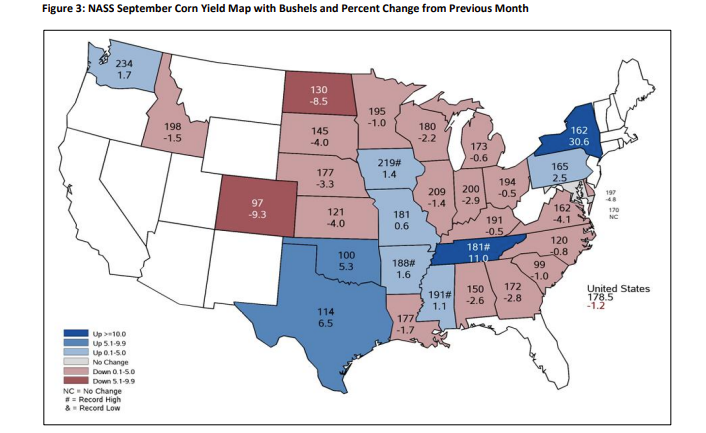
The September Crop Production report estimated the U.S. corn yield at 178.5 bushels per acre. Total production was pegged at 15.8 billion bushels, down 150 million bushels due to reduced yields and harvested area. Yield declines were concentrated in the High Plains, upper Midwest, and eastern Corn Belt.
To offset the production cut, feed and residual usage was lowered by 150 million bushels. U.S. corn ending stocks dropped 86 million bushels to 1.57 billion bushels, lowering the stocks-to-use ratio to 9.67 percent—below the key 10 percent threshold. Demand projections remain steady, with ethanol usage expected at 5.6 billion bushels and exports at 3.275 billion bushels.
Global corn production was reduced by 312 million bushels to 51.1 billion for 2026-27, with cuts in the U.S., India, Kenya, and Russia surpassing modest gains elsewhere. Global ending stocks stand at 10.7 billion bushels, down roughly 100 million bushels from the previous month. World ending stocks excluding China sit at 4.2 billion bushels, down 680 million bushels year-over-year.
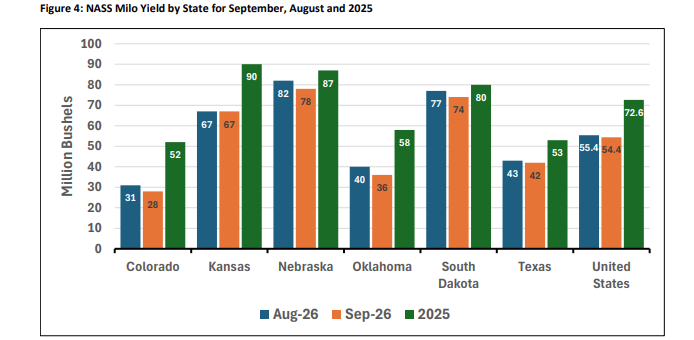
Milo production was projected at 284 million bushels, down 12 million from August and 153 million from the prior year. Yield was lowered 1 bushel to 54.4 bushels per acre, and harvested area fell to 5.2 million acres. Kansas yield projections remained unchanged from August, while Oklahoma yields dropped four bushels per acre to 36.
The milo balance sheet lowered exports by 10 million bushels, bringing ending stocks to 21 million bushels—the lowest level since the 2022-23 marketing year. Total commitments to China sit at 0.8 million bushels, with USDA reducing projected Chinese imports to 230 million bushels. Oklahoma milo cash prices range between $4.46 and $4.63, with basis strengthening over the past month to approximately 70 cents under December corn futures.