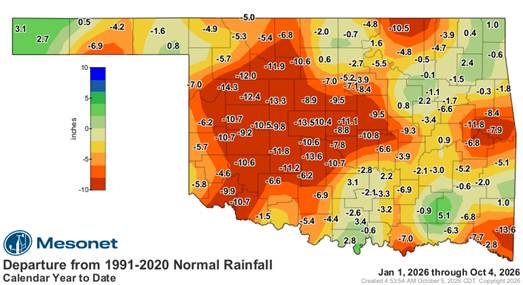
All of Oklahoma has received some rain in the past two weeks, with some spots receiving just about one inch of moisture and a couple of spots receiving six to ten inches of rain. Though the rain is very helpful, most of the state remains below normal for the year, with a large region of central and western Oklahoma still eight to thirteen inches down for the year (Figure 1).
Improved current conditions may provide for limited forage growth despite being so late in the growing season. The rain is especially timely for wheat planting, which accelerated sharply last week. Though a bit later than usual, decent wheat pasture prospects are possible depending on weather conditions in the next few weeks.
Figure 1.
The possibility of wheat pasture raises the question of winter stocker prospects in the current cattle market situation. Cattle prices dropped sharply from July through early September, as a result of a futures-led correction initially and subsequent pummeling from external headlines and industry news. Feeder cattle prices are down significantly from the record highs earlier this year and are currently lower than one year ago (Figure 2).
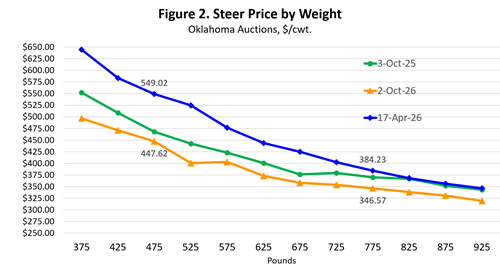
In general, the high cattle price environment is not favorable for stocker margins, or indeed, all margin sectors downstream from cow-calf production. However, the recent price decreases, more severe for calf prices relative to heavy feeder cattle, have improved stocker margins temporarily compared to record prices in the spring. Table 1 shows the current value of gain for a stocker program that starts with a 475-pound steer and adds 300 pounds of gain for a final weight of 775 pounds. In this example, the value of gain in today’s market is $1.87/pound. This compares to a value of 300 pounds of gain in April of this year of $1.23/pound. I expect recovery in calf prices in the coming months with corresponding deterioration of stocker margins, similar to the April market. However, the current lower market may be a relative buying opportunity.
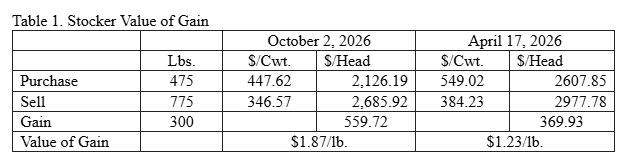
Even the current improvement in value of gain may not offer profitable stocker production possibilities. It depends on costs of production, including animal gains, grazing cost, animal health, interest costs, etc. The market incentives for stocker production remain relatively low. Consider the stocker gain relative to initial cattle cost in Table 1. The total margin per head currently is 26.3 percent of the first cost of cattle ($559.72/$2,126.19). In April, this percentage was just 14.2 percent ($369.93/$2,607.85). By contrast, in October 2021, when the price of 475-pound steers was $172.41/cwt., the 300-pound stocker margin was 47.1 percent of the initial cattle cost. Stocker production may be economically feasible, but it will require careful budgeting.