

Kenny Burdine writes in Southern Ag Today: For most cow-calf operations, winter feed is the single largest cost and one of the biggest drivers of overall profitability. As we move through fall, hay feeding is becoming a major focus: some operations are preparing, some have just started, and some have been feeding hay for quite some time. The cost of winter feeding primarily depends on three things: the cost of producing or purchasing hay, the number of days hay is fed, and how efficiently that hay is stored and fed.
At this point in the year, most hay has already been produced or purchased. If an operator does feel they need to purchase additional hay, it likely makes sense to source that hay soon. Hay prices tend to climb through the winter in years when supplies are short. It is also wise to have a little extra hay on hand since no one can predict how hard the winter will be or how early cattle can get back on spring pastures.
The number of days hay is fed depends largely on pasture conditions, and those conditions are poor in many areas. Much of the country has been dealing with drought for several months, and pastures across the US are generally in unfavorable shape. Farmers who are fortunate enough to still have grazable forage should use it as efficiently as possible. Culling open cows and poor producers can also stretch available pasture a little further. However, with calf prices at historically strong levels, most producers will likely want to keep bred cows, and cows with calves, through the winter.
How efficiently hay is stored and fed also has a major impact on winter feed costs, even though those losses can be hard to see and measure. A ton of hay costs the same whether it is consumed or wasted. Practical steps to cut waste often include storing bales off the ground and under cover, using hay rings or feeders, and feeding hay in quantities that cattle will consume relatively quickly. The right mix depends on the operation, but even modest changes can reduce waste.
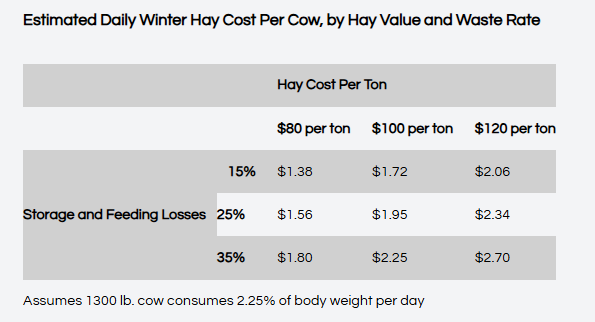
To show the value of reducing waste, the table at the end of this article estimates daily hay cost on a per cow basis. The estimates assume a 1,300-lb cow consumes 2.25% of her body weight each day, or a little over 29 pounds. It is the waste rate that determines how much hay must be fed for the cow to reach that level of intake. The table shows daily costs at hay values of $80, $100, and $120 per ton and at waste rates of 15%, 25%, and 35%. To estimate a cow’s total hay cost for the winter, multiply the daily cost by the number of days you expect to feed hay. For example, at $1.95 per day, total winter feed costs over 120 days would be $234 per cow.
While one can use the table below to examine the potential cost savings related to the cost of purchasing or producing hay, the savings related to storage and feeding losses are likely more relevant at this point in the year. With hay valued at $100 per ton, cutting the waste rate from 35% to 25% saves an estimated $0.30 per cow per day, and cutting it from 25% to 15% saves about $0.23 per cow per day. These numbers can add up quickly. As an illustration, a 50-cow herd feeding hay for 120 days per year would save about $1,800 over the winter by reducing waste from 35% to 25%.
What makes sense for one operation won’t necessarily make sense for another. Some large operations may be able to justify a significant investment in hay storage and feeding systems to drive waste rates down sharply. Smaller operations may need to focus on cheaper ways to achieve smaller reductions in losses. Regardless of size, every operation should know what it costs to carry its cowherd through the winter and look for ways to lower that cost by limiting storage and feeding losses.
Burdine, Kenny. “The Most Expensive Days Are Near: Managing Winter Hay Costs for Cow-Calf Operations.” Southern Ag Today







