
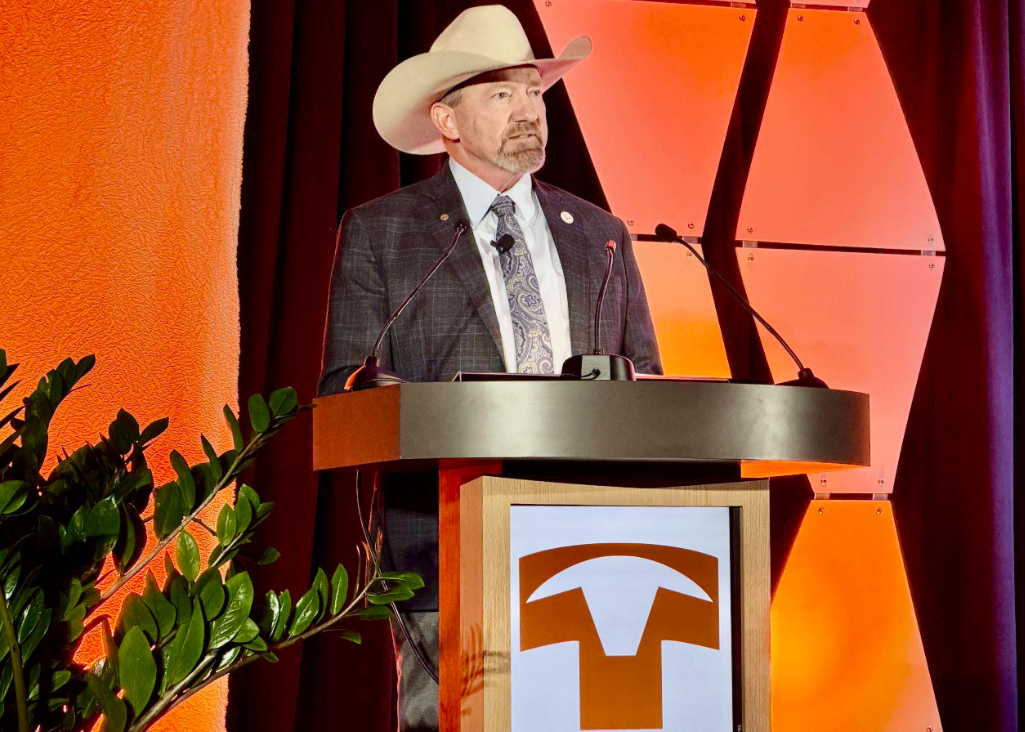
The Texas cattle feeding industry is navigating challenges ranging from Mexican cattle imports and New World screwworm concerns to labor disruptions and the need for long-term herd rebuilding. Laphe Laroe, outgoing chairman of the Texas Cattle Feeders Association (TCFA) and director of operations at Smith Cattle Company, discussed these issues with senior farm and ranch broadcaster Ron Hays following the opening general session of the association’s convention in downtown Oklahoma City.
Texas Feedlots Feel the Impact of Mexican Border Closure
Laroe said his year as TCFA chairman brought several challenges, including volatile cattle markets, tariff issues and the extended closure of the Mexican border to live cattle imports. Although a phased reopening has begun, he said the effects of the closure will take time to overcome. “We’ve had some whirlwind markets, and some of the issues we’ve had are tariff issues, and we’ve had our Mexican border closed,” Laroe told Hays. “We’ve finally got a staged reopening going there, so that’s been good.”
Laroe serves as director of operations for Smith Cattle Company, which operates five feedyards in the Texas Panhandle, all within about an hour of Amarillo. The operation has a combined one-time capacity of approximately 300,000 head.
His responsibilities include overseeing general operations, coordinating incoming and outgoing cattle and assisting individual feedyard managers with projects and other needs.
Discussing the border closure, Laroe said some Texas feedyards were particularly vulnerable because of their reliance on cattle from Mexico. “In our Texas area, there were some individual yards that were 60, 70% cattle from Mexico,” Laroe said. “Some of the individual yards, it was sure enough hurtful for those guys.”
He said the industry hopes to restore cattle trade to more normal levels, although the extended closure may have lasting effects on import numbers. “We stayed closed long enough that I’m not sure we’ll ever get back to the last numbers we used to have,” Laroe said. “But I think if we continue to work at it, we’ll be able to get back to some useful numbers.”
New World Screwworm Response Shows Progress
Laroe also praised the response to New World screwworm concerns, pointing to the use of the sterile fly technique as an important part of the effort to prevent the pest from spreading.
The technique involves releasing sterile flies to reduce reproduction. Laroe said the approach remains central to the current response, with potential technological improvements also being explored. “Sterile insect technique, that was the chosen way of eradicating it the first outbreak,” Laroe said. “We’re using that same technology today.”
He credited the U.S. Department of Agriculture, the Animal and Plant Health Inspection Service (APHIS) and state animal health commissions for developing response plans. “I do have to give a shout-out to the USDA and APHIS and our animal health commissions for putting the playbooks together,” Laroe said.
He added that the response has been encouraging compared with the concerns that emerged earlier in the summer. “Thank goodness that everything seems to have worked very well, and I think we’re on the winning side of this one,” Laroe said.
Cattle Herd Rebuilding Depends on Weather and Prices
With recent rainfall offering some relief in parts of the region, Hays asked Laroe whether improved moisture conditions could help cattle producers begin rebuilding the beef cow herd and eventually increase the number of cattle available to feedyards.
Laroe said there is potential for rebuilding, but favorable cattle prices create competing incentives for producers deciding whether to retain heifers or market animals. “That is really such a mixed bag of opinions on that,” Laroe said. “With these good prices that these cattle are bringing, some people, they may not retain due to prices.”
He emphasized that weather conditions will remain a major factor in producers’ decisions. “Mother Nature’s always first in line,” Laroe said. “I think there’s a chance that we could start seeing a little bit of rebuilding as long as Mother Nature stays the course.”
For feedyards, a larger cattle supply would eventually help support more consistent operations, but the pace of recovery depends on producers’ willingness and ability to expand their herds.
Labor Disruptions Create Additional Challenges for the Industry
Laroe also discussed concerns surrounding immigration enforcement activity in southwestern Kansas and its effects on workers and the broader livestock processing industry.
He said the situation created uncertainty among workers and disrupted operations at a time when the industry was already dealing with limited cattle harvesting capacity. “What it did was it created a lot of uncertainty for some of those workers,” Laroe said.
Laroe stressed that the industry supports removing criminals and maintaining a legal workforce, but he said the manner and timing of the enforcement activity created additional difficulties. “We’re all fine with removing criminals, and we support having legal working staff,” Laroe said. “But it just kind of came as a surprise, hit them all at once.”
He said the issue was not simply about enforcement itself, but also about communication with the industry and the suddenness of the disruption. “I think there could have been some communication a little bit left and right,” Laroe said. “It wasn’t simply the fact that we didn’t want it to be a surprise to the industry all at one time.”
Laroe said the timing was especially challenging because the industry already faced shrinking capacity for harvesting cattle. “The timing was detrimental,” Laroe said, adding that the abrupt changes created another challenge for an industry working to keep cattle moving through the supply chain.
Artificial Intelligence Raises Questions About the Next Generation
During the convention’s opening general session, Laroe heard a presentation on artificial intelligence. One demonstration, in which two AI systems communicated with one another using what was described as gibberish, stood out to him. “The one part of it that actually gave me chills was when the two AIs started speaking to each other in what they were calling gibberish,” Laroe said.
Although he acknowledged the potential usefulness of artificial intelligence, Laroe said the technology raises questions about how it should be used and how the next generation will learn. “There’s going to be some utility to it one of these days, and it is being worked on today,” he said.
Laroe said he has some apprehension about relying too heavily on AI, particularly when it comes to developing practical knowledge and judgment among future agricultural leaders. “I have a little apprehension about most of it, just from a standpoint of wisdom and trying to train the next generation,” Laroe said. “And maybe it doesn’t all have to be done through AI.”
TCFA Focuses on Advocacy and the Future of Cattle Feeding
As Laroe concludes his term as chairman, he said the association’s focus will remain on supporting cattle feeders, preparing future industry leaders and ensuring producers can operate without unnecessary government interference.
He expressed confidence in incoming chairman Ben Fort and described the cattle feeding industry as resilient despite the challenges it continues to face. “I think this is an absolutely resilient bunch here,” Laroe said. “Incoming chairman Ben Fort will do an amazing job.”
Laroe said TCFA will continue emphasizing education, advocacy, property rights and responsible stewardship throughout the Southern Great Plains. “Our motto is to train the next generation and to just make sure that we get to advocate for our feeders and not have too much government overreach,” he said.
He added that protecting land and property while maintaining responsible agricultural practices will remain central to the association’s work. “Fight for our property, fight for our land, and just be good stewards,” Laroe said.
Ultimately, Laroe said the cattle feeding industry must continue supplying consumers with a dependable source of protein while maintaining confidence in beef. “Our goal is to keep protein in the center of the plate and move forward and keep our consumers confident in our product,” Laroe said.