

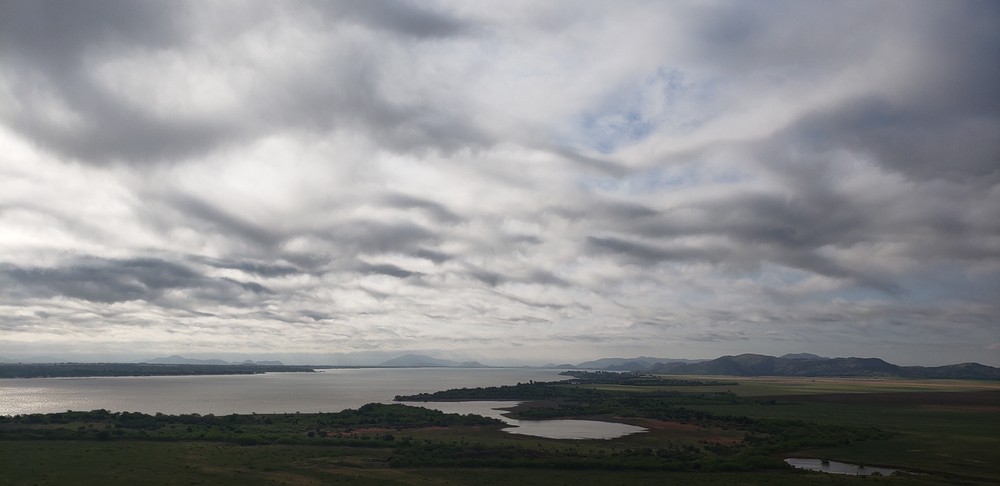
Recent heavy rainfall across Oklahoma brought a welcome rebound to several major reservoirs and lakes across the state, though persistent long-term moisture deficits mean water levels in central and western bodies of water continue to sit well below conservation pool.
The widespread storm system delivered significant runoff to northeastern and north-central watersheds, pushing several key flood-control and recreation reservoirs above their seasonal targets. Grand Lake (Pensacola) reached full conservation pool, sitting at 100 percent capacity at approximately 742.0 feet. Downstream and nearby systems also absorbed healthy inflows, with Keystone Lake holding roughly 1.46 feet above normal pool and Lake Hudson maintaining a surplus of 0.93 feet. Along the Arkansas River basin in northern Oklahoma, Kaw Lake also climbed to 1.46 feet above its normal elevation.
In contrast, central, eastern, and western reservoirs reflect a divided hydrological picture. Great Salt Plains Lake sits near equilibrium at just 0.64 feet below normal pool, but larger bodies of water to the east and central corridors require substantial follow-up moisture to fully recover. Lake Eufaula is currently 3.47 feet below normal, while Canton Lake in northwest Oklahoma sits 4.65 feet down. In the Oklahoma City metro area, Lake Hefner is actively recovering following runoff and upstream water transfers, though it remains roughly 5 feet below its normal elevation.
The deepest deficits remain concentrated across southern, southeastern, and southwest Oklahoma watersheds:
- Tenkiller Lake: 7.17 feet below normal
- Broken Bow Lake: 9.51 feet below normal
- Pine Creek Lake: 11.54 feet below normal
- Lake Altus-Lugert: 19.53 feet below normal
Lake Altus-Lugert continues to post the steepest deficit in the state, standing nearly 20 feet below normal pool. While last week’s storms provided meaningful relief and slowed storage declines across the board, agricultural producers and water managers note that consistent runoff events through the late fall will be critical to recharging storage capacities ahead of the winter freeze.
Lakes Operating Above Normal Pool
- Arcadia Lake: ~3.76 ft above normal (Elevation: 1,009.76 ft / Normal pool: 1,006.00 ft)
- Oologah Lake: ~2.53 ft above normal (Elevation: 640.53 ft / Normal pool: 638.00 ft)
- Fort Gibson Lake: ~0.83 ft above normal (Elevation: 554.83 ft / Normal pool: 554.00 ft)
- Fort Cobb Reservoir: ~0.40 ft above normal (Elevation: 1,342.40 ft / Normal pool: 1,342.00 ft)
Lakes Near Normal Conservation Pool
- Lake of the Arbuckles: ~0.32 ft below normal (Elevation: 871.68 ft / Normal pool: 872.00 ft)
- Lake Texoma: ~1.08 ft below normal (Elevation: 615.92 ft / Normal pool: 617.00 ft)
Lakes Reflecting Moderate to Significant Deficits
- Skiatook Lake: ~3.16 ft below normal (Elevation: 710.84 ft / Normal pool: 714.00 ft)
- Hugo Lake: ~3.87 ft below normal (Elevation: 400.63 ft / Normal pool: 404.50 ft)
- Foss Reservoir: ~4.19 ft below normal (Elevation: 1,637.81 ft / Normal pool: 1,642.00 ft)
Lake Overholser saw a major rebound following last week’s storms and runoff along the North Canadian River basin.
- Current Elevation: ~1,241.9 feet
- Normal Conservation Pool: 1,242.0 feet
- Status: ~0.1 feet below normal pool (essentially full pool)
Prior to the heavy rainfall, Overholser was sitting low at around 1,237.2 to 1,238.0 feet (nearly 4 to 5 feet below normal pool). Runoff over the past seven days pushed the lake up more than 4.5 feet, bringing it virtually back to designed full conservation capacity.
Lake Hefner has seen a steady, significant rebound as runoff and canal transfers from Lake Overholser continue moving through the system.
- Current Elevation: ~1,197.8 feet
- Normal Conservation Pool: 1,199.0 feet
- Status: ~1.2 feet below normal pool
Prior to last week’s storms, Hefner had dropped to around 1,192.4 to 1,192.7 feet (roughly 6.5 feet down). Over the past seven days, the reservoir has risen nearly 5 feet (+4.90 ft), quickly closing the gap toward full pool.
According to data from the U.S. Army Corps of Engineers Tulsa District, Canton Lake did not see the sharp upward rebound experienced by the downstream OKC-area lakes, as heavier runoff centered further down the North Canadian basin:
- Current Elevation: 1,610.75 feet
- Normal Conservation Pool: 1,615.40 feet
- Status: 4.65 feet below normal pool
- Conservation Storage: 68.4% full (~63,269 acre-feet stored out of 92,519 acre-feet conservation capacity)
Levels at Canton have stayed relatively flat, holding within a few hundredths of a foot over the past week.
Relief may soon expand to some of the state’s driest watersheds, as rainfall began moving across western Oklahoma and the Panhandle overnight, kicking off what could be a wetter weather pattern heading into late week. While overnight totals delivered initial moisture to parched soils, forecasters indicate additional precipitation chances remain on the table through the weekend as tropical moisture and incoming disturbances track across the region. Water managers and producers across the western tier—especially around severely depleted reservoirs like Lake Altus-Lugert, Foss, and Canton—will be watching closely to see if sustained runoff can finally materialize to help reverse months of deep conservation deficits.