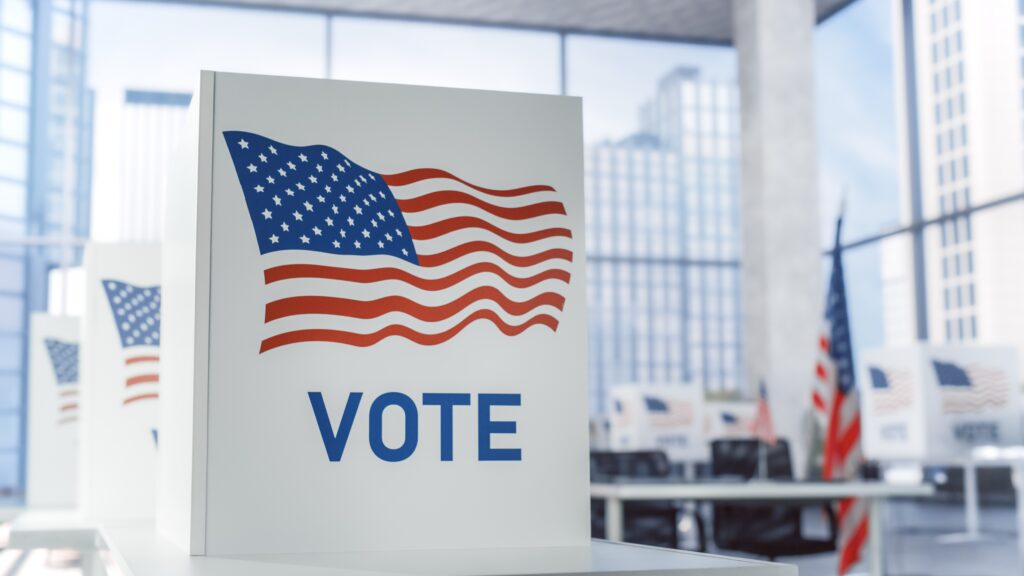
Oklahoma voters will head to the polls Tuesday, November 3, to decide several major statewide offices, a U.S. Senate seat, congressional and legislative races, two state questions, and a number of local issues, including a proposed sales tax to help fund a new Oklahoma County jail.
The 2026 general election will determine Oklahoma’s next governor, lieutenant governor, attorney general, and several other statewide officials. Voters will also weigh in on proposed constitutional changes involving property taxes and the state’s judicial selection process.
Governor and Statewide Offices
With Governor Kevin Stitt completing his second term, Oklahoma voters will select a new governor.
Republican Mike Mazzei, a former state senator, faces Democrat Cyndi Munson, a former state representative. Independent candidates Robert Brooks, Orlando Lynn Bush and Jerry Griffin are also on the ballot.
Other statewide races include:
- Lieutenant Governor: Republican T.W. Shannon and Democrat Kelly Forbes.
- Attorney General: Republican Jon Echols and Democrat Nick Coffey.
- State Superintendent: Republican Robert Franklin and Democrat Jennettie Marshall.
- State Treasurer: Republican Cindy Byrd and Libertarian Kiefer Perry.
- Labor Commissioner: Republican Kevin West, Democrat Kevin Dawson and Libertarian Mike Hall.
- Insurance Commissioner: Republican Bob Sullivan and Democrat Craig MacIntyre.
- Corporation Commissioner: Republican Brad Boles and Democrat Rhonda Eastman.
U.S. Senate and Congressional Races
Oklahoma voters will also choose a new U.S. senator following Markwayne Mullin’s departure from the Senate to serve as U.S. Secretary of Homeland Security.
Republican Congressman Kevin Hern faces Democrat N’Kiyla Jasmine Thomas, Libertarian Sevier White, and independents Ron Meinhardt and Curtis Stinnett.
All five Oklahoma seats in the U.S. House of Representatives are also up for election.
The congressional races include:
- District 1: Republican Mark Tedford and Democrat John Croisant.
- District 2: Republican Josh Brecheen, Democrat Brandon Wade and independent Ronnie Hopkins.
- District 3: Republican Frank Lucas and Democrat Suzie Byrd.
- District 4: Republican Tom Cole, Democrat Mitchell Jacob and independent Rocco Bonacci.
- District 5: Republican Stephanie Bice, Democrat Jena Nelson, and independents Robert P. Henri and Austin Nieves.
Voters in various districts will also select members of the Oklahoma House of Representatives and State Senate.
Two State Questions on the Ballot
Oklahoma voters will decide two proposed amendments to the state Constitution.
State Question 845 — Judicial Nominating Commission
This proposal would change the rules governing Oklahoma’s Judicial Nominating Commission, which helps select nominees for judicial vacancies.
The changes would include allowing commission members to serve two consecutive six-year terms, adjusting appointments to reflect current congressional districts, and removing certain political party and attorney-related restrictions.
A yes vote would approve the changes. A no vote would leave the current constitutional provisions in place.
State Question 847–Property Tax Valuations
This could have a direct impact on Oklahoma farmers, ranchers and other property owners by reducing the amount that property valuations can increase annually for tax purposes.
Under current Oklahoma law, the annual increase in taxable property valuations is capped at 3 percent for homesteads and agricultural land and 5 percent for other real property. If approved, State Question 847 would lower those limits to 1.75 percent for homesteads and agricultural land and 4 percent for other properties beginning in 2027.
For agricultural producers, the measure could provide additional protection against rising property valuations during years when farm income is affected by drought, higher production costs or fluctuating commodity and livestock prices.
The Oklahoma Farm Bureau has endorsed State Question 847, arguing that agricultural producers can experience financial losses while the taxable value of their land continues to increase.
The proposal would also establish a tiered system of valuation caps for qualifying homeowners age 65 and older, based on household income.
However, the measure has raised concerns among public school officials and local governments that rely on property tax revenue to fund education, roads, emergency services and other operations.
The Oklahoma Tax Commission has projected approximately $45.78 million in reduced revenue for local taxing jurisdictions in the next fiscal year if the measure passes, compared with existing law.
Supporters say the proposal would provide greater predictability for property owners and help limit future tax increases. Opponents argue that slower growth in property valuations could reduce funding for local services, particularly in rural communities.
State Question 847 would not directly reduce existing property tax rates or guarantee a lower tax bill. Instead, it would limit how quickly property valuations used to calculate taxes could increase.
A yes vote would approve the lower valuation growth limits, while a no vote would maintain the current system.
Opponents of State Question 847 argue that lowering property valuation caps would reduce future revenue growth for public schools, county governments, CareerTech programs and other local services. They point out that the measure would not actually lower existing property tax bills and could make it more difficult for communities to fund school construction, roads and emergency services. Critics also warn that school districts and local governments may need to increase property tax millage rates to meet existing bond obligations, potentially offsetting savings for property owners. The Oklahoma Tax Commission estimates the measure could reduce revenue to local taxing jurisdictions by approximately $45.78 million in the next fiscal year compared with current law.
Oklahoma County Jail Sales Tax Proposal
Oklahoma County voters will decide whether to approve an additional 0.4 percent sales tax to help fund the construction, operation and maintenance of county detention, diversion and mental health facilities.
The proposed tax would add four cents to a $10 taxable purchase and would remain in effect for approximately 25 years.
County officials are seeking additional funding after construction costs for a new jail increased substantially beyond the $260 million bond package approved by voters in 2022.
Supporters say the additional revenue is needed to complete the new facility, address longstanding safety and infrastructure problems at the current jail, and provide adequate funding for future operations. They argue that the existing jail is outdated and that a replacement is necessary to improve conditions for inmates, detention officers and the community.
Opponents question why voters are being asked to approve another tax after already authorizing $260 million in bonds for the project. Critics have raised concerns about escalating construction costs, financial oversight and the additional tax burden on residents. Some argue that county officials should reconsider the project’s size and cost or explore other funding options before asking taxpayers for more money.
The estimated cost of Oklahoma County’s new jail has climbed to approximately $860 million, more than three times the $260 million in bonds voters approved in 2022. County officials are now seeking a 0.4 percent sales tax to help close the construction funding gap and pay for ongoing jail operations. The proposed tax is expected to generate approximately $70 million annually over 25 years.
A yes vote would approve the additional sales tax, while a no vote would reject it.
The proposal will appear only on ballots in Oklahoma County.
Judicial Retention and Local Elections
In addition to candidate races and state questions, voters will decide whether to retain several Oklahoma appellate judges and Supreme Court justices.
Depending on where they live, voters may also see county offices, local propositions and other races on their ballots.
When and Where to Vote
Election Day is Tuesday, November 3, with polls open from 7 a.m. to 7 p.m.
Voters must provide an acceptable form of identification or follow the state’s provisional ballot procedures.
Because ballots vary by county and legislative district, voters are encouraged to review their sample ballots and verify their polling locations through the Oklahoma State Election Board’s OK Voter Portal at oklahoma.gov/elections/ovp.html
ELECTION DAY VOTING
Voters are encouraged to make a plan to vote. Polls are open from 7 a.m. to 7 p.m. on Election Day. Lines at the polls are typically longest early in the morning, during lunchtime, and after 5 p.m. If turnout is heavy at your precinct, be prepared for possible wait times.
State Election Board Secretary Paul Ziriax encouraged voters to be courteous to precinct officials and other voters waiting in line. “We want all voters to have a positive experience at the polls. We ask that voters please be patient as precinct officials work to process voters and help those who may need additional assistance, such as first-time voters or those with disabilities.” The State Election Board said all eligible voters in line by 7 p.m. on election night will be permitted to vote.
VERIFY POLLING PLACE
All voters should confirm their polling place before heading to the polls. Voters can confirm their polling place using the OK Voter Portal or by contacting their County Election Board or the State Election Board. The State Election Board reminds voters that you must vote at your assigned polling place on Election Day.
BE PREPARED
Study the candidates and issues before going to the polls. View your sample ballot using the OK Voter Portal. You can also use the portal to find your polling place. The election list is available on the State Election Board website.
PROOF OF IDENTITY
Oklahoma law requires every voter who votes in person to show proof of identity before receiving a ballot.
There are three ways to show proof of identity under the law (only one proof of identity is required):
- Show a valid photo ID issued by the State of Oklahoma, federal government or a federally-recognized tribal government; or
- Show the free voter identification card issued by the County Election Board; or
- Sign an affidavit and vote a provisional ballot. (If the information on the affidavit matches official voter registration records, the ballot will be counted after Election Day.)
If your identification card has an expiration, the expiration date must fall after the date of the election.