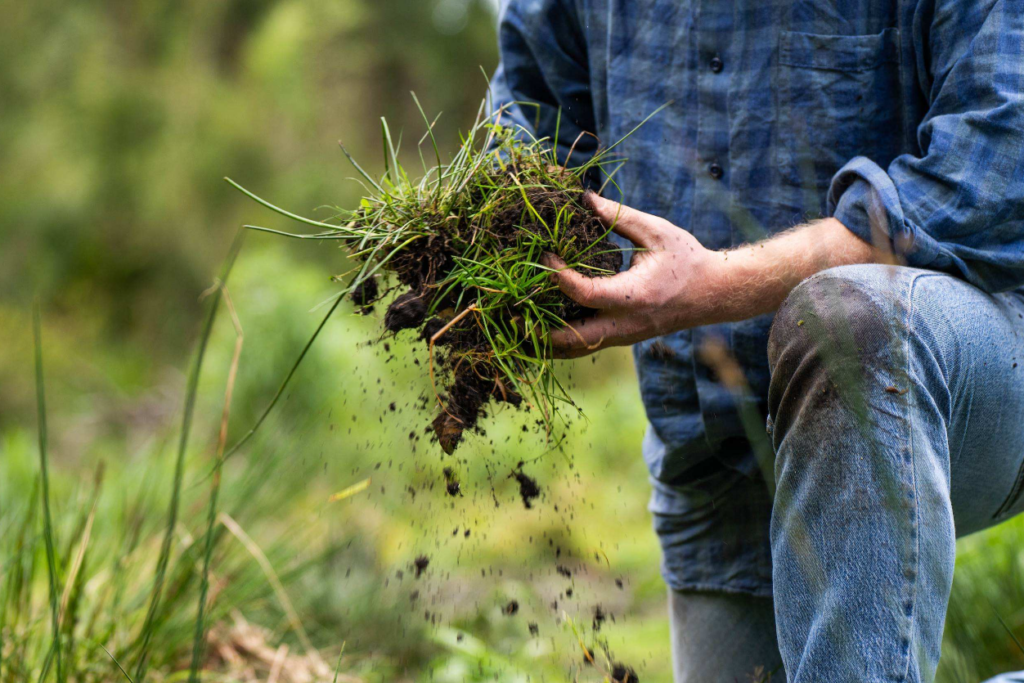
The United States Department of Agriculture (USDA) Natural Resources Conservation Service (NRCS) is awarding American Farmland Trust (AFT) nearly $5 million over five years through its Conservation Innovation Grants On-Farm Trials program to help expand AFT’s national network into a coordinated Soil Health Management Systems (SHMS) Network. Working with 35 trial host farms across 14 states in five regions, and more than 20 partners, the project will demonstrate and evaluate biochar application and its performance when integrated with complementary soil health practices on working farms. Through farmer-led trials, technical and financial assistance, decision-support tools, and peer networks, the project will help farmers and ranchers adopt systems that fit their operations, while generating regionally relevant soil, water, economic, and social data.
“Biochar has the potential to build more resilient agroecosystems by improving soil health, stabilizing and increasing yield and profitability, increasing beneficial microbial communities, improving soil water availability, and providing an efficient means to immediately improve degraded soils, particularly in high disturbance and water-limited systems,” said AFT Climate and Soil Health Director and Principal Investigator Dr. Bianca Moebius-Clune. “And when low-value biomass, like forest debris, is turned into biochar, that can also reduce wildfire risk for communities while benefiting both ecosystems and farm resilience. But farmers and ranchers want to see how new practices perform on farms like theirs before they invest in significant change.”
The project builds AFT’s existing biochar and cover crop trial networks in eight states (California, Illinois, Kentucky, Maine, Massachusetts, Nebraska, New York, and Washington) into a coordinated national 2.0 Soil Health Management Systems Network, expanding into Arizona, Maryland, North Carolina, Texas, Virginia, and Wisconsin.
“This network puts locally adapted, biochar-integrated soil health systems to the test across diverse U.S. production systems and connects farmers with each other through peer networks. To address adoption barriers, AFT and partners will continue to develop coordinated soil health transition support. We do that through on-farm trials, trainings and resources, decision support tools, supply chain connections, and a network that expands access to technical and financial assistance, so that healthy soil becomes the norm, not the exception. This vision is what we call a New Conventional Agriculture: profitable, resilient farming built on healthy soil across all agricultural systems,” Moebius-Clune said.
The project will demonstrate and evaluate the integration of biochar within full SHMS transitions, including practices such as clover living mulch and other cover cropping opportunities, reduced disturbance, microbial inoculation, compost, manure management, agroforestry, diversified rotations, and livestock integration for resilience to water limitations, and improved nutrient and water management. The network will particularly focus on opportunities to tackle challenges in water-limited and high-disturbance systems, including potatoes, sweet potatoes, peanuts, cotton, leafy greens and other vegetables, corn, soybeans, wheat, almonds, dairy, and forages.
Over five years, the network will collect more than 1,500 soil samples along with yield, economic, water, soil microbial, and nutrient density data. Trial hosts will receive financial assistance, including a net-returns guarantee that protects them if a trial reduces their income. The network will engage in at least 100 events, including hosting 20 field days and regional Growing with Biochar trainings, and will publish at least 30 practical resources, from case studies to decision tools to the next National Biochar Survey; the baseline survey report will be out shortly. AFT’s Prosperity Partners team of certified Technical Service Providers will help at least 20 additional farmers and ranchers put biochar to work through NRCS conservation programs, and 5 to 20 partner-led trials will further extend the network. In all, the project expects to reach 3,000 to 5,000 farmers, ranchers, and agricultural advisors.
The USDA NRCS Conservation Innovation Grants On-Farm Trials program award agreement is anticipated to be in place by spring 2027, with new trials to be established from fall 2027 to fall 2028. Partners and supporters include the American Biochar Institute (ABI), Cornell University, University of Louisville, University of Nebraska – Lincoln, Virginia State University, USDA Agricultural Research Service, Dry Farming Institute, Kilimo, Momentum Ag, Lactalis USA (exploring biochar integration into Stonyfield® supplier farm dairy systems), EarthOptics (soil mapping), a growing number of biochar producers (Olympic Biochar, Qualterra, Standard Biocarbon, NY Carbon, Soil Carbon Innovations, PyroNexus, BiocharXchange, Plantd, Cold Steppe, and (Re)wilding Biochar Co.), microbial inoculant producers, Edacious (nutrient density testing services), Salt River Project (biochar from forest-thinning biomass), and Virginia Department of Forestry. More partners are expected to join as the network grows.
Partners agree that farmers need to see evidence close to home and recognize the network’s value in the evidence it will generate to enable farm-adapted change.
“Biochar shows real promise for soil health, but farmers want to see how it performs on working farms close to home, alongside the practices they already use,” said American Biochar Institute Executive Director Myles Gray. “This network will generate that evidence across regions and farm types, and it gives ABI the practical, farm-tested data we need to build sound standards and markets that farmers and ranchers can trust.”
“The Dry Farming Institute is very excited for this soil health network to go through,” said Dry Farming Institute Executive Director Dr. Gabrielle Roesch-McNally. “We are deeply interested in how biochar applications can improve soil water-holding capacity and support farmers to thrive with less water.”
“Biochar and integrated soil health systems hold real promise for farmers, but adoption depends on proof,” said EarthOptics CEO Lars Dyrud. “Growers need trusted, regionally relevant data showing what works on their ground and what it means for their bottom line. EarthOptics is proud to partner with American Farmland Trust to bring consistent, defensible soil intelligence across this national network, turning field-level data into insights that help farmers make confident decisions about resilience and profitability.”
“We are excited to continue our partnership with American Farmland Trust, combining on-farm research, precision agriculture, biochar, and nitrogen management to improve profitability and sustainability for Nebraska growers. Our four large-scale trials, totaling 20 acres, will demonstrate these practices under real farming conditions,” said Dr. Guillermo Balboa, Nebraska Project Lead, University of Nebraska–Lincoln.
“I’m thrilled to see the USDA supporting this AFT initiative to develop and evaluate evidence-based solutions to healthier soils. Our research group at the University of Louisville is proud to partner with AFT to work on how biochar’s benefits to soil can be enhanced even further by microbial inoculation,” said Dr. Natalie Christian, Associate Professor of Biology, University of Louisville.
“As American producers navigate unprecedented soil health challenges, we must leverage every tool we have to provide practical, research-driven solutions. Virginia State University is excited to partner with American Farmland Trust to evaluate biochar-integrated soil health management systems and help producers address these challenges,” said Dr. Tiffany Carter of Virginia State University’s College of Agriculture.
“Salt River Project is proud to partner with American Farmland Trust to explore how biochar can improve soil health, enhance water resilience and support a sustainable future for agriculture in Arizona,” said Elvy Barton, Senior Manager of Water and Forest Sustainability at Salt River Project.
“Cold Steppe is proud to partner with American Farmland Trust, the nation’s leader in protecting farmland and promoting sound farming practices for more than four decades. We look forward to serving the farmers in AFT’s network and to showing how biochar, built into full soil health management systems, can help keep working lands in working hands through improved economics and agronomics,” said Matt Freniere, Co-Founder and President of Cold Steppe.
“It is so important for suppliers like NY Carbon to be involved in these long-term field trials as it gives us a chance to prove out our model of utilizing local Hudson Valley biomass waste by upcycling it into a valuable soil amendment along with guidance from the brilliant researchers at Cornell University and the national reach and dedication of American Farmland Trust to build resilient soils and sustainable food systems that farmers can rely on,” said NY Carbon Director of Business Development and Product Bill Hilgendorf.