

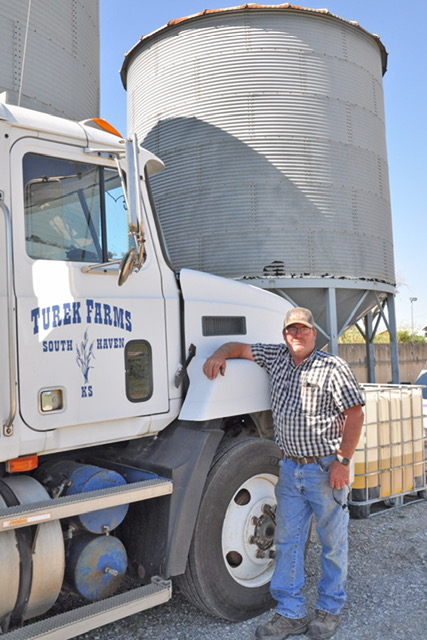
By Candace Krebs, OKGenetics.com: Family history, loyalties and even seed genetics cut across state lines for Tim Turek, who grew up attending school in South Haven, Kansas.
When his youngest daughter Rachel married recently, he was wearing a gold watch he received as an award for winning grand champion at the Kansas State Fair Wheat Show. He did it with an Oklahoma variety, Doublestop CL +.
On November 7, when his alma mater Kansas State University hosts Oklahoma State for a football road game, he’ll be cheering the purple. But that doesn’t tell the full story. Two of his three daughters are OSU graduates who root for the Cowboys.
Friendly rivalries aside, Turek’s operation is an example of successful cross-state collaboration. As a certified seed dealer, he cooperates on research with OSU’s precision nutrient management specialist, Dr. Brian Arnall; hires a consulting agronomist out of Oklahoma, Tyler Knight; and always has OSU varieties in his seed portfolio.
He’s in his second year of growing Orange Blossom CL+, the latest generation in OSU’s Doublestop CL + line.
“I’ve been very happy with it,” he said. “I was particularly happy with how it did this past year, and I think it’s going to be a good one. I feel like OSU is putting out some really good varieties lately.”
Crossing borders
Turek’s roots in the region go back to his great-great grandfather, who was on his way from Nebraska to Caldwell, Kansas, to make the Land Run when he died in an accident. His widow then settled the family on a farm near Renfrow, Oklahoma, but a year later she too lost her life while helping dig a well. Tim’s great grandfather, only 12 at the time, persevered and eventually took over the farm from his older brother.
“He was kind of a go-getter,” Tim recalled while sitting in his office next to a truck scale and a row of grain bins.
In the 1920s, banks in Western Kansas were calling around looking for young farmers willing to buy land out west for a dollar an acre.
“Land around here was $40 an acre, so they could go out there and buy 40 acres for every acre they sold here. At the time, they didn’t know there was water or oil and gas out there,” he said.
When the land they were leaving behind came up for sale, Turek’s great-grandfather saw an opportunity. He made the move from Oklahoma, buying five quarters northwest of Caldwell that are still in the family today.
Though no oil was discovered, it was still a good place to land. Arnall, a member of OSU’s wheat improvement team, said grazing stockers isn’t a priority in the area simply because the farmland is so good.
“It’s a high yielding environment typically,” Arnall said.
Turek, who is on the board of the Kansas Wheat Alliance and serves as vice president of the Kansas Association of Wheat Growers, cleans and sells around 45,000 bushels of seed wheat a year. His brother Greg is in the seed business too. Many of their customers come from Oklahoma and Texas, drawn by Kansas’ strict certification standards.
Turek and his neighbors appreciate the OSU breeding program’s emphasis on flexibility, affordability and value. There’s a trend in the industry now to require farmers to purchase new seed every year without the option to save it back for replanting.
“That approach makes sense for varieties with specialty traits, such as herbicide tolerance or high gluten or fiber content,” he said. “But it needs to be something that will pay for itself.”
In Kansas, industry leaders have elected to put “certified-seed-only” status on popular new KSU varieties for the first four years following their release. Turek isn’t completely at peace with that decision, but acknowledges additional revenue streams are needed to support university programs.
Covering the rising cost of management, labor, logistics, and inputs is a challenge for his operation too. To produce certified seed, he maintains storage bins, pays to bring in certified portable cleaners and sets up his own seed-treatment equipment, often working long days in 100-degree weather to prep the crop for planting.
Selling wheat for seed is one way to add value. Selling it into specialty markets is another angle he’s explored.
Grain elevators in the area are willing to work with growers to collect and segregate identity-preserved wheat. The problem is market premiums often aren’t high enough to offset the extra logistical costs, he said.
“My life goal has always been to grow something somebody wants to buy and get out of the commodity space we’re in,” he said. “Grain Craft (a large milling company) had a program where they gave us a premium to plant preferred varieties, but it really wasn’t enough to justify paying extra for the seed and jumping through all the logistical hoops. For now, we’re being paid on bushels not quality. I don’t know how we get past that.”
He supports efforts by OSU’s chief wheat geneticist Dr. Brett Carver to target new markets, while working in collaboration with breeders and merchandizers in Kansas.
In recent years, Carver introduced a new line of Ox wheats that enable commercial bakers to reduce or even eliminate vital wheat gluten as an additive in bread products.
Turek learned more about the inner workings of the milling industry by attending a popular milling short course at KSU. Now he’s waiting to see if changes in consumer demand and education will increase opportunities in the value-added market.
Expanding diversification
Just down the road from Turek’s grain bins is the Barry Bones Research Farm, which is managed by the Turek family. It’s named after owner Barry “Bones” Patton, an internationally renowned musician who plays an unusual percussive instrument traditionally made from cow bones.
The farm is an important satellite location for Arnall’s fertility research. One of his current trials is looking into the effectiveness of combining fungicide with nitrogen applications. Now in its second year, the trial would get a boost if the record-setting El Niño weather pattern in the Pacific delivers on its promise for a wet winter.
That would be a significant change after several years of winter flash-droughts.
“It sounds a little strange to say this but I’m actually worried about wet weather going forward,” Turek admitted. “You get a big rain, and it can take a long time to dry out when the days are shorter and cooler and the ground has been worked down finer.”
There’s still fall fieldwork to complete, and he’s also thinking of the 300 cows he runs with his dad and brother.
While wheat makes up around 65 to 70 percent of the operation, the farm has become more diversified over the years. In mid-October, Turek had just finished harvesting corn and sorghum and was waiting to cut soybeans. He also had one field of cotton, the first he’d ever grown. Though fall rains stimulated some regrowth, he still expected the cotton to yield about half of normal or around 500 pounds an acre.
Canola planting had been delayed, but still resulted in excellent stands. “We scattered it shallow, hoping it would rain, and it did,” he said. “We have some wheat up as well, mainly wheat pasture to graze our cattle.”
Earlier this year, he enrolled in a regenerative agriculture program that covered the cost of seed for a cover crop mix that included radishes, oats and hairy vetch. Now he’s getting ready to turn cattle on it.
“I like the looks of it,” he said. “We’ll graze it, then terminate it next spring and plant something else.”
One of the biggest concerns farmers have right now is the rising cost of fuel.
When Turek’s dad stopped by the office, he noted the price of diesel had gone up almost a dollar a gallon in just two days, representing thousands of dollars on every load.
Farmers who want to lock-in prices have to pay up-front and be willing to move fast, Turek explained, but the financial risk is high in today’s volatile economic environment. Regardless of the uncertainty, his dad recalled a piece of advice he’d received from his father years ago that helps explain what’s kept the farm going, with Tim’s daughter Paige now the sixth generation actively involved.
“My dad always said, just go out there and keep working hard and things will get better.”







