


Grain and oilseed prices focused on export markets, U.S. harvest, and expectations on USDA’s next round of reports. Focus will turn to South American and Black Sea crop prospects as ample supplies from those regions over the course of the marketing year will place a damper on market rallies. Geopolitical events remain a key driver with major conflicts and trade issues maintaining significant uncertainty levels.
Corn Market Outlook:
As seen in Figure 1, the December corn future price closed on Monday at $4.48 per bushel, down less than a cent from Friday’s close. Corn futures prices appear to have settled into the narrow range on par with prices seen in late July. A series of bearish USDA reports dropped prices over 75 cents since late September. The market awaits USDA’s next yield estimate. Lower production prospects, while feasible, seem limited at this point. Even a two bushel drop per acre of corn yield nationally would not take prices back to previous levels.
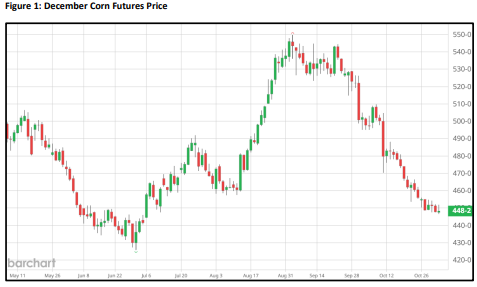
Corn harvest continues to close on the five-year average as the weather allowed further progress over the last week. At 74 percent, harvest pace sits three percent behind the average pace. Harvest in Iowa and Nebraska picked up the pace over the last week but still lag average pace. National corn yield at 181.3 bushels per acre appears to have settled into market expectations with trade analyst leaning a bit lower. Demand moves to the forefront for corn price over the near term. Ethanol and export demand remain key drivers for price setting over the near term.
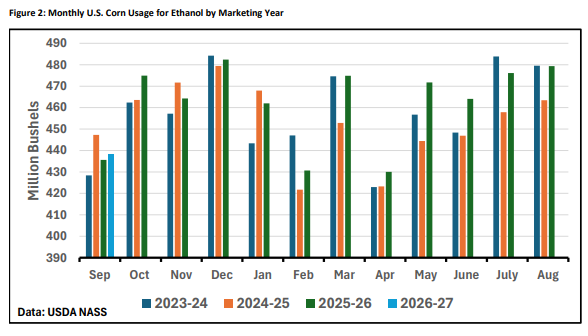
NASS released the September corn grind for ethanol usage on Monday. As shown in Figure 2, the 438-million-bushel estimate came in above last year by 3 million bushels. USDA currently projects corn usage for ethanol at 5.65 billion bushels, up over 100 million bushels from last marketing year. Corn usage of ethanol at that level implies approximately 474 million bushels a month for the remainder of the marketing year. For this to occur, ethanol blending rate needs to stay elevated, ethanol exports need to expand, and milo grind for ethanol production must fall. Ethanol blend rate from June through August averaged 10.85 percent, up from 10.45 percent during the same period in 2025. Ethanol exports closed the 2025-26 marketing year at 2.389 billion gallons, up from 2.135 in 2024-25 and a record level by a significant margin. Data from September and October place ethanol exports at a similar pace to the 2025-26 level. Milo usage for ethanol closed the 2025-26 marketing year at 118 million bushels. August milo grind totaled 6.1 million bushels, the lowest level since February 2025. The smaller milo crop places a reduced milo grind in the picture. Uncertainty on China’s export demand will hang over this number on the milo balance sheet for the next two quarters. Larger corn usage for ethanol looks feasible at this point particularly due to high energy prices in the U.S. and around the globe supporting increased blending of biofuels.
Corn export sales sit behind the pace to hit USDA’s recently lowered forecast of 3,350 million bushels. Total commitments sit at 925 million bushels through October 22. Outstanding sales comprise 528 million bushels of the commitments. New crop sales need to equal 54 million bushels per week over the remainder of the marketing year to meet the forecast. Over the last two weeks, corn net sales averaged 55.7 million bushels per week. Expect corn sales to pick up in the coming months as U.S. corn supply becomes finalized and hits the market.
Soybean Market Outlook:
The November soybean future price closed on Monday at $12.05 per bushel, dropping a little over seventeen cents from the open. The harvest price is dropping into the range last seen in late July and early August of $11.70 – $12.10. USDA’s yield projection of 53.1 bushels appears destined to be close to the final yield. Harvest picked up over the last two weeks and sat above the five-year average pace as October closed out.
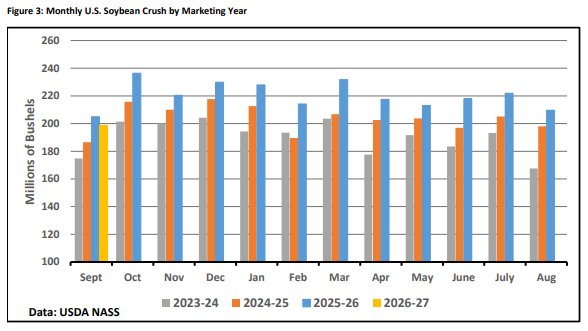
Soybean crush in September totaled 198.8 million bushels in USDA’s latest crush report. At USDA’s forecast of 2,780 million bushels, a monthly crush pace of 234.6 million bushels is necessary to reach the projection. At 7.7 million bushels per day for remainder of the marketing year, the forecast remains feasible given expanded capacity and strong margins. Last marketing year saw a daily crush rate of 7.25 million bushels. USDA’s Fats and Oilseed Crush report showed soybean oil and meal extraction rate totaled 56.8 pounds per 60-pound bushel in September. Extraction at that level is exceptionally low and suggests an adjustment to the September report will occur from NASS. The soybean oil extraction rate totaled 11.62 pounds per bushel for the month, down from September 2025’s total of 11.74 pounds. Last marketing year saw a soybean oil extraction rate of 11.6 pounds per bushel. Given the demand for soybean oil associated with biofuels, expect crush to remain robust.
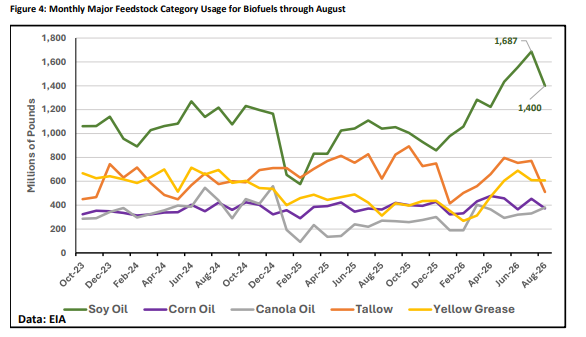
The EIA released feedstock usage for August biofuels production last week. Soybean oil for biofuel usage came in at 1.4 billion pounds as shown in Figure 4. While the total was down from July’s massive 1.68 billion pounds, August usage eclipsed the August 2025 consumption by 359 million pounds. The last two months place marketing year levels at 14.9 billion pounds, slightly higher than USDA’s current projection. Expect continued strong demand for soybean oil over the next marketing year as obligated parties attempt to meet volume obligations for the Renewable Fuels Standard.
Soybean meal exports started the marketing year running a bit behind USDA’s forecast of 22,700 thousand short tons. At 29 percent of marketing year totals through October 22, exports sit eight percent behind the average pace. It remains early in the marketing year and developments with South American crops will go a long way in determining if USDA’s forecast materializes. Nearby soybean meal futures fell from $365 per ton on October 15 to close at $321 per ton yesterday. Strong crush and lower prices should make U.S. soybean meal competitive in the world market.
Soybean exports are off to a good start this marketing year with Chinese buying supporting the recent growth in export sales. Total commitments through October 22 sat at 1,057 million bushels with outstanding sales making up 702 million bushels of the commitments. Chinese export commitments made up 548 million bushels of the total. Chinese buying is well into the 925-million-bushel (25 million metric tons) level agreed in prior trade negotiations. While recent sales have been supportive, USDA’s 1,695-million-bushel projection still seems a prudent level given the potential for the Brazilian crop and uncertainty in geopolitical factors.