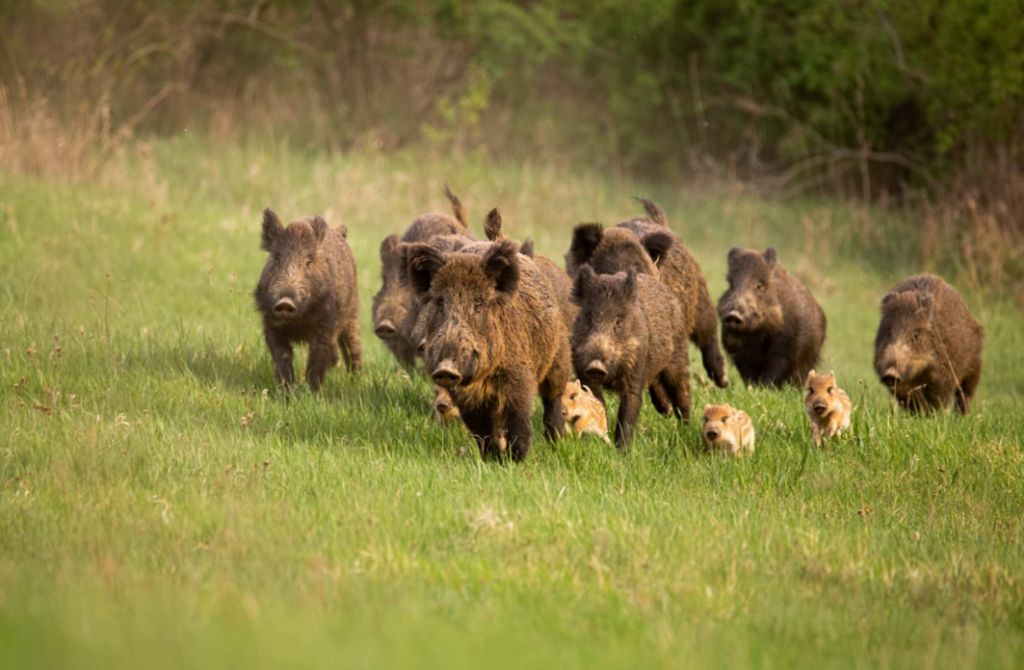
The U.S. Department of Agriculture (USDA) has awarded $51.9 million to 29 partnership projects in 13 states to help partners respond to the threat feral swine pose to American agriculture, landscapes and human and livestock health. The awarded projects are part of a broader $105 million investment for the Feral Swine Eradication and Control Pilot Program, where USDA’s Natural Resources Conservation Service (NRCS) and USDA’s Animal and Plant Health Inspection Service (APHIS) are working together to target feral swine.
“Feral swine pose a threat to America’s working lands, and through this program, we’re bringing together America’s agricultural producers and partners to combat feral swine and protect agricultural landscapes,” said NRCS Chief Colton L. Buckley. “The selected projects will take critical steps to eradicate and control feral swine across the nation where their impact is creating the most harm.”
“Feral swine continue to inflict serious damage on America’s farms, ranches, and natural resources, ” said APHIS Administrator Kelly Moore. “APHIS looks forward to continuing to work with NRCS partners to augment and strengthen our efforts to eradicate and control feral swine populations for the benefit of agricultural and natural resources. Together, we can and will advance the eradication of feral swine and reduce the harm they cause to American farmers and the nation’s natural resources.”
Projects were awarded in Alabama, Arkansas, California, Florida, Georgia, Louisiana, Mississippi, Missouri, North Carolina, Oklahoma, South Carolina, Tennessee and Texas. The funding for the projects was provided by the Working Families Tax Cuts Act, which delivers the largest long-term investment in NRCS conservation programs in decades.
Selected Projects
A few examples of projects include:
Texas State Soil & Water Conservation Board (TSSWCB): Three projects were awarded across Baylor, Brown, Coleman, Fannin, Haskell, Knox, Lamar, Runnels and Red River counties. The projects’ goals are to reduce the population of feral swine so it can be controlled by trained and equipped local landowners using practical, science-based information and coordinated management strategies. Over the five-year project period, TSSWCB expects to directly engage roughly 200 producers and affect approximately 1 million working acres.
Alabama Soil & Water Conservation Committee (ASWCC): Four projects across Baldwin, Barbour, Bullock, Lamar, Mobile, Monroe, Pickens, Sumter and Wilcox counties were awarded to reduce feral swine populations and associated agricultural and natural resource damage. The projects expect to conduct activities on at least 100,000 acres, assisting producers and landowners to restore land damaged by feral swine.
Louisiana Department of Agriculture & Forestry (LDAF): The focus of the awarded project will be 16.6 million acres across 27 parishes, spanning portions of the Red River Basin and Mississippi River Basin. This effort will help establish enhanced surveillance and trapping methods across diverse land uses, improve landowner participation through education and field-based instruction, conduct consistent natural resource damage assessments, and expand coordinated removal operations across the project area.
Feral swine can have significant negative impacts on plant and wildlife habitats, soils, water quality, as well as other natural resources. Livestock and humans are also susceptible to diseases carried by feral swine.
The partners selected to participate in the Feral Swine Eradication and Control Pilot Program will provide landowner assistance for restoration and on-farm trapping efforts and provide related services, like training. Funding for these services will be provided through grant agreements between partners and NRCS.
All projects will be a collaborative and coordinated effort among the selected partner, NRCS and APHIS.
More Information about the Pilot Program
Since 2020, NRCS has invested $92.9 million in 63 projects as part of the Feral Swine Eradication and Control Pilot Program. These projects have assisted more than 6,700 landowners on almost 9 million acres to help reduce feral swine damage. Additionally, partners have conducted more than 800 events related to teaching trapping techniques to landowners.
For more information on the program and to find pilot projects, visit NRCS’s Feral Swine Eradication and Control Pilot Program webpage.
For more than 90 years, NRCS has helped farmers, ranchers and forestland owners make investments in their operations and local communities to improve the quality of our air, water, soil, and wildlife habitat. NRCS uses the latest science and technology to help keep working lands working, boost agricultural economies, and increase the competitiveness of American agriculture. NRCS provides one-on-one, technical assistance and financial assistance and works with producers to help them reach their goals through voluntary, incentive-based conservation programs.
For more information, visit https://www.nrcs.usda.gov.