
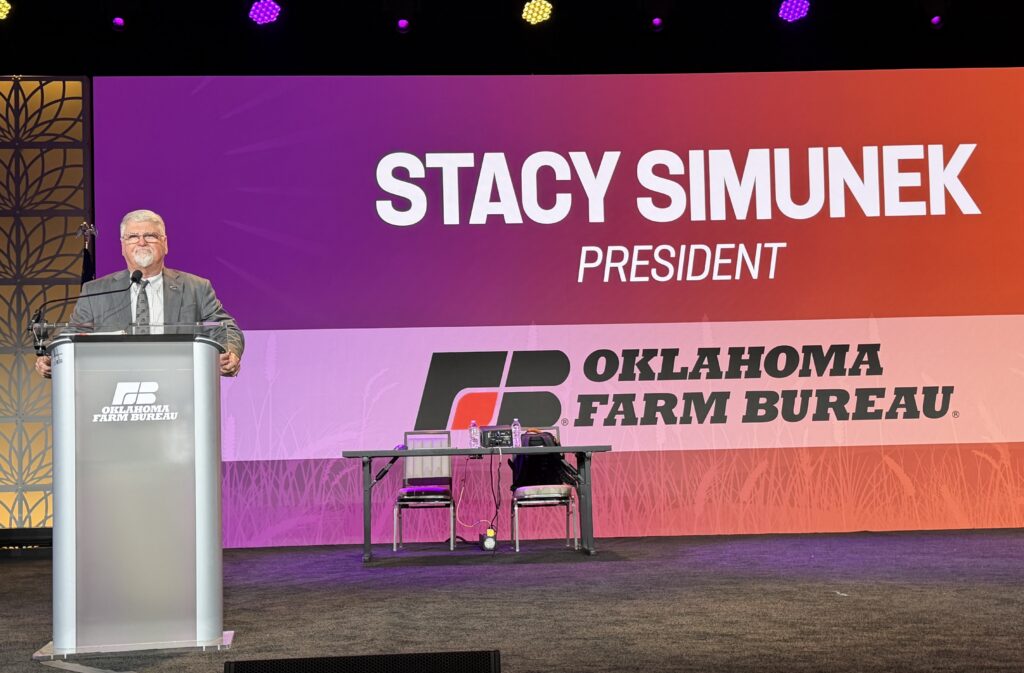
As grassroots delegates wrapped up the policy resolution sessions at the 2026 Oklahoma Farm Bureau (OKFB) Annual Meeting in downtown Oklahoma City, the message from the countryside was clear: Oklahoma agriculture welcomes economic development, but only with ironclad safeguards for natural resources, rural communities, and accountability.
Speaking with Senior Farm and Ranch Broadcaster Ron Hays of the Oklahoma Farm Report, OKFB President Stacy Simunek highlighted the membership’s proactive approach to emerging industrial developments—including proposed data centers and an aluminum smelter planned near Inola—alongside landmark progress on statewide water policy.
“In between the smelter, the data centers, and new industry coming out, I think we should be worried and concerned anytime we’ve got new industry coming into the area that we don’t know,” Simunek said. “We want to make sure that they’re running properly by the rules and regulations that are out there. And I think that’s what we got across today in these resolutions: we don’t mind new industry coming in, as long as they’re doing it properly and by the rules.”
During the Data Center discussion, Delegates called for a “transparent, science based permitting process that protects agriculture and private property rights.” They also approved resolutions designed to ensure state and local officials maintain strict transparency and regulatory oversight, ensuring industrial growth does not compromise rural safety.
Doing the Homework on Aluminum Smelters
A major point of anxiety for northeastern Oklahoma producers has been the environmental and livestock health implications of a proposed aluminum smelting facility in Rogers County. Rather than relying on rumors, Simunek launched a fact-finding mission to Kentucky to examine real-world impacts.
Simunek reached out directly to the president of the Kentucky Farm Bureau, who farms just two miles from an operating aluminum plant.
“My question to him was, ‘Are you having the issues that we’re seeing?’ I went through the issues that we were told we would have, and he said, ‘Absolutely not,'” Simunek explained.
Simunek arranged joint calls with University of Kentucky experts, including a veterinarian who cautioned producers against believing online misinformation, and a state veterinary pathologist who had actively pulled ground and tissue samples on the Kentucky Farm Bureau president’s farm during an unrelated herd health investigation. The pathologist confirmed that testing showed zero evidence of fluoride contamination or related livestock toxicity. Furthermore, a major Tyson commercial feed mill operates between the plant and surrounding farms without issue.
According to the Kentucky leadership, the economic impact helped revitalize an economically distressed region into one of the state’s most prosperous, funding top-tier local schools and infrastructure.
“In his opinion, it’s a very good neighbor,” Simunek said. “There was no ‘no’ to these industries [in our resolutions]. We want to just make sure they’re safe to come to Oklahoma before they come.”
Unanimous Backing for Water Policy
Water security remains another cornerstone issue for Oklahoma farmers and ranchers, driven by population growth and shifting regional demands between eastern and western Oklahoma.
Following more than two years of work by OKFB’s dedicated water committee—which convenes up to six times annually—delegates unanimously adopted a comprehensive slate of water policy recommendations without objection from the floor.
“Knowing that the body now has started to trust that water group and trust the opinions they’re bringing to them, that’s a good sign that we’re headed in the right direction,” Simunek noted.
Simunek emphasized that effective water management cannot rely on a one-size-fits-all mandate. He recently spent nearly a week studying the Ogallala and local groundwater dynamics in the Oklahoma Panhandle, as well as meeting with producers in Beckham County.
“All the aquifers are a little different; all of them need something a little different,” Simunek said. “I think we can get that done this year at the legislature season. I think there’s a path forward to start protecting our resources for our future.”
A High-Throttle First Year at the Helm
Reflecting on his first full year holding the OKFB presidential gavel after succeeding Rodd Moesel, Simunek described his tenure as both grueling and deeply fulfilling.
“It is the highest-stress job I’ve ever had, and the most rewarding at the same time,” Simunek reflected. “We are busy all week, every week. It has not let down, and it’s because we’re out there protecting ag. We’re concerned about what’s coming in the future, and we’re not letting off the throttle… If we find a problem, we go to it to bring back answers for our members.”