
As the growing season comes to a close across Oklahoma, cotton producers are finishing up fieldwork following a demanding year defined by severe weather. Farm Director KC Sheperd recently caught up with Oklahoma State University Extension Cotton Specialist Jenny Ebers to review harvest progress, crop conditions, and planning strategies for the upcoming season.
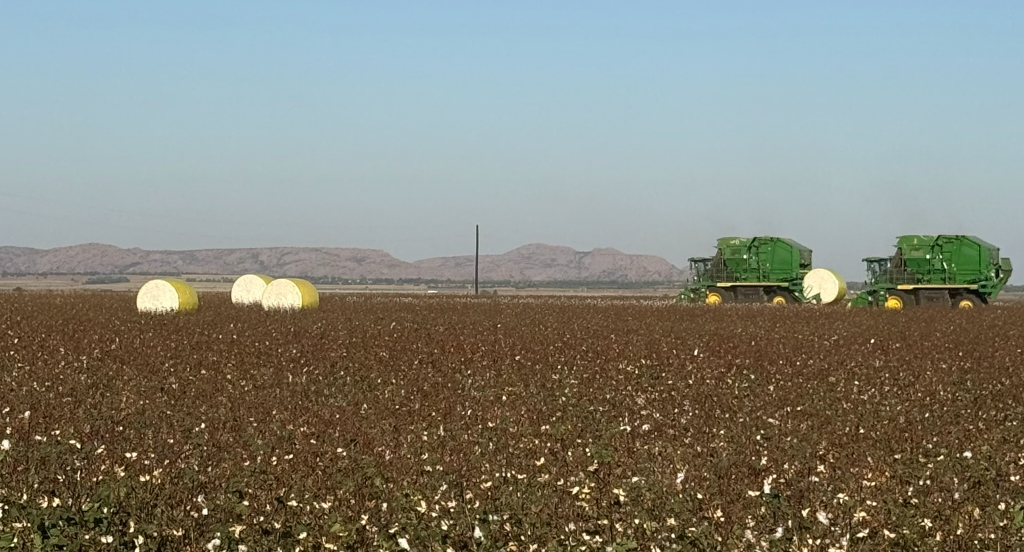
Harvest activity is well underway across the state, with some operations getting an earlier start than usual. According to the latest USDA NASS Crop Progress report, Oklahoma cotton harvest is approximately 51% complete, with 95% of bolls opening. While some early-maturing irrigated fields (such as those around the Fort Cobb area) were stripped early, a significant portion of the state’s acreage is still being harvested or waiting on harvest aid treatments to finish out.
“Right now, I mean, everything’s pretty well open and everyone that’s going to harvest is should be fixing to start harvesting pretty soon if they haven’t already,” Ebers said. “So we’re kind of wrapping up the end of the year here.” She noted that early harvest operations began particularly around the Fort Cobb area, where growers who made a crop got into the fields quite a bit earlier.
Extreme weather served as the defining factor for the crop, with prolonged high temperatures amplifying the effects of dry conditions.
“Obviously the drought was big, that put a lot of pressure on our guys, but coupled with that drought was extreme heat,” Ebers explained. “We accumulated a lot of heat units throughout this growing season, especially in July, August, and September. We live in Oklahoma, we’re used to drought, we’re used to growing cotton in little to no rain, but I think the heat unit accumulation is what really got us this year.”
Because of the severe heat and water deficits, yield outcomes vary widely across operations. Ebers stated that yields are “kind of all over the place” and strongly tied to available moisture. Whether a field was irrigated and the total volume of irrigation applied largely dictated the final outcome. Reports on fiber quality are not yet available, though Ebers anticipates data will begin rolling in soon.
One silver lining of the prolonged hot, dry weather was reduced pressure from pests and weeds. Ebers observed that weed and insect pressure remained lower this year compared to seasons with more ambient moisture to fuel unwanted growth.
Regarding seed performance, definitive variety results are still pending. OSU Extension still has two replicate variety trials in the field, and performance insights will be shared once that harvest data is processed.
With market prices struggling to clear the 78-cent mark, Ebers encouraged producers to take a proactive approach to cost management as they prepare for the 2027 season. Decisions will depend on individual operational setups, but evaluating input expenses is critical.
“Might think about lowering our seeding rate, trying to save costs there,” Ebers suggested. “Residual herbicides, I know it’s an upfront cost, but they do save us some time and some money on some of those in-season herbicide applications, or they can, depending on how much rain we get after we apply those products. Just kind of thinking about being proactive and then maybe looking at where we can cut costs this year.”
Reflecting on the grueling season, Ebers emphasized that poor results were not due to lack of effort on the part of growers.
“I think everybody did everything right this year, it’s just Mother Nature beat us this year,” Ebers said. “Unfortunately that does happen, but Oklahoma cotton producers are some of the most hardy folks that I’ve ever met. Just keep on keeping on, stay resilient.”