

In today’s Beef Buzz, senior farm and ranch broadcaster Ron Hays continues his conversation with Dan Halstrom, president and CEO of the U.S. Meat Export Federation (USMEF), about emerging opportunities for U.S. beef exports in Africa, the importance of maintaining the U.S.-Mexico-Canada Agreement (USMCA), and the outlook for international beef demand heading into 2027. As USMEF celebrates its 50th anniversary, Halstrom says the next 50 years could bring significant opportunities for the U.S. meat industry. See parts one and two here.
Africa Presents Growing Opportunities for U.S. Beef Exports
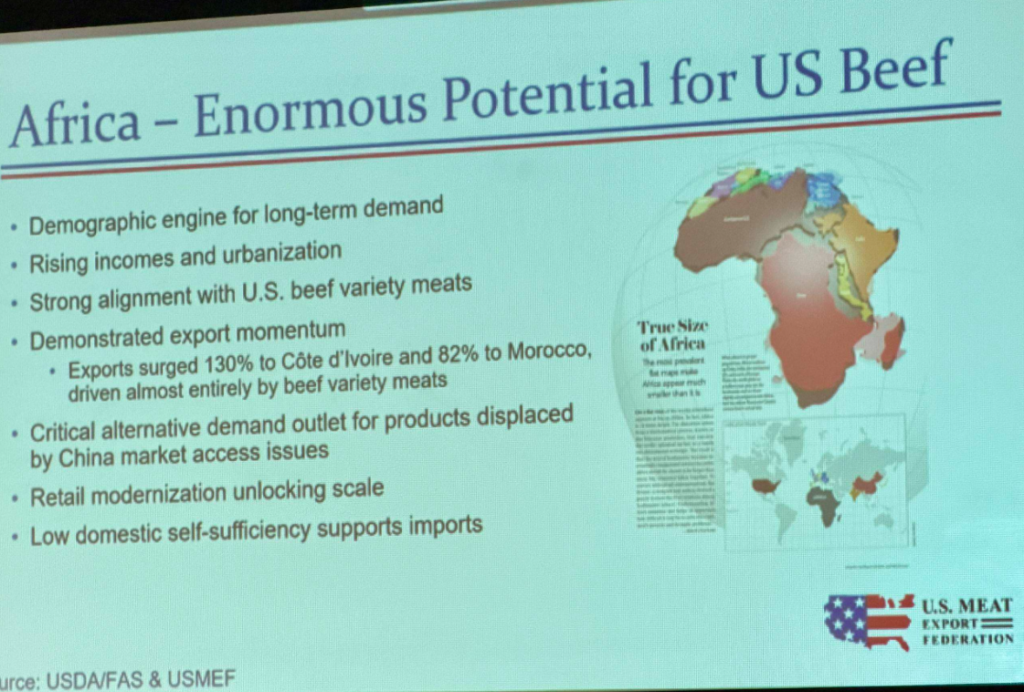
With more than 50 countries across the continent, Halstrom believes Africa represents an important opportunity for long-term growth in U.S. beef exports. He points to the continent’s young population and expanding middle class as key factors that could drive demand for higher-quality imported beef in the years ahead. “Africa is probably the youngest demographic in the world,” Halstrom said. “Depending on who you talk to the average age is 19 years old, 20 years old.”
He explained that as more of that population enters the workforce, starts families and gains spending power, demand for higher-quality food products could increase. “You just imagine 10 years from now the spending power that’s going to come, and the middle class that’s going to grow,” he said.
While variety meats have traditionally provided an entry point into these markets, Halstrom said the long-term goal is to expand demand for U.S. muscle cuts.
“That’s where we’re starting to see some evidence of folks wanting a better, higher-quality product that’s imported,” he said. “It starts with variety meats, but the real goal is muscle cuts, and we’re starting to see some progress there.”
He pointed to Senegal as one example, where U.S. beef muscle cuts are being air freighted in for food service. “Yeah, we’re excited about the prospects. We’re just starting to scratch the surface today,” Halstrom said.
Building a Stronger Supply Chain for U.S. Beef
Expanding U.S. beef exports into Africa will require more than simply introducing new products. Halstrom said developing a stronger supply chain and educating consumers about the quality of U.S. beef will be important to growing the market.
He explained that many consumers in these markets have limited experience with higher-quality imported beef, creating an opportunity to demonstrate the difference. “Our goal is the muscle cuts,” Halstrom said. “These countries don’t know what they don’t know.”
He described how consumers may have a very different understanding of beef quality based on the products traditionally available to them. “You get U.S. beef, you know, get a chuck roll steak, for example, in their mouths, and they’re like, ‘This is beef,’” he said.
Halstrom believes introducing consumers to U.S. beef quality and continuing to tell the industry’s story will be essential to building lasting demand. “I just think the opportunity is enormous, but we have to continue to push forward and tell our story,” he said.
USMCA Remains Critical to Beef and Pork Exports
Turning closer to home, Halstrom discussed the importance of maintaining the U.S.-Mexico-Canada Agreement as the United States works through negotiations with its North American trading partners.
He emphasized that Canada and Mexico represent some of the most important export markets for the U.S. meat industry. “Over 40% of our pork exports go to the USMCA, and over 20% of our beef exports,” Halstrom said. “I would say there’s no region more important to what our business does.”
He explained that the importance of the agreement extends beyond finished meat products, with the three countries operating through a highly integrated agricultural system. “It’s not just U.S. beef. It’s corn. It’s soybeans. It’s piglets from Canada coming down. It’s feeder cattle from Mexico coming up,” he said.
“We’re so integrated, and it works so efficiently today from our perspective that this is, and I think a lot of other parts of the industry would agree, we have to protect that.”
Reopening the Mexican Border Brings Greater Stability
Halstrom also addressed the impact of the delay in reopening the U.S.-Mexico border to feeder cattle following concerns about New World screwworm.
He said the extended closure created concerns about the potential for Mexico to expand its own cattle industry as an alternative to sending feeder cattle into the United States. “All we’re doing indirectly is incentivizing growing the cattle industry in Mexico as a competitor,” Halstrom said.
While he acknowledged the need to protect the U.S. cattle industry from New World screwworm, he said reopening the border has helped restore confidence in the relationship. “But I think the fact that we’re reopened now, we’re getting back to some normalcy in that area,” he said. “We feel much better about it now.”
Halstrom Optimistic About Beef Export Demand Through 2027
Looking ahead through the remainder of 2026 and into 2027, Halstrom said he remains optimistic about international demand for U.S. beef.
He pointed to continued strength in established markets, along with opportunities in emerging regions such as Central America and Africa. “With demand where it is, and as I said earlier, demand is off the charts in a lot of these countries, I think we’re very optimistic going forward,” Halstrom said.
He recently traveled to Colombia, where he saw firsthand how far U.S. beef promotions have come in international markets. “Prime promotion, you know, on U.S. beef in Colombia. That, you know, 10 years ago, that was unheard of,” he said. “So it’s exciting to see this development.”
USMEF Celebrates 50 Years and Looks Toward the Future
As USMEF prepares to celebrate its 50th anniversary, Halstrom said the organization is looking beyond its history and focusing on the opportunities ahead.
Founded in 1976, USMEF has spent five decades developing international markets for U.S. beef and pork.
While the anniversary provides an opportunity to recognize the organization’s accomplishments, Halstrom said the future is what excites him most. “We’re really excited about the opportunity to celebrate that with our members,” he said. “But we’re going to celebrate the potential for the next 50. That’s really where it gets exciting.”
The Beef Buzz is a regular feature heard on radio stations around the region on the Radio Oklahoma Ag Network and is a regular audio feature found on this website as well. Click on the LISTEN BAR above for today’s show and check out our archives for older Beef Buzz shows covering the gamut of the beef cattle industry today.







