Thu, 03 Nov 2022 10:37:11 CDT
U.S. Department of Agriculture (USDA) Secretary Tom Vilsack and Ambassador Susan Rice, White House Domestic Policy Advisor, today announced the expansion of the Rural Partners Network (RPN) to 17 commu…
Nov 03
Thu, 03 Nov 2022 10:37:11 CDT
U.S. Department of Agriculture (USDA) Secretary Tom Vilsack and Ambassador Susan Rice, White House Domestic Policy Advisor, today announced the expansion of the Rural Partners Network (RPN) to 17 commu…
Nov 03
Thu, 03 Nov 2022 10:34:03 CDT
The first Saturday in November offers everyone an opportunity to rally around a symbol of national unity, as National Bison Day celebrates the cultural, historical and economic significance of our National Mammal. The American bison is at home in a wide variety of climates across the continent, with herds today found in American parks, refuges, national forests and grasslands, Tribal lands, private conservancies, ranches and farms.
Since 2013, the United States Senate annually has designated the first Saturday in November as National Bison Day. This resolution has the full support of a community bound by the heritage of the American Bison and includes the National Bison Association, the Wildlife Conservation Society and the InterTribal Buffalo Council. These three organizations championed the enactment of legislation in 2016 designating bison as the National Mammal of the United States.
Today’s bison herds continue to grow despite a three-year cycle of pandemic, drought, and economic uncertainty. There are exciting advances in understanding bison through the Center of Excellence for Bison Studies, established in 2020 within the South Dakota State University system. Researchers and academics from across the country are bringing together projects to improve the ability of bison caretakers to manage healthy herds and produce healthy meat.
As bison return to the landscape, the National Bison Association remembers their rebound from near extinction only 150 years ago. With this National Bison Day we celebrate the heritage of the buffalo, strive to keep learning more, and create a sustainable future for the caretakers of the animals.
Nov 03
Thu, 03 Nov 2022 10:31:36 CDT
Annual Award Recognizes Stewardship Efforts of Cattle Producers
Applications are being accepted until March 10, 2023, for the National Cattlemen’s Beef Association 2023 Environmental Stewa…
Nov 03
Thu, 03 Nov 2022 09:35:51 CDT
Senior Farm and Ranch Broadcaster, Ron Hays, is featuring comments from the president and CEO of the U.S. Meat Export Federation, Dan Halstrom, about August beef export numbers in 2022.
Halstrom said tha…
Nov 03
Thu, 03 Nov 2022 09:25:27 CDT
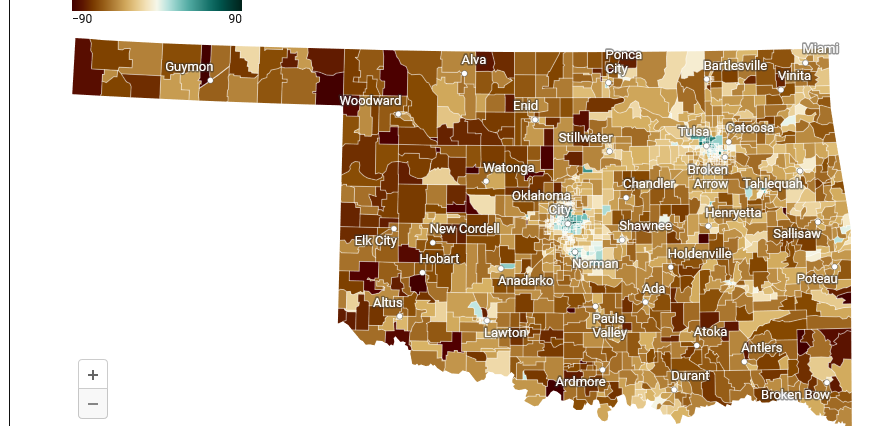
Chances for rain in the next week remain, and after recent precipitation, drought in Oklahoma has improved slightly in some categories while remaining unchanged in others.
In Oklahoma, exceptional …
Nov 03
Thu, 03 Nov 2022 08:45:30 CDT
The 2023 Oklahoma Ag in the Classroom Art & Photography Contest is now LIVE!!
Our theme this year is Oklahoma Agriculture: Our Roots Run Deep. We hope you will explore Oklahoma’s rich agricul…
Nov 03
Thu, 03 Nov 2022 02:53:33 CDT
OKC West Livestock Auction – El Reno, OK
Wed Nov 2, 2022
AUCTION
This Week 8,239
Last Repo…
Nov 02
Wed, 02 Nov 2022 15:24:25 CDT
The U.S. Department of Agriculture and the Oklahoma Department of Agriculture are now putting the Daily Cash Grain Report into a PDF format – we are saving that PDF and archiving them for today’s specific report. To see today’s update, click on the PDF report link at the bottom of this story.
In addition to the PDF of the daily report, you can also listen to the Cash Grain Report by calling 405-621-5533. Push 2 for the grain report.
Click here: 04947_OklaCashGrain11022022.pdf
Nov 02
Wed, 02 Nov 2022 14:40:24 CDT

Listen to today’s report with Justin Lewis, by clicking or tapping on the LISTEN bar
Justin Lewis of KIS Futures has all the details on today’s agricultural markets for RON listeners, below.
Nov 02
Wed, 02 Nov 2022 13:40:38 CDT

Oklahoma State University researchers have joined Texas A&M University and Kansas State University in a $2 million collaborative research project to develop better nitrogen management practices for producers.
The U.S. Department of Agriculture’s Partnerships for Climate-Smart Commodities project could be allotted up to $65 million with $2 million of the funding going to the research side of the project while the rest will go toward the United Checkoff Program, which will help producers implement better nitrogen management practices and adopt smart technology into their operations.
“We’re all Extension specialists, so basically, that means we take the research straight into the field, and by the end of this five-year project, we will have tools and strategies to put out there that are aimed at increasing nitrogen use efficiency,” said Brian Arnall, Oklahoma State University Extension specialist for precision nutrient management. “All three universities are doing the same base set of treatments and analysis, then we may add some regionally specific ideas on nitrogen management.”
Nitrogen management research is usually conducted in a variety of regions and examines factors specific to the area. Examples include studying specific fertilizers commonly used in Oklahoma or GreenSeeker technology, which reads crop health and uses an N-Rich strip to make precision nitrogen rate recommendations.
“The question is can we protect the nitrogen we’ve applied with products that are in the marketplace to keep nitrogen from being lost?” Arnall said. “What’s nice about this project is many of us are already doing work like this on our own. This just allows a concerted effort to better focus in on management practices that can be adapted across the plains.”
The research will re-evaluate nitrogen management guidelines. Arnall said in most of his research, he evaluates nutrient stabilizers and nitrogen safener technology.
Jason Warren, OSU Extension specialist for soil and water conservation, and Josh Lofton, OSU Extension specialist for cropping systems, will look at how nitrogen management affects nitrous oxide transmissions from sorghum and the impact of nitrogen management on plant physiology.
Lofton said most of the applied research conducted within plant and soil sciences at OSU, whether related to nitrogen or soil health, is connected to climate change.
“In Oklahoma, it’s not necessarily just research to see the top end yield of a crop. Our job is to be focused on our environmental conditions and limit the cost and excessive inputs across the board. We’re focused on putting the right things in the right places at the right time,” Lofton said. “This current project came together because of decades worth of work that wasn’t focused directly on climate change but had it in the background. Now that we have the background information, we can focus on more direct aspects of how the agricultural system and crop is affecting the climate.”
This material is based upon work supported by the Climate-Smart Commodities Project under the U.S. Department of Agriculture. Any opinions, findings, conclusions or recommendations expressed in this publication are those of the author(s) and do not necessarily reflect the view of the USDA.
OSU Ag Research is Oklahoma’s premier research and technology development agency in agriculture, natural resources and the life sciences.