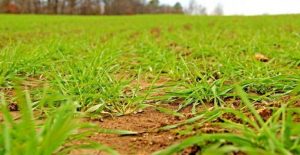
Nationwide Winter Wheat: Winter wheat planted in the U.S. reached 92 percent, up 2 percentage points from the previous year and the average. Winter wheat emerged reached 73 percent, even with the previous year and down 1 point from the average. Winter wheat conditions for the states reported rated 30 percent good to excellent, 36 …
Category: Top Ag News
Nov 07
Oklahoma CattleWomen President Cheyenne Sparks Gives Overview of Upcoming Events
Farm Director, KC Sheperd, caught up with the president of the Oklahoma CattleWomen’s Association, Cheyenne Sparks, and talked about exciting events coming up for the association. “First and foremost, we have our Region IV meeting,” Sparks said. “ANCW (American National CattleWomen, Inc.) has regions all across the United States, and Oklahoma is in Region IV …
Nov 04
Governor Stitt Allows Farmers and Ranchers to Grow and Produce without Added Regulation or Burden
Senior Farm and Ranch Broadcaster, Ron Hays, got the chance to visit with farmer and rancher from western Oklahoma, Monte Tucker, about his views on the upcoming election for Governor of Oklahoma from an agricultural perspective. “It’s always one of my favorite quotes from Will Rogers is, ‘you have to remain politically active to …
Nov 03
War Between Russia and Ukraine to Continue Impacting Wheat Prices and Potentially Corn
Thu, 03 Nov 2022 16:43:49 CDT
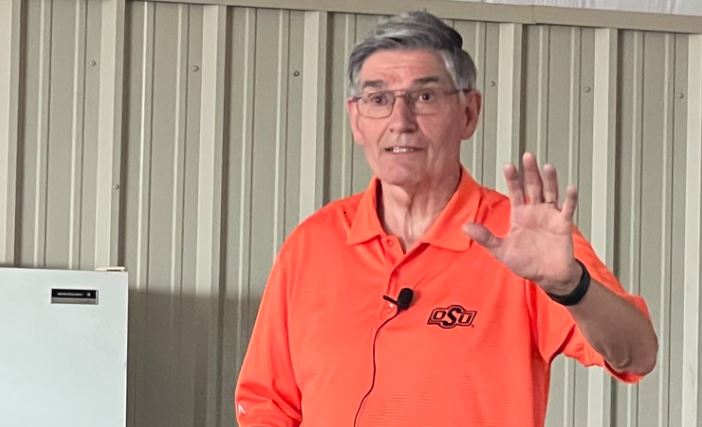
This week on SUNUP is Dr. Kim Anderson, Oklahoma State University Extension grain market economist. During this week’s edition, Anderson talks about the factors impacting commodity markets and crop conditions.
“President Putin announced that he was not going to support Ukraine exporting wheat, and wheat prices went up 55 cents per bushel,” Anderson said. “Then he announced that he would support the export of wheat, and prices fell 48 cents a bushel. So, we have prices right now somewhere around the 9-dollar level. The basis is 46 cents.”
If you are looking at forward contracting wheat for the 2023 crop, Anderson said it is $8.75 with a minus 55 cent basis off of that Kansas City July contract for 2023.
“Corn continues to move in an 18-cent range sideways,” Anderson said. “Prices are about 6 dollars for forward contracting for 2023, and the basis is 25 cents under that ’23 December corn contract.”
We had a rally in soybeans, Anderson said, not because of the war but because of the weather in South America. There was a 36-cent price increase to prices around $14.19.
“Forward contract for beans is around $13.10 for the ’23 crop with a minus 85 cent basis,” Anderson said.
Cotton is falling from $1.20 about a month ago down to 72 cents early this week and back up to 79 cents, Anderson said, so it looks like cotton has probably bottomed out.
“The USDA released the crops condition report for wheat,” Anderson said. “84 percent of Oklahoma wheat is planted, and the average is 85.62 percent of that wheat has emerged, and the average is 66 percent.”
36 percent of that wheat is in the poor to very poor category, Anderson said, and only 11 percent at good to excellent.
“A big factor for wheat is that war between Russia and Ukraine, and it looks like that war is going to be dragged out over years,” Anderson said. “It appears that when something happens to disrupt the flow of product out of Ukraine, we get about a 50 to 60 cent price move. We saw that this last week.”
Ukraine’s wheat right now, Anderson said, is worth about 60 cents a bushel.
This week on SUNUP:
• Brian Arnall, OSU Extension precision nutrient management specialist, has soil fertility guidance for wheat producers.
• Wes Lee, OSU Extension Mesonet agricultural coordinator, discusses the total daily average solar radiation for the year so far. State Climatologist Gary McManus looks back at the month of October and how the recent rains impacted the drought monitor.
• Mark Johnson, OSU Extension beef cattle breeding specialist, talks with Parker Henley, OSU Extension beef seedstock management specialist, about fall vaccinations in cattle herds.
• Kim Anderson, OSU Extension grain marketing specialist, gives condition reports for Oklahoma crops.
• Barry Whitworth, OSU Extension veterinarian, discusses the recent uptick in rabies cases in the state and says livestock producers need to be extra careful when handling sick animals.
• We travel to Noble County for an OSU Extension workshop that helps producers determine how much or how little feed they’re giving their herds.
• Finally, we highlight the 2022 Ferguson College of Agriculture Distinguished Alumni and OSU Agriculture Champions. Dr. Tom Coon recognized the esteemed group at the recent OSU Agriculture Honors ceremony.
Join us for SUNUP:
Saturday at 7:30 a.m. & Sunday at 6 a.m. on OETA (PBS)
YouTube.com/SUNUPtv
SUNUP.okstate.edu
Nov 03
Oklahoma Wildlife Department- Statewide Quail Numbers Up Six Percent from 2021
Thu, 03 Nov 2022 09:44:38 CDT
Quail Season Prospects Slightly Higher for 2022-23- 2022 Quail Roadside Survey Results and Quail Hunting Outlook
By Tell Judkins, Upland Game Biologist
More than 30 years ago, the Oklahoma …
Nov 02
Higher-Priced Turkeys on the Holiday Menu
Wed, 02 Nov 2022 12:06:45 CDT
The worst HPAI outbreak in U.S. history takes another bite out of turkey supplies
U.S. consumers can expect to pay more for their Thanksgiving turkeys this year as supplies have dwindled followin…
Nov 02
Ag Economy Barometer Declines Again, Producers Worry About Interest Rate Policy
Wed, 02 Nov 2022 04:39:08 CDT
Farmer sentiment weakened again in October as the Purdue University/CME Group Ag Economy Barometer dropped 10 points to a reading of 102. Both of the barometer’s sub-indices also declined this month. The Current Conditions Index dipped 8 points to a reading of 101 while the Future Expectations Index dropped 11 points to a reading of 102. The Ag Economy Barometer is calculated each month from 400 U.S. agricultural producers’ responses to a telephone survey. This month’s survey was conducted between October 10-14.
“Concern over rising interest rates grew once again in October and is adding to the unease amongst producers who are worried about its impact on their farm operations,” said James Mintert, the barometer’s principal investigator and director of Purdue University’s Center for Commercial Agriculture. “Additionally, challenging shipping conditions throughout the Mississippi river valley have hampered exports recently and the corresponding widespread weakening of corn and soybean basis levels could be contributing to heightened unease about financial performance.”
Producers’ concerns about their farm’s financial performance were one of the primary drivers of weakening sentiment in October. The Farm Financial Performance Index fell 13 points this month to 86 and was a distillation of producers’ concerns about high input costs combined with weaker commodity prices. Looking ahead to next year, over 40% of producers viewed high input costs as their top concern, followed by 21% who chose rising interest rates, 13% who chose lower output prices, and 13% who chose input availability.
After dipping to a new record low last month, the Farm Capital Investment Index improved 7 points this month to a reading of 38. Producers who viewed this as a bad time for large investments revealed that increasing prices for farm machinery and new construction (40% of respondents) was the primary reason for their negative outlook, followed by rising interest rates (20%) and uncertainty about farm profitability (17%).
Producers’ expectations for short and long-term farmland values rose this month. The Short-Term Farmland Value Expectation Index rose 10 points to a reading of 133 while the Long-Term Farmland Value Index rose 5 points to 144. Strength in both indices comes on the heels of reports from farmland auctions around the Corn Belt that land values are setting new record highs again this fall. Even with this month’s rise both indices remain weaker than a year earlier. The short-term index this month was 15% lower and the long-term index was 11% lower than in October 2021.
Farm policy discussions are underway as Congress prepares for debate on a new Farm Bill in 2023. As a result, several farm policy related questions were included in this month’s barometer survey and posed to crop producers. Crop producers were asked which two policies or programs would be most important to their farm in the upcoming five years. More than one-third (36%) of crop producers chose interest rate policy as the most important policy issue for their farming operation, followed by crop insurance program (27%), environmental policy (16%), conservation policy (11%) and climate policy (10%). When asked how effective the current ARC-County and Price Loss Coverage (PLC) programs are at providing a financial safety net, 72% of respondents rated the two programs as either “somewhat” (61%) or “very effective” (11%). When the same question was posed relative to crop insurance, 84% of respondents rated it as either “somewhat” (56%) or “very effective” (28%).
Read the full Ag Economy Barometer report by clicking here. The site also offers additional resources – such as past reports, charts and survey methodology – and a form to sign up for monthly barometer email updates and webinars.
Each month, the Purdue Center for Commercial Agriculture provides a short video analysis of the barometer results, and can be seen by clicking on the play button in the video box below. For more information, check out the Purdue Commercial AgCast podcast available at https://purdue.ag/agcast, which includes a detailed breakdown of each month’s barometer, in addition to a discussion of recent agricultural news that affects farmers.
Nov 01
USMEF Strategic Planning Conference Set for November 9 in Oklahoma City
Tue, 01 Nov 2022 13:01:00 CDT
Click here to listen to audio
Farm Director, KC Sheperd, visited with the president and CEO of the U.S. Meat Export Federation, Dan Halstrom, about exports the upcoming USMEF Strategic Planning C…
Nov 01
Final 2022 Pasture and Range Ratings Show Recent Rains Offered Little Improvement
Tue, 01 Nov 2022 09:35:44 CDT


The last Crop Progress report in October each fall gives us a look at the USDA Pasture-Range ratings as we head into the winter season- and 2022 shows us a picture of dire conditions in Oklahoma pasture range ratings that we have not seen since the drought of 2011 and 2012.
The low water mark in that time frame came at the end of October 2011 when the last report of the season showed Oklahoma pasture/range ratings were 2% good and 86% poor to very poor. 2012 showed a 6% good and 70% poor to very poor.
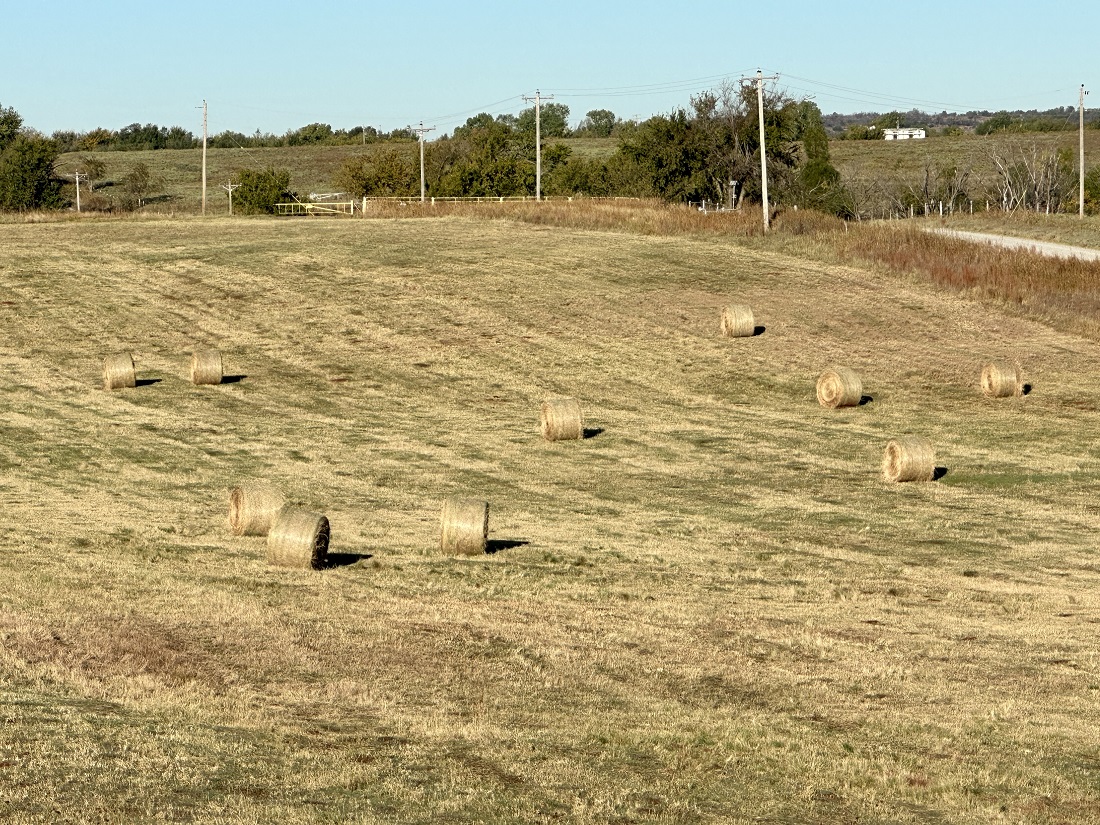
Here in 2022- we were at 2% good a week ago- but the rains of this past week did give us a nudge higher to 4% good this week- even as the poor to very poor ratings slipped another 3 points and stand now at 80% poor to very poor. (this hay field pic of last week shows a few traces of green grass but little time to grow and recover before cold weather- it was seen south of Chickasha along the turnpike)
Nationally- the Oklahoma rating of 80% poor to very poor is the second worse in the US- Nebraska has an 82% poor to very poor rating- while Kansas and Arkansas are right there with ratings of 79% poor to very poor.
A wet late fall and winter will help our pastures and rangelands recover- but there’s no assurances of that out on the horizon. Like 2011 and 2012- drought may impact pastures and rangelands for quite some time.
Looking back at the last pasture/range report of the season- here are the last ten years for Oklahoma and the good to excellent ratings provided by USDA:
Year Good to Excellent Rating
2022 4%
2021 39%
2020 24%
2019 56%
2018 61%
2017 46%
2016 46%
2015 40%
2014 42%
2013 42%
2012 6% (70% Poor to very poor)
2011 2% (86% poor to very poor)
2010 32%
Click here for the October 31st Crop Progress report from USDA.
Oct 31
First Oklahoma Winter Wheat Condition Rating for 2023 Crop Rates 11 Percent Good to Excellent
Mon, 31 Oct 2022 16:06:36 CDT
Dry conditions this fall in the winter-wheat-producing Southern Plains are already taking a toll on the newly planted 2023 crop, USDA NASS reported in its weekly Crop Progress report. However, some pa…