
There are reports of grain elevators turning away grain sorghum this fall due to lack of bin space. Many elevators are prioritizing storage for wheat and corn because of poor export demand for grain sorghum and soybeans. This situation has widened the local basis for grain sorghum, lowering its price but creating opportunities for livestock producers willing to feed it.
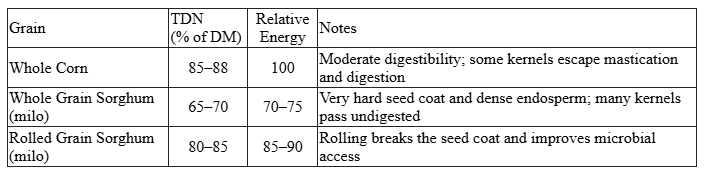
Unprocessed grain sorghum is one of the least digestible cereal grains for cattle. Sorghum has a hard outer seed coat and a dense endosperm where starch is tightly bound to proteins. This starch-protein matrix resists microbial digestion in the rumen, and when fed whole, much of the grain passes through undigested. Total tract starch digestibility of whole sorghum is typically 40 to 60 percent, with total digestible nutrients (TDN) of about 65 to 70 percent. This corresponds to an energy value roughly 70 to 75 percent that of whole corn.
According to the Nutritive Value of Feeds for Beef Cattle factsheet (ANSI-3018; extension.okstate.edu/fact-sheets/nutritive-value-of-feeds-for-beef-cattle.html), whole corn averages 88% TDN, while unprocessed grain sorghum averages 70% TDN—only about 75 to 80% as good as corn. Processing sorghum by rolling or grinding increases TDN to about 86%, improving energy value by roughly 25%. That improvement can significantly impact both rate of gain and feed efficiency in backgrounding or finishing programs.
Grain sorghum can be economical when priced at 90% of corn, but it must be processed to capture its full feeding value. In some areas of Oklahoma, sorghum is currently priced at only 75 to 80% of corn—making it an attractive, cost-effective feed option for supplementation and feeding programs this winter.