
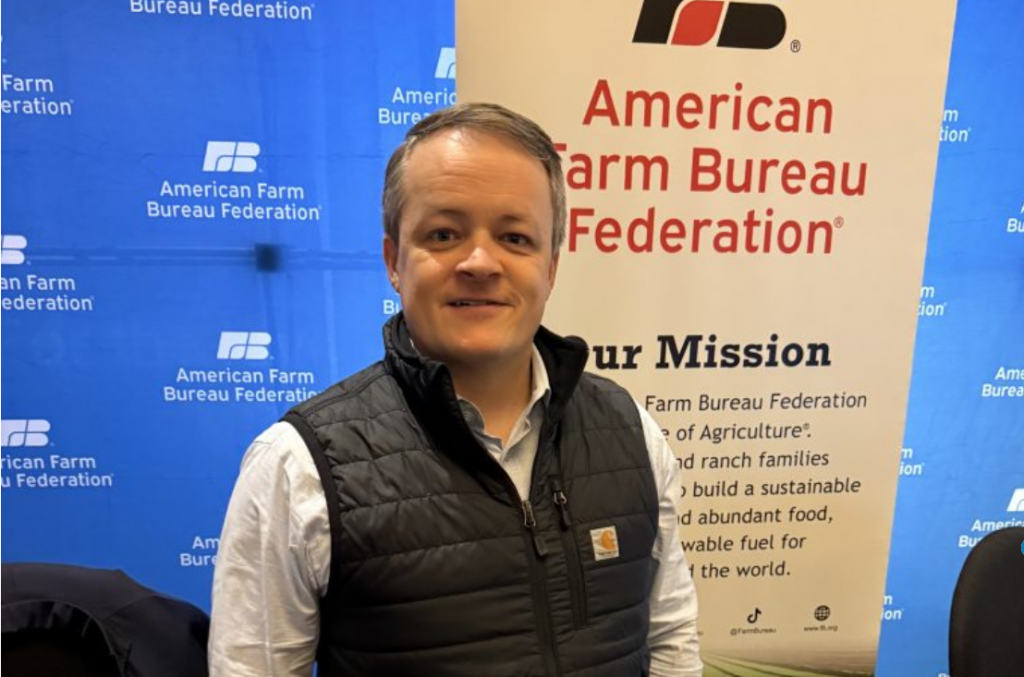
Joby Young, Executive Vice President of the American Farm Bureau Federation (AFBF), recently outlined the organization’s policy priorities to Intern Karleigh Erramouspe, focusing on regulatory relief, the slow completion of the Farm Bill, and the challenging economic landscape facing U.S. farmers and ranchers.
Focus on Food Safety and Health Initiatives
Young began by discussing the AFBF’s input on the MAHA Commission, which is focused on childhood illness and food safety. He emphasized the industry’s commitment to providing the safest food system in the world.
“We work on those issues every day and so we love the ability to advocate for farmers and ranchers and bring their views forward… about just how we approach that, you know, both in terms of an industry and then also how the system we’ve created in this country to create the healthiest and safest food system in the world,” Young stated.
The AFBF supports several health-related policy pursuits that benefit farmers, including:
- Whole milk in schools.
- Increased access to fresh fruits and vegetables from the producer straight to the consumer.
He also stressed the need for science-based regulation in areas like pesticide use: “We just wanted to ensure that any conversations around that are based on science, are based on data and they recognize the system we built in the country that ensures that that safety is first and foremost.”
Regulatory Wins in Labor and Water
A major win for farmers has been in addressing regulatory burdens, particularly concerning labor and the environment.
On the complex issue of agricultural labor, Young noted the AFBF is pursuing legislative solutions like comprehensive labor reform, but also celebrating recent regulatory progress, specifically concerning the H-2A guest worker program.
“The agency’s come out with a new rulemaking that would bring that back in to a reasonable level, to a rational level that’s based on the correct data and so forth. And so we’re really happy to see that,” he said, referencing changes to the Adverse Effect Wage Rate (AEWR) calculation. “The estimates are that would reduce wage rates to a manageable level across the country… and so that’s a big win.”
The organization is also encouraged by the recent direction taken by the EPA on the Waters of the U.S. (WOTUS) rule. For years, uncertainty over what constitutes a federally regulated water feature has posed a major challenge for farmers.
“For years it’s been a challenge in farm country, just the uncertainty around what’s regulated under the Clean Water Act,” Young explained. “The new approach that the agency is taking… they’re trying to bring more certainty, they’re trying to make clear rules that you don’t need those lawyers and consultants to decide that, to make an initial determination.”
The Unfinished Farm Bill and Economic Pressures
While the 2025 “One Big Beautiful Bill Act” addressed about 80% of the Farm Bill’s expiring programs, Young made it clear that the job is unfinished.
“There’s still that 20% out there that covers things like… loan limits for young producers or rural development title programs, some conservation programs, agricultural research,” he said.
These remaining priorities need to be updated. Although a recent government funding bill extended the expired programs until September 2026, Young affirmed, “we really need those programs to be updated,” and they will be advocating to finish the “last 20%.”
Finally, addressing the current farm economy, Young painted a bleak picture:
“It’s very challenging right there across farm country. We’ve seen four years of declines in a lot of your major commodities. We’ve seen input crisis that grew exponentially during the COVID time frame and had sustained high prices in inputs. And so a lot of balance sheets for farmers across the country are upside down right now.”
To combat this tough spot, the AFBF is advocating for relief payments to help producers bridge the gap until the long-term updates from the OBBBA are fully implemented next year, and to mitigate losses from recent international trade disruptions. Young reiterated the core goal: “We just want to grow these markets in the future and get the economy back on track.”